Showing posts with label study abroad. Show all posts

Monday, November 21, 2016

Week Seven: Nujoma and the Namib

by Lolita Schalekamp and Hannah Johnson

Reflecting back on the week that just ended, we have to appreciate the various ways in which we’re able to learn here at CGEE. This week alone, among many other field trips, we had the opportunity to visit one of Namibia’s most important monuments and think critically about the problematic ways in which a nation’s history can be represented. Before the week’s end, we also got to travel into the world’s oldest desert to learn about sustainable living.

At beginning of the week, our group had the opportunity of visiting the Heroes’ Acre outside Windhoek. This monument honors the heroes and heroines of the liberation struggle in Namibia, and operates for the purpose of “fostering a spirit of patriotism and nationalism, and to pass on the legacy to the future generations of Namibia.” We learned that this site is not only a memorial, but also hosts many events, particularly army demonstrations. Heroes’ Acre currently contains 174 tombs for the courageous men and women in the fight for independence. Not all of the tombs are filled, but as the heroes pass away, spaces will be reserved for them.

One of the questions that arose from our tour was what are qualifications in choosing who gets to be buried at Heroes Acre? As our tour guide explained, the criteria was not always transparent, as many families of leaders in the liberation struggle would like for their loved ones to be buried at the monument. Indeed, this process has sparked controversy within some circles.

Statue of the Unknown Soldier at Heroes Acre
The monument itself consists of a marble obelisk and a bronze statue of the “Unknown Soldier.” Upon seeing the statue, its resemblance to Sam Nujoma is striking. Although our guide stated that the soldier is not modeled after anyone in particular, the statue has come under criticism for being a tribute to Sam Nujoma himself. Since Nujoma is the founding president of the independent nation, along with being the initiator of Heroes’ Acre, this theory seems relevant.

Another one of the group’s iniquities regarded the architecture of Heroes’ Acre. Compared with other monuments in Namibia, the architecture felt foreign. The grandiose nature of the obelisk is characteristic of Stalinist Empire style or Socialist Classicism. After some research, we learned that North Korea was given a N$60 million contract to build the monument. This has rightfully made many ask: where were the Namibian architects in the construction of their ‘national’ monument?

This leads to the next point: the collaboration of world leaders in the struggle for Namibian independence. As a part of Racism and Resistance class, we became increasingly aware of the parallel development of the SWAPO/SWANU political ideology alongside the PLAN military wing. North Korea’s support of the liberation movement is not as surprising as one might perceive. In fact, many communist nations such as the USSR, Cuba, and North Korea contributed aid to the Communist Party in Namibia, which in turn has strong ties to SWAPO’s formation. This could be interpreted as geopolitical strategy of Communist countries in the context of the Cold War, or from the Namibian perspective, a lack of support from international governing bodies such as the United Nations.

Namib Desert Environmental Education Trust (NaDEET)
As the weekend approached, we packed our sleeping bags, lathered ourselves in sunscreen, and trucked our way toward the desert where we had the privilege to stay at the Namib Desert Environmental Education Trust (NaDEET) Centre. NaDEET lies in the dune valley of the Namib Desert and serves as a place for people of all ages, but more specifically school children, to properly practice eco-sustainability. NaDEET is a non-profit, non governmental organization whose mission is to protect the natural environment of Namibia by educating its citizens to practice sustainable lifestyle. We were immediately greeted by the warm sun and soft sand, where we hiked over a few dunes to reach our base.  

Spectacular sand waves in the Namib Desert!
The entire weekend was full of fun and hands-on learning. We discussed sustainable energy and water, where we monitored our water use and discovered that the centre was fueled by solar energy, discussed waste management and nature conservation. Water conservation was one of the largest topics of conversation. It is undeniable that water is the basis of all life on Earth, however Namibia has a limited freshwater supply and labeled one of the most dry countries in sub-Saharan Africa. Being in Southern Africa, we have learned to be more mindful of our water use and waste. NaDEET introduced a variety of ways to reduce our water use, including implementing bucket showers. The bucket showers reduce shower time and water waste. We have returned to CGEE house with the mindset to take shorter showers and investigate what it would take to have dual flushing toilets. In fact, the average toilet flush uses over ten litres of water per flush. If we introduce a low flush or dual flush toilet in our home, we would reduce our water waste by 2-3 liters of water each flush. As discussed at NaDEET, in a five person household, this can lead to saving nearly 200 liters of water per week!

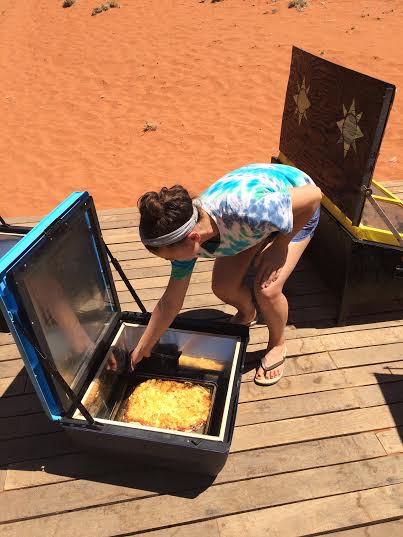
The delicious end result!
Our homemade pizzas cooking
in the solar ovens! 
The true fun began around lunch time, where we prepared food as a community and made homemade pizzas in the solar ovens. The fierce Namibian sun fueled the solar ovens and naturally, eliminates the use of gas, electricity, or wood and produces zero pollution (solar cookers baking our homemade pizzas and the end result shown in the pictures).

After a walking tour of the dunes, observing the tracks and droppings of the diverse ecology and wildlife in the desert, and sand boarding, we finally caught the breathtaking stars!  Namibia’s NamibRand Nature Reserve, which is one of Africa’s largest nature reserves, remains one of the naturally most dark places on Earth. NaDEET aims to protect the environment and educate guests, and this includes understanding how we have contributed to all forms of pollution. Attached is a link shared at NaDEET of a short video called “Losing the Dark” by the International Dark Sky Association regarding light pollution and solutions. https://youtu.be/dd82jaztFIo

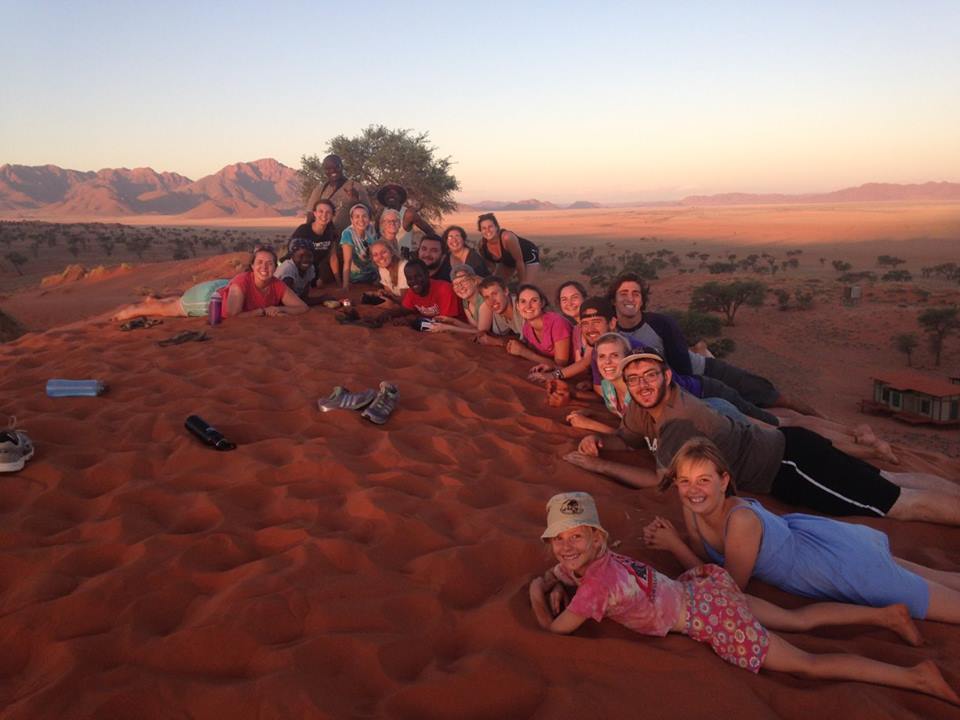
CGEE students after a successful evening sand boarding
in the stunning Namib Desert.
Our group was split up along three different houses, therefore when the weekend came to a close we were elated to compare our water and electricity usage with our friends (a good ol’ competition was a great way to spark environmentally sustainable habits!) Upon returning to Windhoek, we reflected on ways we can promote sustainable living but also practicing what we learned. Some are proposing solar cooking to their internships to combat the issue of expensive electric bills as some of us are researching dual flush toilets. The program was the perfect balance between educational and entertaining!

In short, during our visit to Heroes’ Acre and NaDEET, we learned to think critically about issues of memorializing a country’s history, in addition to more contemporary questions on how to build a sustainable and environmentally conscious society. In both cases, there is an inherent politicization that is ultimately involved in the process, whether that be foreign outbidding in the construction of a national monument or access and availability of environmentally friendly practices. As we learned at NaDEET, the only way to truly make a difference as a socially conscious community is to actually practice what we learn; through an increase in knowledge comes a responsibility to create spaces of dialogue that address these issues.

Tuesday, October 25, 2016

Week Five: Home Far Away from Home

by Hannah Davidson & Clara Randimbiarimanana

One of the best parts of studying abroad is the homestays, it is a special way to emerge into a new culture and also to learn in an unstructured and experiential way. Homestays are a period of time in which we are matched with a family and given the opportunity to live with them and get to know the culture through people that quickly become our extended family. Last week was our second homestay with CGEE after Soweto in Johannesburg. For this home stay most of us were matched with families in Katutura and Khomasdal, which are areas on the out skirts of Windhoek.  

Clara’s Week:

My host family is Tswana speaking and has lived in Katutura for as long as three or four generations. I only learned so much in such a short period of time during my stay there. My host mom is very passionate about social justice and women equality in Namibia and she was kind enough to share her experiences with me.

"This is a picture of my host mom
and myself after church", Clara.
Like in many other countries, gender inequality is still a big issue in Namibia. Women sometimes are expected to follow certain social norms and expectations. One of the questions I was asking was about young Namibian women clothing standard. My host mom usually wears a dress, which looks really nice but I was just wondering if it was her personal choice. However, she said that it all started when she got married because dresses are seen as respectful clothing and “lady like”; thus her husband expected her to wear dresses even though she did not like it in the first place. Although I’m aware that not all Namibian women have had the same experiences, her story made me think about gender expectations in general and the way women internalize and accommodate to social expectations. The cultural values associated with gender sometimes start as simple as clothing, but can go all the way to what is the “normal” way for women to behave. Furthermore, we need to acknowledge the power dynamics behind the perception of gender role in general and the space of socialization such us: culture, background and family. Family is the primary place of perceptions about different concepts. 

During my homestay, I see my mom doing most of the chores: cooking, cleaning, serving, etc. and I can’t help but think that this phenomenon is not exclusive to Namibia, because I see a lot of similarities in the household I grew up in. Each and every one in the family is assigned a certain role. The issue is that that’s where women start to develop their identity according to the type of family and culture that they grow up in. In short, my host mom experience is very unique and I could not generalize all the Namibian women as being the same. However, this experience made me realize about the socialization and formation of concepts like gender and cultural identity.

Hannah’s Week:
Throughout this trip I have met some amazing children, especially in the last week. We were staying with host families, and I had the pleasure of having an energy filled eight-year-old sister.
This week I also started at my internship, which means I met my 20 five- and six-year-old students. I am an education major, so many kids have come in and out of my life, always seeming to shake things up for me a bit, and make me look at things in a new light. But this was a different sort of shaking up that my past with kids hadn’t been able to prepare me for.

I walked in to my first day of being a real live teacher with a backpack full of tricks, a white skirt, and candy jar with a skittle for anyone who followed the rules. I left at noon with a backpack of broken and ripped tricks, a light tan skirt, and a full candy jar. Even a game of duck, duck, goose had miserably failed. My first day as a real teacher was less then successful, but it was only the first day and I had quickly realized that teaching these students in the same way I would teach a class of students in the US was not going to cut it. I left feeling unsure of how I was going to actually be a sufficient teacher for these kids. 

Hannah's host home for the week.
As my week continued I felt blessed to have my host sister and mom to go home to. My host sister was rambunctious, but the cozy feeling of family and being loved gave me energy. Every night my sister would play with my hair as we would co-read a chapter book together. Being able to have this comfortable space to call home was probably why my patience continued to surprise me with my students. 

I survived all three of my internship days with some sort of grace and I hadn’t completely wrecked the kids yet, so there were definitely positives in my week. I found myself comparing what my students and host sister knew and how they learned to students that I had worked with in schools in the US. My students here struggled to sit through a whole picture book and my host sister was taught subtraction in a way I had never thought of before. The idea that context has a direct effect on how students learn and actually do school has definitely been ingrained in my mind going to school to be a teacher, but seeing it like this was a whole other thing. Trying to consider if a book will actually fit in my students frames of reference or letting my host sister show me how she does her math homework are some of the things that I know are going to make me a better educator now and in the future. As I continue to learn (and struggle with) these children that are coming in and out of my life, I hope I can learn how to be the teacher that they need, rather then getting frustrated that they aren't the students I am used to. 

This last week was one, that for most of us, we will share and grow from for many months. Although each of us had vastly different experiences, we were given an opportunity to learn and explore a new culture in a way that pushed us outside our comfort zones or made us wonder and question. This is something that is truly invaluable.  We are so blessed to be welcomed into these families’ homes and lives. 

Week Four: Hooked on Windhoek: Introduction to Namibia

by Jeremiah Chamberlin & Hannah Johnson

At the beginning of the week, the CGEE group had the opportunity to engage with students from the University of Namibia (UNAM) in an informal discussion. This became an invaluable experience; for many of us, it was the first time we were able to interact with Namibian peers and dually analyze some the experiences that have shaped our lives as students. The topics of discussion ranged from our favorite hobbies and involvement in campus life, to deeper issues such as racism and discrimination on campus.

One of the topics that emerged from conversation are the barriers to accessing education at the collegiate level. For many of us at CGEE, we echoed the idea that financial considerations present the largest challenge in the United States, compounded by the realities of institutional racism and economically diverse backgrounds. From the perspective of the UNAM students, race did not play as important a role in college choice and acceptance rate. However, they did emphasize the role of the education system in Namibia, especially concerning regions outside of Windhoek. It was surprising to learn that the quality of teachers and curriculums is low in many regions, and this has impacted the demographics of students that attend college. For example, particularly in the Northern regions, teachers are underpaid and schools are understaffed. From both the US and Namibian perspectives, we were surprised on how many similarities we were able to draw between education systems.

On Tuesday, our group spilt into subgroups to explore the various facets that Katutura, a former black township in Windhoek, has to offer. We received itineraries for the day and were accompanied by guides from Young Achievers, a local youth organization. On this ‘Katutura Quest,’ we visited a diversity of both government and non-government organizations and programs that are involved in the community. One such program is the Katutura Community Arts Center, which is open to the public. Within the arts center is the College of the Arts (COTA).

During our tour, we had the opportunity to sit in on a staff/student meeting where the changing financial policies of the college were discussed. Many of the challenges that small colleges face while moving forward are connected to some of the topics we discussed with the UNAM students on Monday regarding education. Among the concerns is the increasing cost of tuition as a government-subsidized college, which has put pressure on many students of low-income backgrounds.

In our interview with Joost Van de Port, head of the Media Department at COTA, he explained that the college and students need be able to gain more agency to receive national recognition from the state. Currently, COTA is not listed under the Ministry of Education, and therefore, not seen as a priority. As Van de Port explains, the college is in the process of gaining status to be listed under the Ministry of Education, which allows greater funding for the college, particularly from the National Arts Council. Van de Port claims that media literacy, particularly under the department of the Media, Arts, and Technology, is crucial for all Namibians to learn. 

Those of us with internships began officially on Wednesday, with a full day at our individual organizations. These included The Namibian Chamber of Commerce, Planned Parenthood, Namibian Women’s Health Network, Friendly Haven (for victims of domestic violence), along with a number of others. Because many of these organizations work with vulnerable populations, these first few days of interning were emotional for some individuals. For a few of us this meant hearing heartbreaking stories of domestic abuse; for others, it means coming face to face with the inadequate funding and understaffing of specific educational institutions. Naturally, it’s not all negative; there are organizations like Sister Namibia which are doing incredible work to empower Namibian women in surprising ways, while simultaneously challenging gender stereotypes. Collectively, these shared experiences are giving us a fuller, more complex understanding of the Namibian story.

One of the highlights of this week would have to be Thursday’s ‘Community Day’, held at the Elisenheim Guest Farm. While we may have complained about waking up early, the day became an insightful opportunity to reflect on our experiences. The day also gave us the chance to get closer to those we are sharing our experiences with, especially other members of the CGEE staff (specifically Evelyn, Jenobie, Sarah, and Passat). Initially playing games like ‘Seven’ (learned from our Katatura tour guides), the day began on a relaxed, informal note. We shared simple secrets about ourselves, like facts about our families or our favorite memories. It was a welcome reprieve from the emotionally intense schedule of Johannesburg. 

Elisenheim Guest Farm on Community Day.
ables are set up for our various identity stations.
However, as the activities progressed, the subject matter became much more personal. Entering ‘identity stations’, individuals were asked to share in small groups their personal feelings on aspects of their identity, such as race, religion, sexual orientation or gender identity, class, and nationality. Many of us were reduced to tears in the process of hearing each other’s deeply held thoughts and emotions, yet the overall sentiment was one of openness and acceptance. 

Friday marked the first day of actual class: Race and Resistance in Southern Africa and the US taught by Albertina. This included a field trip to the Owela Museum, which records the lifestyles, cultures and practices of Namibia’s indigenous tribes. The museum also addresses some of the injustices faced by these groups, like those suffered by the San people. Dubbed ‘Bushmen’ by early German colonizers, members of the San were considered evidence of the ‘missing link’ theory connecting apes and humans. In an effort to record data on what they considered an evolutionarily incomplete group, German ‘scientists’ made molds and casts of San people’s faces and body parts. Skewed information was then published, propagating racist narratives of white supremacy which are sadly still influential even today.

Molds of actual San people created for the Germans'
racist interpretation of the 'missing link' theory.
Despite the tragic reality of colonization and discrimination, the Owela museum remains an important place for appreciating Namibian history and heritage. Named after a board game common among many Namibian tribes (similar to Mancala), Owela stands as both a tangible and symbolic representation of the larger Namibian identity. The shared story of the nation is as beautifully haunting as the unique communal experiences which are braided into its past. As we acclimate ourselves to this new environment, we begin our journey backwards in time to the tumultuous formative age of disillusionment.

Tuesday, August 23, 2016

Week Two: The Unseen Colors of the Rainbow Nation

by Imani Briscoe & Kitty McGirr

I remember waiting for my flight not two weeks ago genuinely envisioning what this “rainbow nation” was going to look like once I landed in Johannesburg. Now as we conclude our time here in South Africa, I am beginning to appreciate that what lays beneath this widely propagated ideal is much more complex, nuanced and problematic than the romanticized image I and many others with a similarly elementary understanding of post-apartheid South Africa would imagine this so-called rainbow nation to be. 

The varied nature of our activities and conversations on the program so far is indicative of the diversity of views and circumstances among the people of South Africa. However, while at face value this diversity supports the dominant narrative of South Africa as a rainbow nation, upon closer examination one begins to recognize that formerly institutionally separate racial groups are not suddenly coexisting harmoniously with one another now that apartheid has ended. In fact, the majority of what I have seen on the program so far suggests almost the opposite. Rather than achieving real unity and equity in the post-apartheid era, the many colorful identities comprising this so-called rainbow nation seem in some ways to be just as far removed from and unequal to each other as what was previously instituted under the apartheid system.  

In addition, it is very intriguing that, even with the acknowledged importance of the history of South Africa’s “Rainbow Nation”, discussions surrounding the indigenous people and colonization of what is now known as Cape Town rarely occur. Most of what we find in the American education history books regarding the changes Cape Town has gone through seems to focus on the racial issues of blacks and whites.  There is little to no conversation about the people who originally lived, loved and lost before the social constructs of race dominated the historical narratives; narratives such that influenced the process of colonization , which has very much impacted current day Cape Town. This past week we took a walking tour of the city of Cape Town with Lucy and Kadijah from Transcending History Tours, and learned a plethora of information about the way of life before and during colonial settlement and were given an opportunity to discover the untold story of Cape Town’s first people, the khoi-san.

Our tour took us through many notable areas including the first colonial settlement in the area, the Castle of Good Hope, Cape Town City Centre which holds some historic markers pertaining to the slave trade prior to the 1834 emancipation, and the well-known Iziko Slave Lodge which housed slaves from all over the world during the slave trade.

In every building we entered, every short filmed viewed, and every monument we paid respect to, I thought of Cape Town’s historical parallels to what was happening in the United States of America during the same time. It is illuminating to learn that on the other side of the world the same methods of racial division through systematic control and oppression were being implemented. It’s interesting to consider how both regions were shaped by the countless issues that colonization and devastation left behind. As a black American and proponent of black-consciousness, with no known blood relative connections to the Africa as a whole, I, Imani, have heard about the same kind of oppression and slavery time and time again on American soil and therefore felt like I shared a common history with those people who went through the same struggles as my ancestors did, just in another place of the world.

After leaving our homestay families in Soweto, we travelled to the University of the Free State in Bloemfontein, a city traditionally associated with and populated by Afrikaner people. Upon arrival we met with the deputy director of the Institute for Reconciliation and Social Justice, JC van der Merwe for a discussion on the history of the campus as well as the issues facing the institution at present. One detail that I found particularly striking was the fact that no formal pressure was placed on UFS or any higher education institution in South Africa to desegregate their campuses after 1994. In fact, according to van de Merwe, the residences of UFS were still racially segregated as early as 2007. I was moved by this information for two reasons. Firstly, I was immediately reminded of the parallels between South Africa’s failure to desegregate its educational system and the language of Brown v. Board of Education in the US whereby the Supreme Court only required schools to desegregate “with all deliberate speed”. Secondly, I was struck by how incongruous the politicized idea of a rainbow nation was to the reality on the ground in South Africa. Thirteen years after the ANC led the liberation struggle to overturn apartheid, white students at this university were still resisting administration mandates to integrate. 

The last activity for our day at UFS involved taking a tour around campus with two students we had met previously at a group discussion about our respective experiences as university students. One of our tour guides was keen to relay to me her experience being part of the first racially mixed female residence on the campus, which she described as a genuine “sisterhood”. However, the visual landscape of the campus was again at odds with the widely proliferated image of the rainbow nation, the narrative of unified racial integration and even the story my tour guide relayed to me about her mixed residence minutes before the tour began. Walking around the campus I did not see one mixed race friendship nor did I notice any white students present at a growing gathering of protestors demonstrating for higher wages for black workers on campus. Confused at what ostensibly looked like a state of enduring racial separation in the university community, I asked our guide if it was at all unusual that we hadn’t seen any interracial friend groups on our tour. Her response was a disheartening one: “No, it’s not unusual. People still don’t really mix”. These words, for me, were symbolic of the countless discrepancies I have witnessed in these two short weeks here in South Africa with regard to the romanticized ideal of a rainbow nation and the enduring reality of chronic racial inequality in the post-apartheid era.


Tuesday, August 16, 2016

Week One: Reflections on the Motherland

by Chiara White-Mink & Anne-Claire Merkle-Scotland

Apartheid ended 22 years ago when the first democratic elections were held in 1994, the same year I was born. For a nation that experienced so much horror in throughout apartheid these elections marked a new era of possibility and prosperity. That hope was shared throughout the world, when the message of a newly united nation travelled half-way across the world to the classrooms and schools I attended. However as residents and students in the United States, we should be well aware that change, especially social change, may take years and even generations to truly happen. Therefore, we were exposed to the realities of post-apartheid South Africa and the continuously growing economic challenges and disparities faced by South Africans, particularly the black citizens still facing severe effects from Apartheid.

Apartheid was crippling for black families, communities, and individuals by destroying communities and separating blacks from whites and sending them to specified “townships”areas of land outside of the cities where black people were confined to. Accessing medical care, education, and transportation cost money, and all the resources designated to blacks were far inferior in quality to the resources offered to white people only a few miles away. Blacks could not travel outside of their designated community, as well as work, attend school, or do almost anything without a permit.

Our current educational practices are a reflection of eurocentricity, intrinsically perpetuating the marginalization of communities of color and rendering us invisible in educational spheres. Blackness is positioned as the antithesis to whiteness and is thus implicitly framed as deficient and pathological. This is absolutely not indicative of Paulo Freire’s vision of education as a tool for liberation and social change. Instead, this exhibits an immensely problematic model of education that enables the success of the privileged at the expense of the oppressed. I, unfortunately, was unable to conceptualize my educational experiences as such until I began my collegiate career. I was provided with the space to critically reflect on my schooling, paying close attention to how aspects of my identity (such as race, gender, class, etc.) impacted what privileges and opportunities I was afforded and what I was deprived of. As a Black woman, I was faced with the harsh reality of oppression on the basis of race and gender. The most potent example of deprivation I can think of is the lack of culturally relevant material/the inability of educational spaces to centralize African-Indigenous belief systems as a method to empower students of color and expose white students to an undervalued world view; and subsequently, the expectation for students of color to assimilate to hegemonic notions about success.

Thus, my trip to the continent of Africa signifies my journey to increased critical consciousness, psychological emancipation and self-love, a revolutionary act. Education is intricately connected to our sense of humanity and I desperately sought an educational outlet that not only recognized, but honored my humanity. I concluded that this program attempted to a foster a space grounded in anti-oppressive ideology and actions that reflect intentionality and purpose. The first week of the program was spent in Johannesburg, South Africa where we went on various field trips to become critically acquainted with the country. I was deeply disturbed by the failure of my educational systems to acknowledge the interconnectedness of the struggle for liberation here and in the United States, or rather acknowledge the plight of people of color beyond the United States, period. It is also important to highlight the manner in which information is presented as well. Schools, as I have articulated above, typically convey information in immensely problematic ways (the dominant narrative), often excluding vital narratives and potent perspectives. Thus, I felt beyond privileged to hear about events here in South Africa from the voices of people directly involved, because I know that my educational spaces are lacking. One thing in particular I have been marinating on is the role of ordinary people in worldwide liberation struggles. This stood out to me on our visits to the Hector Pieterson museum and Orange Farm Human Rights Advice Centre. At Orange Farm, we had the opportunity hear from people on the micro level about issues that impacted their community. For once, leaders who rose to national prominence were decentralized and it was more about the work ordinary people are doing to provide for their communities. They actually shared their thoughts on one leader we have all been conditioned to love—Nelson Mandela. I am not attempting to refute his importance or discredit his accomplishments, but I was forced to critically analyze Mandela in a way like never before—in a way that countered the dominant narrative surrounding his political reign. The Hector Pieterson museum was especially interesting because we got to speak directly to Antoinette Sithole, a key player in the June 16, 1976 Soweto Uprising that resulted in the death of her brother. It is about time that we recognize the bravery and resilience of everyday people who are not necessarily internationally known or praised. 

Through visits to communities such as Orange Farm, located about an hour outside of Johannesburg, we saw and heard about the enormous problems within education and employment that poor communities are still facing even 22 years after the country was supposedly desegregated. With little resources offered from the government, schools continue to suffer from overcrowding and lack of materials, while adults and young adults are facing high rates of unemployment and lack of opportunities. Speaking to citizens, we learned how frustrated black South Africans are with the lack of economic mobility since the end of Apartheid. Still stuck in an oppressive and vicious cycle of poverty, many citizens have given up on expecting the government to create real effective change after so many years of what many view as false promises. One of our speakers Molefi Mataboge said it best when he stated “When politicians talk, we must listen not to what they’re saying, but to what they’re not saying.”

Coming to South Africa, I was expecting to see the land of Nelson Mandela and an integrated society somewhat free from the obstructions of apartheid, and constantly moving forward to maintain that promise of democracy shared throughout the world for years after apartheid ended. My experiences this week however showed me how much farther this great nation needs to go to truly see economic prosperity and opportunity for all of its citizens, and the serious changes that need to be made in order to make this happen.

The honorable Steve Biko once said, “The most potent weapon in the hands of the oppressor is the mind of the oppressed.” I have recognized that education thus far has been the practice of domination—keeping me ignorant, silent, and perpetuating social inequities. I am here to build upon what I have been unlearning in the U.S. and am ready to take back my mind from the oppressor, by any means necessary.

Friday, April 29, 2016

Week Twelve: Equal Rights in an Independent Namibia

by: Katie Bosse, Gabbi Mpagi, Lia Wellen

Siri and Gabi being politicians!
The common theme for this week’s classes centered on the question of equal rights in post-independent Namibia. The politics class visited Parliament and discussed gender equality in government, Mr. Ya Nangoloh spoke about segregation and race relations in terms of equality in our history class, and gay rights activist Wendelinus Hamutenya talked about LGBTQI rights in Namibia.

Students enrolled in the politics course had the honor of listening to the brave and beautiful social activist Wendelinus Ndiwakalunga Hamutenya, otherwise known as Mr. Gay Namibia. Mr. Hamutenya shared his struggles and triumphs about finding his identity, promoting equality, and upholding the civil liberties of individuals who identify as LGBTQI in Namibia. Becoming Mr. Gay Namibia opened many doors for Mr. Hamutenya, including an opportunity to participate in San Francisco’s Gay Pride Parade, but unfortunately he experienced backlash from Namibians who weren’t tolerant of his sexuality. Namibia has been recognized as one of the more lenient countries within Africa when it comes to the topic of LGBTQI rights, yet the truth of the matter is that LGBTQI persons are still being denied basic equal rights based on their sexual orientations and or preferences. LGBTQI persons are being ostracized in rural communities, forced into marriages for the sake of reproduction, and are experiencing dangerous acts of violence based in hate by their fellow Namibians as well as government officials. Mr. Hamutenya’s dedication to defying the status quo has had dangerous consequences such as being denied access to public transportation and enduring unlawful arrests by Namibian police officers, but his perseverance has remained resilient. He continues to work towards equality for all Namibians. 

Lia pretending to make a
speech in the speaker’s seat.
This week the Politics & Social Change in Southern Africa class began our day by getting a tour of the Namibian Parliament. We spent some time in the National Assembly. We had fun sitting in the speaker’s seat, and looking at the elegant building. The gardens around and in the center of the Parliament building were also very nice. When speaking about civil rights, or equality amongst the Namibian people, we spoke about gender equality in Parliament and we were able to draw some lines between parliament and inequality in Namibia. In terms of gender equality, the government is attempting to equalize the number of seats that women take to that of men. SWAPO (South West African Political Organization) is the ruling party and takes up the majority of seats in Parliament. They have a system where a woman takes every other seat. There is still a majority of males in government, but the number has improved drastically since independence in 1990. In terms of post-apartheid segregation and inequality, in class our instructor, and a few speakers, has talked about how the SWAPO party, the party who liberated Namibia, is now becoming a sort of oppressor due to the fact that they are the overwhelming majority in Parliament. Mr. Ya Nangoloh, director of NamRights, stated that only the color of the people in charge of Namibia has changed, but many apartheid-like policies are still in place. The fact that opposition parties have very little say in government exacerbates the power that the SWAPO party has and the lack of power that opposition parties have. So, in general, Namibian Parliament is becoming more equal in terms of gender, but is arguably unequal in terms of fairly representing the Namibian people because of the overwhelming SWAPO majority party.

This is an example of the beautiful decorations and architecture
in Parliament. These are the lights in the National Assembly building.
In our history class on tuesday we had Mr. Phil ya Nangoloh visit our class for the second time this semester to speak about the similarities between liberation struggles in Southern Africa compared to the Civil Rights Movement in the United States. As the founder of Namibia’s National Society for Human Rights (NSHR), also known as NamRights, Mr. Nangoloh is an expert in human rights politics and history on the liberation struggle for Namibia’s independence from South Africa. He finds that the situation of apartheid and racial inequalities under the South African government is not a unique case and one can draw several parallels between the regime’s policy of “separate and unequal” in South Africa and the United States Jim Crowism and subsequent New Jim Crowism. Nevertheless Mr. Nangoloh did locate where the two movements differed in nature and strategy, despite having the same overarching goal of separation. Mr. Nangoloh believed there are fundamental differences that distinguish the two movements beginning with the fact that the liberation struggle in Southern Africa was a “violent civil disobedience” against a white minority while the United States’ civil rights movement tended to more of a peaceful civil disobedience against a white majority. Moreover, Mr. Nangoloh made the tactical distinction that during the civil rights movement it was focused on gaining rights for all, while he believed the liberation was more of a fight against colonialism. Finally, he wanted to leave with the class that there is a difference between freedom and independence. For example, Namibia might be liberated from colonial forces legally, but in actuality as Mr. Nangoloh explained, Namibia is still dependent on outside markets that control their major industries such as the fishing and diamond industry. 

The courtyard near the National Assembly.
Mr. Nangoloh’s visit to the class was important for us to hear the gaps in history we missed in our education in the United States. It was beneficial for the class to ponder the dichotomy of freedom and liberation in the context of a globalization and neocolonialism reign. This week helped set the framework for examining how these racial processes occur in our own home and aid in setting the tone for intentional action when we return to the United States.

Thursday, April 28, 2016

Week Ten: Confronting Contradictions

by: Sydney Wipperfurth, Rich Wehman III, Emily Simpson

Following our rewarding weeklong rural homestay, the CGEE students were off for another Namibian adventure! Our group had the privilege of visiting Etosha National Park, which is located in northwestern Namibia and widely considered to be one of the world’s finest game reserves. In the company of Ovambo traders (who probably discovered this region before the Europeans, but who writes history amirite?), Europeans Charles Andersson and Francis Galton “first discovered” the region in 1851 (http://www.etoshanationalpark.org/history). Etosha is loosely translated as “Great White Place” in the Ovambo language because of a massive mineral pan, part of the Kalahari Basin that covers around 25% of the national park. Renowned as one of Africa’s finest conservation areas, Etosha serves as a refuge for large herds of plains’ animals, several rare and endangered species, and richly diverse birdlife. This beautiful national park has a plethora of springs and waterholes where an abundance of wildlife typically congregates. The animals of Etosha are of the southern savanna plains of Africa, and large herds of springbok, zebra, gemsbok, blue wildebeest, giraffe, and elephant roam the plains. The numbers of animals can vary considerably depending on factors such as migration patterns, the condition of the veld, and the availability of water. 

One highlight of the trip would have to be when our group visited the Okaukuejo waterhole, noted as one of the best watering holes during the dry season. All of the students saw elephants, springbok, Burchell’s zebra, and giraffe, amongst others, during our short, yet eventful visit to the site. Perhaps the most exhilarating moment of the game drives occurred when the group spotted a cheetah far off into the distance. Although Namibia boasts one of the world’s largest populations of free roaming cheetah, there are a relatively small number of them found in Etosha. Our group was fortunate enough to witness this beautiful animal gracefully trot towards our vehicle, truly a breathtaking experience!
Etosha National Park during the drought in Namibia

After our game drives, we arrived at the Mokuti Lodge, where we would be staying for the night; our group was welcomed with wet towels and glasses of grape juice (the wet towels were welcome relief from the brutal heat making us feel like we were melting). After entering the front doors, we discovered the lodge was outrageously extravagant. A vast juxtaposition to our experience a week prior, when we got off of the vans in Outapi, Namibia to the warm and welcoming smiles of our rural host-families. This juxtaposition stemmed from the extreme differences in resource availability and resource accessibility. Our rural homestay families, while there was variance, had significantly limited access to basic amenities like running water or electricity, if any at all. The Mokuti Lodge had air conditioning, running water, electricity, television, a pool, and a full, expensive, buffet for dinner, to name a few.

The differences in these environments stirred many conversations, questioning and critiquing the privilege that each of us possess. Although we understand that the program usually stays at a campsite in Etosha and that there were no spots open, the fact that we had the ability to stay in the lodges shows the mobility and privilege we have access to. We were able to choose to live the life of our families in rural Namibia, however, a week later, were able to leave that environment and exchange it for a much more excessive lifestyle in Etosha. The ability to make this transition felt heavy as we reflected our incredible experiences at our homestays and on the stark contrast between the two lifestyles we were living. 

Richard taking a little nap
so he has enough energy to
look at the beauty of
Etosha National Park!
Furthermore, our stay at the lodge highlighted an excessive use of resources, namely water, providing a dramatic contrast between our previous week at our homestays. For instance, during our homestays, many students noticed that their families use water extremely sparingly, ensuring that every single drop is being used. Given the current drought that is affecting Southern Africa, our families did not have much of an option for their water use. However, we were surrounded by water when we arrived at our lodge. All of our rooms had large, luxurious showers, seemingly enticing all visitors to take lengthy showers (tip to the folks back home: shorten your showers!) Additionally, the lodge had TWO pools, filled with the same water that had been so precious and valuable to us just one day ago.

However, we did not experience a dramatic ecosystem change from our homestays to Etosha. If anything, Outapi, with its green grasses and trees, seemed to have more water than the dry landscape of Etosha. So where was all this water coming from? I cannot even begin to imagine how much water is consumed per day at the lodge, and consequently how quickly the groundwater is being depleted. Given everything we have learned about the drought severity in Namibia, this groundwater depletion is especially concerning. Yet this resource depletion is the reality for many tourist destinations, where lodges are focused on ensuring that visitors are comfortable- even at the cost of the environment. 

An intentional community of elephants in Etosha National Park
In the context of Etosha, this reality is especially frustrating, since Etosha provides visitors with an opportunity to appreciate nature and all the wildlife diversity it has to offer. Etosha itself is notable for its conservation efforts, and yet visitors oftentimes live in a contradictory manner. This inconsistency makes it seems as if we are only focused on protecting ecosystems when it is for our own benefit, such as the recreational opportunities provided by game reserves.

These spaces we were existing in were complicated and contradictory. They forced us to reflect on and complicate our environment. But doing so is never an easy task. Although our environment was physically comfortable, confronting these contradictions is extremely uncomfortable and emotionally heavy. But it is also important to acknowledge these feelings, so that we are better able to understand our role in this world.

Monday, April 25, 2016

Week Eight: The Many Shifting Layers of Identity

by: Amanda Siskind, Katie Bosse & Monique Lillis

Ashly, a female identifying person,
and Patrick, a male identifying person,
showing how gender is often identified by
a person’s clothing and physical appearance.
In our classes this week, as well as throughout our time in Windhoek, we’ve been talking a lot about identity. At the start of her presentation, Immaculate Mogotsi took Taylor and Monique to the front of the room and asked, “What do you see?” The class identified them as male and female based on hairstyle and clothing. This exercise was intended to help students understand the difference between gender and sex. As we discussed that day, sex is the biological organs that leave a person with male or female organs or genitals; or a combination of the two. A person is born with their sex, however gender is part of a person’s identity and the identity they typically ascribe to is defined by their culture. For example, Monique identifies as female and she could be identified as such by the dress she wore, and her long hair. However, gender roles are not fixed, they are different in every society; therefore, there is not one identity for females in Namibia because there are many different tribes that ascribe different roles to a woman. For example, we learned from Sara, one of the staff members, that in the Himba tribe the women are in charge of taking care of the livestock while in the Owambo tribe it is a duty ascribed to men. This is just one example of how the identity of women and men and the gender roles that are given to these categories are culture-based and different around the world. 

Identity is not only defined by the cultures into which we are born, but also by the cultures in which we immerse ourselves. For example, in a country entrenched with racist and classist social boundaries, as well as visible physical contrasts, we as Americans have a unique ability to exist in both spaces as third party persons without the label of direct oppressor or oppressed. As we are learning, Namibia’s history has been one of colonialism and genocide of native Namibians by both the Germans and the South African apartheid regime. Yet, because all CGEE students occupy neither of those titles, many of us have felt we are free to navigate through spaces that usually have their set identities and occupants with very little room for integration. 

Our house in Windhoek West
We have both reflected and analyzed our own individual and collective identities as they exist here in Namibia, and how our shifting identities change as we move from one space to another. As a geography and urban development and social change major, I (Katie) could not help but notice how apartheid spaces continue to exist and how that has influenced communities socially. Positioned in Windhoek West, our community house rests in a neighborhood that situates us in an equal distance to stark opposites, Katutura and Klein Windhoek. Because of this unique setting, the CGEE students participate in both areas for different reasons.  

The Katutura Township is a product of the South African apartheid state, where a mix of Namibians from various tribes coexisting in what was known as the “old location” were forcibly removed to live in neighborhoods based on language groups. By doing such acts of othering, Namibian identities changed from one collective existence into identities defined by language group history. This, as we have observed this semester, was a powerful tactic in separating the masses, as now there are language group conflicts and language group inequalities. Nevertheless, despite their personal language groups, the people in Katutura are all united in a collective identity of being black, which is why the apartheid state put them in these townships in the first place. 

More than just a tool for separating tribes, the township was also designed so that white people never needed to enter and the black people only had to leave for work. These rules might not exist anymore, however I see white and black Namibians continuing to follow these reverberated historical norms. There are small houses, informal settlements, outdoor markets, people selling anything they can on the side of the road, shebeens (local bars), and a ton of people walking outside among unkempt trash and blaring house music. Yet it is very rare to see a white person walking in this area.

The white colonizers who did not want to intermingle with black Namibians historically occupied Klein Windhoek and other white-only suburbs during Apartheid. Still today, Klein Windhoek is set aside so that one can only reach it intentionally, not by merely passing through the city. The majority of residents of this area are still white Germans and Afrikaners, because the high housing prices and lack of public transportation prevents the migration of black Namibians from moving into the area from other neighborhoods around Windhoek. Here, one will find farmers markets, expensive restaurants, private schools, newly erected malls, and more-recent development. There are clean streets and very rarely will you see a street taxi roaming around looking for clients.

Katie, Sydney, Molly, and Siri out to dinner at Andy’s,
one of our favorite restaurants in Klein Windhoek.
As three white American women, it is important to critically examine what our identity means in each space we occupy here and to further acknowledge how we are able to exist in both of these areas as somewhat of a third party actor. On a larger scale, what does it mean for a group of comparatively privileged Americans to come to this unique space and ask for the people in Katutura to educate us on their oppression here and the history of their struggle? What does it mean, further, when at the end of the day we go to Klein Windhoek to eat at a nice restaurant or spend our Saturday mornings at a farmers market buying fine cheeses, fresh bread, and local crafts? As a group of American study abroad students we must continuously reflect on our individual and community identity here in Windhoek West and the implications it might have on the people here.  

Even as we’ve been learning about the identities of people in Windhoek and our personal identities, we’ve also been creating a new group identity. We are no longer those strangers from the first nights in Johannesburg. We know each other’s personalities, we’ve learned about important moments in everyone’s pasts, and we’ve built a collective history together here. We’ve settled into a comfortable group identity that allows us to encourage and support each other. We’ve had many discussions in our living room or over dinner about what we’ve learned, what has made us uncomfortable or challenged our views, and what role our identities and privileges have had in the way that our experiences have played out. These discussions can be tough to have, especially when we are already often out of our comfort zones living in a new city and a new country far away from our friends and family. But thankfully we are all in this together, and that has let us feel more supported as we continue to dive deeper and learn more about these issues of identity. 

One of the main things we’ve learned about identity is that it’s complex, layered, and varied depending on where you’re from and your life experiences. We’ve all had unique experiences here in Windhoek, but we’ve also all been studying and living here together, and that is a part of our identities that we will keep beyond this program.

Wednesday, March 23, 2016

Week Seven: The Forgotten Genocide & (Sweaty) Sustainability Under the Desert Sun

by: Emily Simpson, Ashly Brun & Beatrice Misher

The Forgotten Genocide

Have you ever heard of the Herero Genocide? Chances are you probably have not. Understanding the reasons why this history is often neglected in our classrooms  is something that we have had to come to terms with. This week in our history class, we spoke to Uranaani Mantundu, a genocide scholar, whose ancestors escaped the very genocide we are discussing.

According to Mr Mantundu, The Herero genocide occurred  between 1904 and 1909, but is often referred to as the German-Herero colonization. The ideology behind German settler colonialism stemmed from the idea of spreading the wealth and seed of Germans to the land known today as the Erongo region of central Namibia. The German colonization of South West Africa was built on these colonialist ideas and also served as a response to overpopulation and poverty of Germany in the late 1800s. After a period of time of  what Mr Mantundu called  “slow colonization,” the settlers became restless for their promised land. However, central Namibia was already home to the established empire of the Ovaherero people. In the beginning, the Herero people maintained control over their land by renting it out to German settlers. The Germans violently sought to take over this land through means such as ambush attacks on the Herero people and rape of Herero women. Under General von Trotha, the German colonists began the systematic annihilation of the Ovaherero people. As a form of resistance, the Ovaherero people fought back to reclaim their land, but were ultimately  victims of genocide. Through a propaganda campaign in Germany portraying the Herero people as dangerous savages, a wave of racist sentiment spread throughout the country resulting in the official declaration of war against the Herero people. As a result, von Trotha issued an extermination order to kill any Herero man, woman, or child, armed or not, who was found within German colonial territory. Any Herero person who was not killed during the war was subsequently rounded up into concentration camps, some of which were labor camps and some, like Shark Island off the coast of the town of Luderitz, were strictly death camps. By the end of the genocide in 1909, approximately 65,000 Herero people had been killed. Many still lay in unidentified mass graves that are used today as ATV tracks for tourists in the Swakopmund area.

After this lesson and our new knowledge of this genocide, the German influence here in Windhoek, such as street signs in German, made us think harder about the historical context of the city we are living in. Today, the Herero people are asking the German government to acknowledge this genocide and pay reparations of $2 billion. According to Mr. Matundu, in the US, 48 of 50 states have officially recognized the Armenian genocide, yet none have done so for Namibia. While horrifying, the silence of this genocide was not surprising given the western lense through which our history is taught. Why do we selectively choose whose genocides to remember? There is a specific narrative chosen that neglects the stories of black and brown bodies, and their stolen land. Only through decolonizing our minds can we acknowledge forgotten history, and allow the voices of the oppressed to be heard.

(Sweaty) Sustainability Under the Desert Sun

The following weekend we traveled to the Namib Desert Environmental Education Trust (NaDEET) to camp sustainably in the middle of the oldest desert in the world. Upon arriving, we made our way to the main building for a solar cooked dinner and a brief orientation of NaDEET. Viktoria, the founder, explained that NaDEET is focused on providing environmental education to Namibians and promoting sustainable lifestyles. In addition to education, Viktoria also explained that NaDEET believes in practicing what they preach, and therefore the entire center is as sustainable as possible. It is fully equipped with solar cookers and ovens, an extensive recycling and compost system, solar electricity, and bucket showers to promote water conservation. I was amazed by NaDEET’s ability to build a nearly 100% sustainable organization in the middle of an inhospitable desert with limited access to necessary resources. If NaDEET can do it so well, why can’t the rest of the world?
9027d287-5c34-4236-8f0c-469484bee786.jpg
As the sun burns the back of her legs, Beatrice
realizes that the same sun can be used to
beautifully cook a vegetarian pizza.
The next day, we woke up early to embark on a dune hike before the scorching heat took control. As we crawled up the bright orange sand dunes, we stopped to identify different tracks in the sand and learn about the survival mechanisms of the animals and insects. The sun was scorching by the time we finished up our hike, creating perfect conditions to cook our lunch in the solar ovens. After feasting on our pizzas, we spent the rest of the day hiding from the heat, planting native trees, and experiencing our first Namibian sun-downer, which involved us dune boarding as the sun set. It was the perfect ending to our long and educational day-- an evening full of laughter, sand-beards, and the reminder that the natural world can provide us with overwhelming amounts of joy. We ended the day with an astronomy lesson as we gazed up at Africa’s first International Dark Sky Reserve, learning about different constellations and squealing over every shooting star. 

As an environmental studies major, I've thought a lot about how to effectively demonstrate the need to live sustainably, and I've become very frustrated by my lack of a solution. However, this weekend at NaDEET helped me realize a major theme in promoting environmental consciousness: access. In order to get to NaDEET, we drove through dozens of dried-up river beds and hiked through sand dunes that provided views of a water-empty landscape, demonstrating that we did not have easy and plentiful access to water. Consequently, water instantly became more valuable and we all became conscious of our water use. The location of NaDEET, and the limited access to water that comes along with it, makes it the perfect place to teach water conservation and other sustainable practices. But the instant we gain more access to resources, we forget the importance of conservation. 

10565206_10153632678973935_892668656047346881_n.jpg
Ohana in the desert
This is a large issue with conservation at home in the US, and also at our house in Windhoek. In most places in the United States, there is an abundant access to water, causing people to mindlessly run the tap. Even in dry areas, such as the Southwest, we have manipulated natural waterways to provide an endless supply of water to deserts. This has seemingly provided us with too much access to water, creating a disconnect between us and our natural resources, and thus diminishing our value of water. The same is true in Windhoek, which is in the middle of a huge water crisis. Despite the drought, water magically pours out of our faucets, falsely making it seem as if we have unlimited access to water. This contradiction can make it extremely challenging to understand the value of resources.

But thanks to NaDEET, we were fortunate enough to fully understand the importance of sustainable living. Therefore, when we arrived back at our home in Windhoek, we all got together for our community meeting and discussed our plans for living more sustainable lives. If NaDEET is able to inspire this same reaction in all their visitors, they are effectively changing the environmental mindset of Namibia.

P.S. We also visited the water treatment plant here in Windhoek that transforms our sewage into drinking water but we are legally bound to not disclose this information. Bye.

Wednesday, March 16, 2016

Week Six: Lions and Cheetahs and Learning - Oh My!

by: Olivia Cook, Lia Wellen, Richie Wehman III, Nathanael Juliot

We are settling into our routine at the Center for Global Education and Experience here in Windhoek, Namibia. Most of our classes involve either speakers or field trips which enhances our learning and understanding of Southern Africa and most specifically Namibia in terms of history, politics, development, religion, and environment. In this post we will tell you about some of these engaging class experiences! We felt weird taking pictures of the speakers, but we have some pictures of the Environment & Sustainability class field trip, which is more exciting anyways! Why is it more exciting? Keep on reading to see!

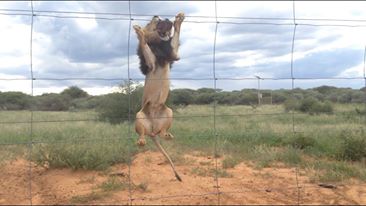
Clearance the lion roaring for his dinner.
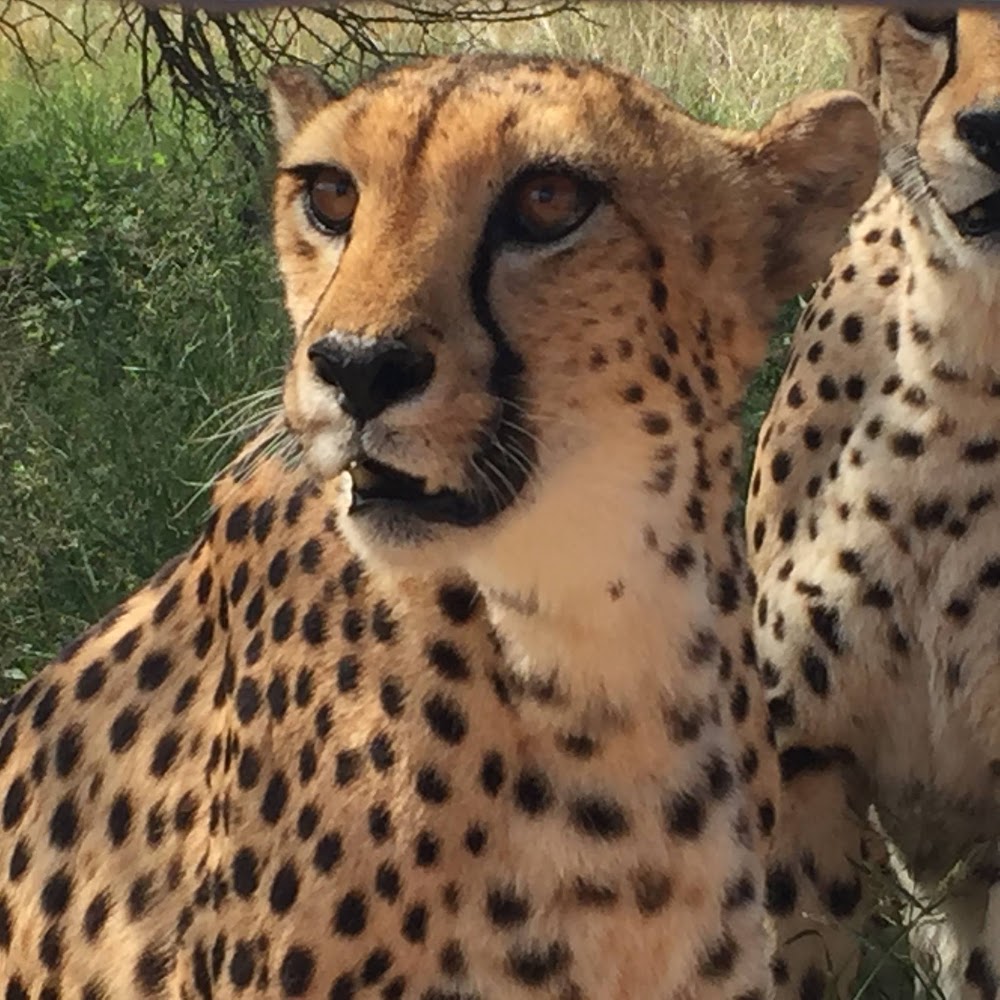
Following an incredibly rewarding week-long urban homestay, the CGEE students were ready to attack the new week. On Monday the Environmental and Sustainability class had the great pleasure of visiting the N/a’an ku se Lodge and Wildlife Sanctuary, located just 42 km east of Windhoek. Upon our arrival the tour guides drove our group out to visit a San Bushmen family that periodically stays at the sanctuary to educate tourists about their traditional lifestyle. The San people took us around the land to showcase their traditional hunter-gatherer techniques, as well as the way they utilize plants for holistic healing purposes. It was a tremendous learning opportunity, but many members of our group felt conflicted about the implications of our experience as the San people were removed from their lands and are now considered the most marginalized community in Namibia, forcing them to commodify their culture to tourists. Shortly following the tour, our group was off to visit and learn about the Wildlife Sanctuary. Through the visitation of different animals such as lions, wild dogs, baboons, cheetahs and leopards, our class was able to get a much better idea as to how N/a’an ku sĂȘ has successfully been able to protect wildlife and their habitats. The sanctuary provides a haven and second chance for countless injured, orphaned, and abused animals. It’s the organization's goal to release every animal free so they can live a natural life in the wild, but that sadly isn’t always the case. We learned that the release or rehabilitation is not always possible due to the severity of an animal's injury or habituation to humans, all serving as a threat to their safety if they were to be released. One highlight of the trip was being able to witness Clarence, the male lion, soar into the air to snatch his dinner. It was extraordinary seeing him viciously mark his territory and establish his dominance.
Beautiful snapshot of one of the cheetahs

On Tuesday March 1st Mr. Phil Ya Nangoloh spoke in our History class, entitled “Race & Racism in Southern Africa and the U.S.”. Mr. Ya Nangoloh is a human rights activist and director and co-founder of NamRights. He described NamRights as a monitoring and advocacy human rights organization that can be compared to Human Rights Watch or Amnesty International, except that NamRights operates on a national, rather than international, scale. NamRights also gives paralegal services of which most cases are either people dismissed in the private sector or women seeking complaints against their male counterpart.

His task was to explain his understanding of discrimination and racism in Namibia and Southern Africa currently and historically. Mr. Ya Nangoloh claims that Namibia has historically been a victim of state racism, having undergone both German and South Africa occupation, the latter of which engulfed Namibia into apartheid. He spoke of how the Namibian constitution is extremely liberal and has very good human rights components, but that these laws are not effectively implemented in Namibia, if at all. The main point Mr. Ya Nangoloh made was that since the end of apartheid, and the liberation struggle, the way in which discrimination plays out has changed. During the liberation movement there was one common enemy to fight against, which was South Africa and the apartheid regime. Now, as this one enemy has technically been conquered, discrimination stems from wealth inequality, racism, and the scramble for scarce resources. Discrimination, now, he explained, comes from within societies or communities rather than from outside. He concluded on what I thought was a grounding note. He said that “racism is an innate and human nature, but there are good people doing things about it, like you and me”. We have been struggling with learning about all the awful disgraces of both the United States and Southern Africa, and it was nice to hear a “realistic” view on things, that there is discrimination but that there are people working to combat it. 

On Wednesday March 2, we had a very interesting speaker visit our Development class. Herbert Jauch, a German expat and political activist in Windhoek, has spent the last couple years studying income inequality in Namibia. The beginning of his presentation explained key points of Namibian history and eventually evolved to explain how income inequality is a product of old historical systems still prevalent today. After setting the foundation for today’s inequalities, Jauch continued to explain a study that was conducted in hopes of alleviating poverty in Namibia. This social experiment, set in a small village south of Windhoek, focused on people who earn so little that basic necessities, such as education and health care, are inaccessible. A solution to these problems was an idea called a Basic Income Grant. This monthly grant of N$100 (US$ 6.25) was given out to every person in the area regardless of income or age in order to help cover basic costs of school books, registration fees, small health needs, or other costs that would help families access services and improve their quality of life. One staggering statistic Jauch shared with us was that in this community 60% of kids dropped out of school because they were hungry, but after the BIG was implemented, 95% of kids completed school. He also shared various benefits such as increased visits to clinics, and malnutrition dropping by half within a year of this grant. Unfortunately leaders at the time did not appreciate the success rates as much as Jauch and his organization did, and plans to continue this idea nationwide are at a standstill.

The idea of a monthly income grant fit well with what we have been covering in our Development class, specifically ideas of poverty alleviation and cases of well-intentioned development projects that do more hurt than harm. Jauch’s presentation was an interesting example of a poverty alleviation strategy and I was intrigued by the both the positive outcome and some ramifications such as the conclusion that programs like this are hard to implement regionally because of family members who migrated to the area to benefit as well. Another point Jauch made was that social welfare programs are generally stigmatized and by providing every individual with an equal grant stigmas are avoided and people are empowered to live healthier lives. Many people in the United States dislike the terms socialism and social welfare, but this speaker highlighted how these ideas can be helpful to society and gave me a case study I can use to support new ideas of aid implementation that I can share with others. Overall, I was very impressed by our speaker; his comments added insight into what we have been studying and local poverty alleviation efforts to combat a nationwide problem.

On Friday March 4th, the Religion and Social Change class had a guest speaker visit named Reverend Gotthard Gurirab. Reverend Gurirab is a faculty member at the University of Namibia working with a focus in critical issues facing the church. His talk focused on African Traditional Religion and how it has been affected by colonialism. Specifically, he discussed the diminishing role of Ubuntuism in African culture. Ubuntu is an African word which refers to a universal concept where people value the good of the community above self-interest. Reverend Gurirab has seen that Ubuntuism is almost dead in cities and those people who live on the same street live as if they are in foreign countries. He went on to describe the relationships between people in the cities and it paralleled greatly with relationships between people in the United States. I found it extremely interesting to hear him describe in detail, American society and condemn it as ruining the Namibian people. Africa is constantly subjected to the effects of colonialism even to this day and it can be seen that western society has overwhelmed the traditional values of the Namibian people. Ubuntu has ideologies of sharing, compassion, peace, reconciliation, combating crime and violence, and poverty eradication. These ideologies have been cast away by the younger population for western ideologies of focusing on the individual. Reverend Gurirab called for a massive revitalization of African Traditional Religion in Namibia and throughout Africa. This will be an uphill battle, however, to remove the stains of imperialism that still exist within Africa and many Namibians do not have any desire to move away from the western ideologies that promise a path to prosperity.

Overall, we had a great week of learning through speakers and field trips. We hope you enjoyed following us along our journey!