Showing posts with label district six. Show all posts

Monday, March 12, 2018

From the Mother City to our Home City

By Hal W.

      We began this week in Cape Town, South Africa, and ended it in Windhoek, Namibia. We have set up shop here in Windhoek, where we will be staying for the next three months. I have the luxury of writing this with the comfort of A/C, something we all missed while we traveled around the Cape.

     We began this week by visiting the Slave Lodge Museum in downtown Cape Town. The tour began by meeting Lucy Campbell and her assistant Khadijah outside of the Castle of Good Hope. The fort was built by the Dutch East India Company between 1666 and 1679, it is the oldest standing colonial building in the whole country. It originally was used as a replenishment stations for British Ships sailing around the horn of Africa. Today it is a museum and historical site for tourists and memorialization of Cape Town’s brutal history.
 
      Lucy Campbell shared the history of the fort and how it impacted the native people of South Africa. She explained how colonization integrated new and often detrimental impacts onto the preexisting culture that existed here. From there we walked up Spin Street to the Slave Lodge Museum, making a brief stop at the Slave Tree memorial. This inconspicuous raised octagon is the site that slaves were sold during the economic and population boom of Cape Town. It feels overly modest, a plinth easily passed by without noticing its significance. The town was built by the men and women who were sold under that tree, and today it can be overpassed without a moment's thought. This place is worth stopping by to acknowledge on a historic remembrance of Cape Town, often forgotten.
 
     The Slave Lodge bustled with school trips and tourists gawking at the blinking lights of the eye-catching exhibits. We sat on the concrete floor as Campbell presented stories and trinkets traded during the Transcontinental slave trade. Ships stopped by Cape Town bringing tobacco and alcohol to suppress the health of the native tribes, for the sole intention of exploiting them for their land’s resources. The Slave Lodge was the physical space that the slaves were kept in decrepit conditions, with morality thrown out the barred windows.
 
     In the early 1800’s the building was modified to be used as government offices including the upper house of Parliament and the Cape Supreme Court. In the 1960’s it was again transformed into a museum of remembrance. “From human wrongs to human rights, exhibitions on the lower level of this museum explore the long history of slavery in South Africa”.
The original Parliament Hall. (Used during the Apartheid Regime)
     After lunch on Long Street we walked to the current Parliament facility for a discussion of the on-going political turmoil happening in South Africa. We were met by Andricus Pieter van der Westhuizen, a current member of the Democratic Alliance (DA) party in Parliament. He is currently appointed as the Shadow Deputy Minister of Labour, but his background is in education. We discussed how volatile the politics of South Africa have been since the turn of the country in the early 1990’s. We lucked upon a interesting time in South Africa’s politics. Jacob Zuma, the current president of South Africa, is being asked by his own party the African National Congress (ANC) to step down from his position. He has over 100 charges of corruption and is overwhelmingly disapproved of by the majority of the South African population. He is charged with using public funds for supposed “security” improvements for his estate including a pool and housing for his security team. Our meeting and tour of Parliament proved interesting and eye-opening.
 
      Tuesday morning we ate breakfast at St. Paul’s Guesthouse, our accommodation for our time in Cape Town, then went to the District Six Museum. This small, one building museum pays homage to the thousands of mixed race South Africans who were forcibly removed from their homes in the early 1900’s. District Six was a neighborhood of diversity and culture for laborers and merchants for decades before white colonists decided to bulldoze the area and force the residents into the surrounding areas known as the Cape Flats. The white government deemed District Six to be a destructive slum that bred vices like gambling and prostitution. They also declared under apartheid regime that mixed race communities were against the law. In 2003 the area began a reconstruction process. But of course true to the bureaucratic form it was executed with inadequate resources and labor. Today many of the homes lost remain rubble.

District Six museum complete with a floor map
      After a pensive tour of the District Six museum we de-stressed by going to the Kirstenbosch Botanical Gardens. The five square kilometer complex featured a tree canopy boardwalk and sculpture garden. It was a relaxing break from the onslaught of information about the destructive history of this town. My personal favorite was the fragrance garden, buzzing with exotic insects that were double the size of the critters we have back home.
     We ended our outing with a empowering discussion at the Sex Workers and Advocacy Task Force (SWEAT). The goal of SWEAT is to decriminalize sex work in South Africa. They participate in rallies and demonstrations to bring media coverage and educate people about Sex Workers rights. They also offer resources to Sex Workers like medical aid and helpful connections. The discussion was positive and light-hearted, despite the rather blunt topic. The people that work there are fighting a noble battle.

Camryn and Lamont getting down
The next day we were given a tour of Langa and Gugulethu by Mrs. Laura. These two townships are primarily black and have had a troubled past. We stopped at the Dompas Museum in Langa for a tour of the history of passbooks in the apartheid regime. The Dompas or Passbooks were issued to all black laborers who traveled into Cape Town for work. Dompas translates to “dumb pass”, these books were used to restrict black movement throughout the city and give the police another reason to throw innocent people in jail. If someone was caught without their passbook or if it was out of order they were put in jail for a month. The museum resides in the same building that black people were kept against their will for not having this aforementioned “Dumb pass”. Afterwards we walked through Langa to a restaurant where we ate authentic South African food, served family style, and were serenaded by talented group of musicians. They even let us try their instruments!
 
A young Jimmy among the Pines
After lunch we went to the Museum of Contemporary Art Africa (MOCCA) that lies on the waterfront of Cape Town. The exhibits depicted historic mediums brought into a contemporary light. Animal pelts, weapons, and traditional african garb decorated the six story building. It is a place worth visiting for art enthusiasts to anyone willing to experience history through modern and artistic means.

For dinner we went to an African cafe aptly named “The African Cafe”. The food was again served family style and we enjoyed the music of the staff dancing, singing, and drumming through the restaurant. Truly a sight to behold on your trip through Cape Town.
The next morning we woke up early to pile into the van to ship off to the airport. We made our way through customs and security and onto the plane. After a quick two hour plane ride we touched down in our home for the next three months. The drive to Windhoek offered a few sights to show us what was to come. I watched out my window as the desert brush zipped by us, the occasional baboon or boar poking out along the side of the road. We were all quite tired from the travels of the day so after a quick orientation session we all called it an early night.
Today we began to make ourselves acquainted with our new home with a walking tour of Windhoek. Our fearless R.A. Jamila showed us around town, we saw the local mall, club, ice cream shop, and cafe. Windhoek is a big town and a small city. The taxis are cheap and the streets are (mostly) safe. We were warned by Paul From the U.S. Embassy about the petty muggings and opportunity crime that stems from the lack of employment. The overall message though was that if you keep your wits about you this city is a fun and safe place to stay.
The next day we were all feeling much more at home in our air conditioned manor complete with pool and wifi. We continued our orientation with a driving tour of Windhoek and Katatura, the biggest township of Windhoek. Our guide Martin was friendly and showed us the ins and outs of Windhoek. We visited the Kapana market in Katatura where we had the traditional grilled meat dish for the first time. You pay the price you want to pay and they grill the meat right in front of you on a wood burning stove, we returned back as soon as we could.
So much awkward in just one photo. (Visiting a local Namibian dam)
     Windhoek has graciously welcomed us into their city. The people are friendly and the air is dry. It has only been free from the apartheid regime for less than thirty years so the town quiets down at night. The stars are beautiful.
                   

Friday, September 22, 2017

Week 3: Two Countries, One Continent


By Mickey Liebrecht

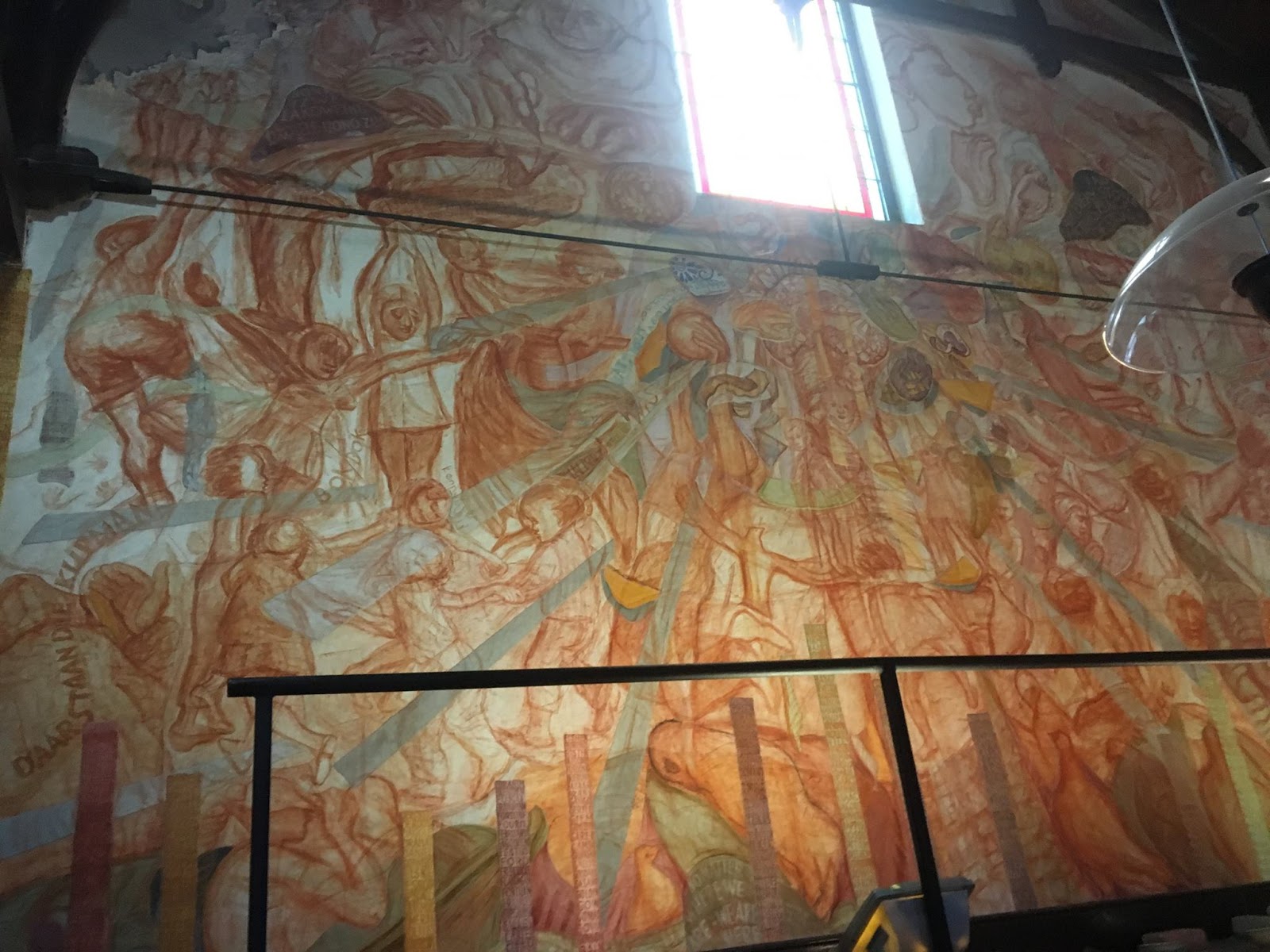
Mural at District 6 museum
In the past week we’ve transitioned from exploring Cape Town in South Africa to exploring Windhoek and our semester schedule in Namibia. I’ll start off with telling my experience with learning more about what Apartheid did to many communities of color from the District Six museum. Then I’ll move to talking a bit about Namibia and the budding possibilities that I’ve been able to see coming in my future.
While still in South Africa, we went to a museum called the District 6 Museum, and though its building is small, the gravity of its contents is not. The museum is a collection of donated items not just from the destroyed community of District 6, but the people who were forced to ‘relocate’ to another area so their community could be used for white homes – spoiler alert, they never did anything with the land after destroying the community that’d already been there. Our tour guide had his own stories from when he lived in District Six, and with them there was an air of pride about him that really stood out to me. He was proud because the district itself was filled with people of all kinds – race, religion, etc. – living together as harmonically as human beings can live with one another. This, in his opinion (and mine too), was what made the district a threat to the government, as they believed this could never happen in real life, or at least were selling that idea to their “fellow whites;” the most important ones at the time to sell this idea to, as they did have the easiest position within the structure of the country to do something about it.

Top view of District 6
His stories, along with the many others illustrated within the museum, were heart-breaking yes, but they didn’t break my heart in the same way other stories I’ve heard about Apartheid in the past few weeks have. Other stories have left me close to tears, or just flat out crying, as I hear them and/or read them, but I believe the stories of District Six had a different effect on me, because the storyteller was a man who experienced this atrocity and managed to leave me smiling after ending his story with a few jokes and some hope thrown in there for good measure; the government is currently working on a project that will rebuild District Six from the rubble that’s still there. The tour guide was a fun, happy, and naturally light-hearted spirit, a lot like who I used to be when I was younger. Also, the fact that he went through all this and still manages to make fun of it and be happy with himself and his life and the simple pleasures of it, gives me hope for myself. Hope that eventually, I’ll be able to do the same thing with some of the darker parts of my past, and move on to do something about them – within society – in the future. It’s one of the best experiences I’ve had so far, for that reason.
My future in Windhoek also seems brighter because of this, as I’m continuing to learn more about the area and the organizations that reside here, fighting the good fight for their groups of humanity who are being “screwed over” essentially by the government and society – my words. I look forward to learning more from the two organizations I’ve been focusing on as the semester goes on, and helping in any way I can – if they’ll have me. The first is an orphanage that goes by the name of Village Hope, and the other is an LGBTI advocacy group that goes by the name Outright Namibia.  

Visual lounge space in HIV exhibit at Slave Lodge
 

Wednesday, September 20, 2017

Week 3: The On-going History of Slavery in South Africa

By Adelina Alcaraz  
Our week started with a powerful tour informing us of the history of slavery in the Cape. As we went on our tour, we were informed that the places are ancestral grounds belonging to the Coy and Sun tribe. Common amongst colonization stories, when the colonizers came to Cape Town, they did not distinguish people by the various and divergent tribes, but simply by the color of their skin. It was better for colonizers to not use the Coy and Sun as slaves from the beginning. However, when slavery did come to the Cape, it came with a great force. Among the imported slaves were tens of thousands of children.
Small slave memorial in Cape Town

Later, our tour guides pointed out the surprisingly small memorials of slavery in Cape Town which exhibits the problem of being ignorant of the past. For example, there was a memorial of black blocks small enough to sit on. These block had words like slavery, resist, and a list of names to symbolize the horrors of the slave trade and following oppression in Cape Town. Although artistic, the message of the blocks is unclear to those that aren't familiar with that history therefore, is not efficient in educating others.

One of the most troubling memorials is a block in the shape of a tree trunk to symbolize the trees used to auction off slaves. This horrifyingly inhumane practice is ironically meant to be remembered by placing a circular block, not even big enough to sit comfortably on, in the middle of two busy roads, where people pass it daily, not even getting a glance at it. From this, we learned that ignorance of the past can not only threaten the future but also hurt and disrespect descendants of the oppressed.

After the tour, we were guided to an emotional HIV exhibit. We not only saw the pictures and stories of HIV survivors around the world, but were also introduced to an HIV survivor who is also a transgender woman, cancer survivor, former drug addict and sex worker. Her story of surviving so much trial proves her strength and amazing capability. Her main message to us was to break down stereotype of those living with HIV. They are not only capable of living a normal life, but strong in facing not just the HIV disease, but the harsh stigma put on them by the society they live in. Her story was inspirational and empowering to not only those living with HIV, but those being unjustly punished by society for not fitting into the box each society places every person in.

Some of us ended the day with a Swami yoga instructor. Interestingly, he identifies no religion, but is knowledgeable of many so that he may offer guidance to those that wish to connect the spirituality of yoga with her or his religion. The spirituality of yoga is something that mainstream yoga in the U. S. rarely mentions. One of the things the yoga instructor emphasized was the idea of selfishness in today’s world. He argued that selfishness is the base to the world’s problems and that happiness should come from making others happy. Coming from a society where self-care and helping yourself before you can help others is a common thought, it was interesting and frankly hard for some of us to accept. As for myself, I’m still struggling on what this means for complex situations, like what this looks like across cultures. Although the yoga instructor insisted this being a simple teaching, I think in practice it’s much more complex.
Photo from the HIV exhibit.

 
At the District 6 museum, we learned the story of someone who experienced inhumane relocation. He explained to us what it was like being forced out of his home during apartheid.
 
On Wednesday, we went to church, to school, and then to the Sex Workers Education and Advocacy Task Force. At each place were taught about love for each other and helping one another though things like acceptance and support. One of the most striking things to challenge my perspective was being introduced to the term sex worker, a more respectful way to address prostitutes. It was the idea that sex work can be just like any other work: a choice done willingly by the worker that should be protected by law instead of being criminalized. Unfortunately, a majority of the media, public, and politicians do not distinguish the difference between sex workers, those that choose their occupation, and human trafficking survivors, those forced into sex slavery.
 
The rest of the week involved moving into Windhoek, Namibia, a place we’ll call home for the following three months. Here, we reunited and met with the rest of the staff, or more appropriately labelled the rest of our family.

Wednesday, September 13, 2017

Week 2: Exploring Identity by Carly

By Carly Dillis

A view of Cape Town from historic Wale St, a community that
has historically been predominantly Muslim.
Over the past week, our group has been exploring Cape Town and different parts of the Eastern Cape. Throughout this time, we have been learning the story of South Africa through the people in these places. Our learning in this program is designed to be through experience, including that of others. Thus, we rely greatly on shared personal narratives to humanize and contextualize the more traditional learning that we have been engaging with in museums and historical sites. Simultaneously, we are also navigating our own identities in a new country and learning who we are and how we relate to the world.

Portraits of Steve Biko in front of the museum.
For our first day in the Eastern Cape, we drove from Port Elizabeth to King Williams town to visit the Steve Biko museum. The museum was about the anti-Apartheid struggle, but more so it was about Steve Biko as a person. The museum helped bring a human energy to the history of Apartheid. As Apartheid is such a violent system, it begins to feel the opposite of human. Therefore, reminding ourselves of the humans involved is a much-needed facet of a complete education in the subject. We have also found this human element at the Red Location Lodge, a women’s co-op that we have been staying in for our time in Port Elizabeth. The co-op is a women’s empowerment and support group with about a dozen members. They have been sharing their stories with us as well and showing us a more everyday type of resistance in their solidarity.

As we move onto Cape Town, we again get a new perspective on the history of South Africa and Apartheid. We took the ferry to Robben Island, the site of the prison in which Nelson Mandela, Walter Sisulu, and Robert Sobukwe were held during the anti- Apartheid struggle. Our tour guide was a former prisoner at Robben Island and was able tell the story of prison life from his authentic experience there. He gave us a sense of what it felt like to be a prisoner under Apartheid and to be taken away from society. The story of Apartheid is one that is still being written. As the first democratic elections took place in 1994, the official era of Apartheid is over, but it is still very fresh in the minds and lives of the people of South Africa.

A collection of the original signs of District Six
before the Apartheid government tore down all
houses. Behind the signs, there are also handmade
quilts that depict everyday life in District Six. 
 We were also able to tour the District Six Museum. Our tour guide’s name was Noor and he was born in District Six. He was the third generation to raise his family in his home and was forcibly evicted when the area was declared “for whites only.” He watched his house be torn down and had to begin a new life away from the community which had become a part of his identity. He told his story with enthusiasm and passion, which gave us a sense of his greater self and identity and made his story exceptionally human. District Six and Noor’s story are a microcosm of Apartheid and help us understand how the events and policies enacted by the government affected everyday people such as Noor.

Learning through a personal lens helps one to internalize the curriculum and understand its importance. It also helps to decolonize our education by diversifying our knowledge source and helping us to be critical of institutions of knowledge. It has also helped us to understand our own places in the struggle, as we are connected to this history, and all histories, by our existence in a globalized world. 

Monday, September 14, 2015

Week Three: Broken Systems, Broken Promises

By: Emily Campbell

“The people shall share in the country’s wealth.” Originally written in South Africa’s 1955 Freedom Charter and adopted by the current ruling party, the ANC, this sentence took on new life when we saw it spray painted across several overpasses in the Cape Flats. When displayed in the primarily black townships southeast of the city center, these words seemed to highlight the existing discontent with the current system. Sixty years after it was written, this promise, and many others, have yet to be realized. We repeatedly heard frustration over the perceived lack of follow through on promises made during the liberation struggle and how little has changed for the living conditions of many people residing in townships. Despite the ANC’s promises of 1994, many black South Africans still lack basic services such as power, clean water, housing, healthcare, education, and employment. 

On Tuesday, we met with Mandla Majola at the Treatment Action Campaign. His work exemplified the failed promises of the ANC. Located in Khayelitsha, a township within the Cape Flats, TAC was founded to increase HIV and AIDS awareness and to provide universal access to antiretroviral drugs. Since its formation in 1998, TAC has spread its reach far beyond HIV. Poor sanitation and failing infrastructure are tied to a wide range of health issues, and Majola has been an advocate on many of these fronts. In Khayelitsha, there are many homes without electricity or clean water, one (infrequently cleaned) public toilet for roughly every ten families, a high rate of TB, four reported rapes daily, and poor maternal health care, to name a few of the issues Majola is passionately tackling. Many of us left TAC carrying the emotional weight of Majola’s heart-rending stories, but inspired by his tireless work for his community. But these issues are not unique to his area and represent the symptoms of a weak infrastructure nationwide. As Henrik described in an earlier blog post, we saw many of the same issues when we visited Orange Farm outside of Johannesburg. The government system is set up in such a way large segments of the population fall through the cracks, receiving virtually no government services. The conditions in both townships illustrate this issue and how many of the rights secured by the 1994 South African Constitution are still nonexistent for many people across the country. 

On display at the District Six Museum, a member of the
demolition crew saved these street signs for decades. 
Land rights are another contentious issue that many activists feel the ANC has failed to address. During the Apartheid, segregation forced many black and coloured South Africans to relocate. One such area was District Six, a mixed neighborhood in Cape Town. In 1982, it was declared a whites-only area and 60,000 people were forcibly relocated to the Cape Flats. On Monday, we visited the District Six Museum and met Noor Ebrahim, a former resident of District Six. He explained the many financial, physical, sociological, and emotional impacts of the forced removals. Homes and businesses were destroyed, many were left without work and paying rent for their new residences. Those who had once walked to work had to start paying for transportation. The Cape Flats were overcrowded, leading to poor sanitation and additional health issues. Communities, and even families, were split up and segregated. People were pulled out of their communities and uprooted from their support systems. This is part of what makes forced removals such an effective tool of oppression. A community divided is less powerful and less able to organize against the unjust system. Since the official end of Apartheid, there has been a movement to restore the land rights of people forcibly removed from District Six, The government promised to build homes for former residents who wished to return to the area, but to date, few houses have been built and the area still remains largely empty. Hearing from Ebrahim and exploring the museum helped us to understand the many ways people are still healing from the scars of Apartheid.

Frustration over the government's lack of attention to these problems and its perceived inability to develop effective infrastructure has led to service delivery protests across the nation. During our time in Cape Town, we witnessed one of these protests (don't worry parents, we didn't participate). A group of citizens gathered in front of a government building to protest a government that has failed to provide the basic services its people need. Not only has the current system failed to close the gap between the wealthy and the impoverished, but the failure to deliver services and improve the infrastructure has deprived many people of basic human rights. Just as the spray painted overpasses in the Cape Flats proclaimed, the people are still not sharing in the country’s wealth. 

The group gets comfortable at the
CGE house on our first night in Windhoek.
My own frustration grew as we saw a different side of Cape Town. It seemed that everywhere we went there were mountain views and unending seascapes, delicious restaurants and busy marketplaces. It came as no surprise that Cape Town is consistently ranked as one of the top tourist destinations in the world. But as we experienced the tourist side of the city, we learned about places tourists don’t go. It seemed that the stories Majola and Ebrahim shared with us aren’t stories routinely heard. It was unsettling how easily their perspectives can be overlooked, despite the fundamental role they play in the history and present reality of the city. I found myself very lucky not only to hear their stories, but to share them. It was the dichotomy between their underrepresented perspectives and the overcrowded tourist destinations that helped us to understand more about post-apartheid South Africa. We came to Cape Town to explore identity. We left wondering about the two seemingly irreconcilable identities of the city, the many identities of its people, and our own identities in relation to everything we learned. Experiencing these many sides of Cape Town pushed us to ask questions about history, politics, inequality, and ourselves as we began to develop a global perspective. And now that we’ve settled into our home in Windhoek, we’re excited to dig deeper into the history and politics of Southern Africa as we continue to grow in our social and cultural understanding of the region.