Showing posts with label environment. Show all posts

Wednesday, April 25, 2018

Leopards, Lions and Cheetahs, Oh My!

By Jimmy D.
On Sunday March 4th we had just returned from our homestay in Katutrua, which means “The place where people do not live”. To me it was quite the opposite. My family was welcoming and helpful in teaching me their culture. We had just attended Church and returned back to the house for our last meal before they had to drop me back at CGEE. My family did not want to drop me off, and I didn’t want to go either. After spending a week in their home we had built a good relationship that I hope to expand on during my time here by visiting them often and joining them for dinner.  After being gone for a week it was strange being back at CGEE, but then transition went well, it was nice to all be eating dinner as a group again and talking about our experiences in our homestay, considering we all had vastly different conversations and interactions it was very interesting to compare and contrast our week away from each other.
           On Monday we started our regular schedule again which consists of breakfast, class, internship, and then returning for dinner. During class on Monday we talked about Small Medium Enterprises (SME’s) and their potential, especially in Africa, at increasing the economy and lifting people out of poverty. Our speaker, Forrest Branch went into great detail on how this is possible. But it’s important for investors to notice the potential of SME’s. A barrier to SME’s is funding, which can be difficult to obtain in Namibia. Most banks will not give a loan without collateral that may be hard to obtain due to varying circumstances. A majority of SME’s will use their own savings to start a business; the next group relies on friends and family for the funding to start their business. This causes challenges on many fronts. One issue I see is expansion, for example if your business is doing well, but you still haven’t made back your initial investment, it is hard to invest more money in increasing your stock or staff, even if your business is doing well, the capital isn’t there to expand. There are a few ways to support SME’s. First is to go to the business and support them by using their services or buying their products. The second option is to invest small amounts of money much like a microloan, where you and the business operator can establish a timeline and action plan, and once the return is made the investor will get their initial investment back with a small percentage of return. The power of microloans comes from many people investing small amounts of money at once so this will overall make up a medium to large loan, but the risks are small because the individual will only lose their small investment, rather than a bank or large investor having to take the full impact of losing a large investment.
N/a'ankuse Lodge and Wilderness Sanctuary main entrance
 
           The most notable part of my week was visiting N/a’ankuse Lodge & Wildlife Sanctuary. During our Environmental Connections class we had the pleasure of traveling out to N/a’ankuse to go on a feeding tour to see lions, cheetahs, leopards, wild dogs, baboons and caracal. It is sad to see animals in cages instead of being able to roam the wild but there are reasons for the work N/a’ankuse does. All of the animals there are either orphaned and would not be able to survive alone in the wild, injured by traps and the damage cannot be fixed to the point where they can be released, or conflict animals, which are animals that attack livestock and pose problems for farmers. If they are not removed they would either be shot or have the potential to injure or kill humans. N/a’ankuse also provides the animals with much more space than a typical zoo in the USA would, each enclosure has about 5 hectors of land. Lastly we talked to a researcher who works at N/a’ankuse, he explained some of the research projects taking place and how interns have been coming up with some innovative ideas to combat wildlife conflict such as using lion scat to deter other animals from approaching livestock. He also talked about how hard it is to keep count of the animals in the wild to produce reliable numbers about how many are left. As of now there are only around 7,000 cheetahs left in the wild, but in 1900 it was believed that there was 100,000 cheetahs in the wild, so in 100 years the cheetah population has plummeted due to a lack of conversation efforts and this issue is only starting to be addressed. This is why the work N/a’ankuse does is so important because they not only protect animals that are endangered, they also do research to better animal populations and increase conversation.
Lion at N/a'ankuse

Tuesday, December 5, 2017

Living Sustainably

By Adelina Alcarez
We started out the week by coming back from our Swakopmund stay, a touristy German town, and ended our week in NaDEET, a camp-like area on the Namib Reserve at which there was no wifi and mounds of sand, all kinds of creepy crawlies, and oryxes for miles around us. Needless to say, NaDEET was my favorite excursion of the week.
In between, we attended a couple of class on Monday, Tuesday, and Wednesday. Personally, I went to a couple of churches for my internship at an LGBTI human rights organization. A colleague of mine, Mickey, and I have been working on constructing a list of churches that are tolerant to the LGBTI community and measuring their tolerance. We do this by interviewing a leader of the church (if possible) and giving them a survey about their relationship with the LGBTI community. Thus far, most of the various places of worship have been a little apprehensive, yet welcoming and willing to talk with us. On Wednesday, we went to two churches. Both gave us a perplexing look when we first introduced ourselves. However, they were still willing to direct us to someone to talk to. I think that our experiences with churches may suggest that Namibia is ready to talk about LGBTI issues and even support their human rights, if well educated about them. What better place to start this conversation then with the system at which many members have shamed people for being part of the LGBTI community in the 16 century and many continue to make being LGBTI taboo today.
Description of the dry toilet system.
On Thursday, we left for NaDEET. NaDEET is a place to learn about sustainable eating, pooping, wasting, and cleaning. There is a dry, no-flush toilet. When dried, a person’s total amount of yearly poop can be just enough to fill a bucket. On top of that, there are dung beetles decomposing the poop at the very bottom, at least 6 feet underground. Their electricity was also powered by solar panels and food made mostly from solar cookers. Solar cookers look like large metal disks used to communicate with alien life, but they actually concentrate the sun's ray on the pot. They also had solar cooker in box form. There was a cup or bucket of water for the sinks and showers because there was no faucet; albeit, the shower did have a bucket attached to a shower head. I was astonished at how well the showers worked like a regular shower and how much water I could save by lowering the water pressure a little bit and not using water when I didn’t need it (like while I was washing and not rinsing). This tied in with the 17 sustainable development goals.
Surprisingly, the goals did not stop on issues directly associated with environment, but also social and economic issues like gender equality and poverty. On Friday, we went on a Dune Walk (which was more like a hike for me) and talked about the biodiversity of the Namib Desert. We encountered interesting creepy-crawlies like the Dancing Lady Spider and various fast pace beetles and a couple of oryxes. Something we also focused on was how connected each species is to each other; everyone’s actions can create a domino effect. For example, one year, there was a huge increase in the moth population. It is unknown why, but our guide Elias suspected it was because a predator to the moths was in low population. This created in influx of moth cocoons all over the desert. The oryxes mistook the cocoons for food. A moth infestation killed a large portion of the oryxe population that year.
Solar cookers. Not to be confused with alien
communication devices.

Later that day and weekend, we continued to learn about and live a more sustainable lifestyle. We watched a documentary about the NamibRand Nature reserve and NaDEET’s place within it. The reserve all started with one rich man who bought a lot of cheap land in Namibia to preserve it. It was rough in the beginning, but now it’s not only a place of animal preservation; it’s a place for research, a dark sky reserve, tourism, and environmental and sustainability education. I am so blessed to have been able to visit and learn from such an amazing place. I hope to put the education I learned here into practice and not only use less water and push for renewable energy, but also to educate myself about the environmental issues in the area I live in. This experience has changed my perspective on what role I play on this earth: to help protect it and protect the people who live in it. What a great week.


Sunday, December 3, 2017

Amidst the Stress and Sand

By Maddie Dilday
As we approach our last few weeks in Namibia, we are all doing our best to finish final papers, pull our integrative projects together, and still enjoy our time in this beautiful country. While this can be a very enjoyable experience, I think almost everyone is feeling some sort of stress. But in the middle of all this stress, comes our final group trip to NaDEET. NaDEET is short for Namib Desert Environmental Education Trust. Essentially, it is a small oasis in the middle of the Namib Desert Nature Preserve, where they teach about environmentally sustainable living, all while living out this life. And for a few short days we got to live it out with them.
 
There are 3 major moments throughout the trip that I know will stay with me. The first of which is the dune walk that we took just outside of NaDEET. In total the hike was about 6 km, 3 both way, and we walked throughout the dunes outside of the NaDEET. On this walk we were able to see the amount of biodiversity that the dunes of Namibia hold. The majority of the diversity is on a small scale, specifically they have a large diversity in the types of bugs that the dunes hold. I found this fascinating as biodiversity is a topic that I have often heard about in class, but that I rarely have had the chance to see. Although the creepy crawlies were just that, creepy and crawly, the dune walk was an amazing experience that I am hoping to have the opportunity to do again once I am back in the United States.


Above is a picture of a Dancing White Lady Spider that was
seen on the dune walk. It received this name due to the
"drumming" patter it leaves in the sand in the morning.

The next activity on the itinerary for the weekend that blew my mind was the drive to a nearby mountain, as well as the hike up the mountain. The drive was gorgeous, it was one of those moments where you are stunned by the beauty that Earth holds, and you think about just how small you are, and how much of this beauty that you have yet to see. Having the opportunity to see the Namib Desert in this way is one of the highlights of my entire trip and I hope that I am one day able to return to this beautiful country.

 
The final activity that we had at NaDEET was by far my favorite. The entire group went out to the top of a near by dune, and we star gazed for about an hour. NamibRand is one of the few International Dark Sky reserves, and a top tier reserve at that. As an Astronomy major, having the chance to see the night sky with such clarity was out of this world. I wish I had been able to capture the view of the stars, galaxies and dust that could clearly be seen in the dark night sky, but unfortunately my phone's camera isn’t strong enough. But, it is an image that I will remember for the rest of my life.
This picture was taken on the drive to the mountain range.
This country's beauty just does not end.


Overall, NaDEET was a interesting and enjoyable break from the stress of the final papers that are piling up at the end of the semester. Although we only have 2 weeks left, I am sure that they will be packed with as many adventures as possible.


Wednesday, November 29, 2017

Exploring waste management, Islam, and Swakopmund


By Michelle Andersen
 
20171106_094649.jpg
Windhoek waste management site
My week started with a visit to the waste management site with our environmental class. We got a talk from the leader of education, Estelle, and learned of her struggles as the only one in her department. The rest of her team and most of their resources were moved to a different government office, so she has issues getting educational materials about waste management to the local people. From what she told us, it seems as if the people do not know about the recycling program or the difference between the various types of waste bins. With a lack of resources, she is fighting an uphill battle. When we went to the waste site, the gorgeous backdrop of the mountains was covered by the piles of trash. They try to do some sorting of recyclable items on site but it can be a challenge. Most of the waste is simply flattened and covered with sand to keep it from blowing away. Waste management is a huge problem in Namibia with the lack of necessary infrastructure and education.

For religion class, we learned about one of Namibia’s minority religions, Islam. We discussed the five pillars; fasting, alms giving, praying five times a day, declaration of faith, and the pilgrimage to Mecca, if you can afford to. We got to visit the school that April, our Professor Lamont’s wife, is opening soon that is built on land that the mosque owns. April told us about her curriculum, values, and hopes for the school. The Sheikh Imam furthered our discussion by going into detail about the history behind the small Muslim population in Namibia, the effects of this, and Islamic beliefs. Islam is considered a way of life and should be reflected in a person’s every action. We ended with a tour around the mosque and seeing one of the daily prayers.
20171109_142346.jpg
Controversial monument depicting the German soldiers
who dies during the genocide

Additionally, this week we traveled to Swakopmund and Walvis Bay to learn about the historical and current issues there. Our tour guide was Laidlaw Peringanda, who is a Herero activist who is passionate about the Herero-Nama genocide by the Germans. In the town square, there is a monument to the German soldiers who died committing the genocide. The local Germans and their government are denying that there is a problem with this statue and refuse to take it down. Next, we went downtown to visit the cemetery,  where there is a large section of unmarked graves of those Herero and Nama people who were murdered during the genocides. The German government donated a plaque which refers to their deaths due to "mysterious circumstances," despite the heavy photographic and official documentation of a genocide order. There is even a wall surrounding the cemetery because people were building houses on graves. From Laidlaw’s tour we expanded what we learned in Lüderitz and saw again the lack of proper memorialization for the losses of the local people. 
 
20171109_144237.jpg
Namibian peoples memorial from the Germans referencing the
genocide as deaths due to "mysterious circumstances"
 We also took a tour of a fishing factory, which is a major part of the local economy. The factory is not running until Monday because no fishing is allowed during October to let the fish population to replenish. The ministry was late with announcing what each factory's new fishing maximum quota would be, which caused the delay. During October, the factory pays for employees to travel home as well as providing a bonus. There is competition from foreign boats who do not follow the same rules but they are not allowed to have a factory on-shore unless 51% of the employees are Namibians. From what our tour guide told us, it sounds like there are many regulations in place to try and create sustainable fishing as well as proper treatment for Namibians.

Later that day our group hiked the tallest dune in Namibia, Dune 7. It was a struggle to get up but the view was worth it. Overall, it was a great trip filled with discussions of social issues, the economy, and seeing the natural beauty in the area. This week covered a lot from environmental waste issues, Islam in Namibia, and the history in Swakopmund.
20171110_171732.jpg
Dune 7
 

Monday, November 20, 2017

Life on the Farm

By Evan Carr
Following an amazing week with our families in the rural Khorixas area our homestay experiences for the semester are already over! While this is a sad realization I feel incredibly fortunate for the experience this past week, but also to be connected to three great families across the Southern Africa region. A huge thanks to Sarah, our Homestay Coordinator here in Namibia, and all of the staff for making this week a great success!


../../Pictures/Photos%20Library.photoslibrary/Masters/2017/10/18/20171018-150904/22664045_1209877775779500_257626772_o.jpg
Returning from a trip into town.
Our schedule in the so-called “Damaraland” area allowed for plenty of time bonding with our families on the farms combined with ample opportunity to continue the learning process with our busy schedule during the day. Our homes for the week did not have plumbing or electricity so we quickly adapted to the local lifestyle of cooking over fire and open-air toilets, but we were also fortunate to experience stunning night skies thanks to zero light pollution. Daily activities on the farm ranged from playing with baby goats and donkey cart rides to games of Owela under the sun and hot cups of Rooibos tea around the campfire. Owela is a local game requiring strategy and wit that was traditionally played between chiefs to settle disputes in the community. Another highlight of my week was the opportunity to develop my Damara language skills. As my host grandmother, the head of my house, did not speak English it was important for me to pick up some phrases in order to connect with her. While mastering the four clicks used in Damara presented a significant challenge, I was able to hold very minimal conversation in Damara by the end of the week about things like how I slept or how hot the weather was. Our week on the farm wrapped up with a big party where all five homesteads on each farm came together to celebrate the week and eat delicious food to our heart’s content. We danced and the sang the night away as we exchanged American and Namibian songs and dances with our families.
 
While we ate breakfast and dinner and spent nights at the farms, we spent our days together as a CGEE family. Some highlights of the program included visits to Cornelius Goreseb High School and the traditional court of Khorixas. The traditional court operates under the jurisdiction of the local Damara clan and mainly deals with domestic issues and theft, while other matters are left to the municipal court. It was valuable to see how people in rural areas integrate their traditional community structures with those of the modern Republic of Namibia. We delved further into Damara culture with a visit to the Damara Living Museum. In order to preserve their culture, people working there run demonstrations on blacksmithing, natural medicine, and jewelry making. Our trip also included a visit to the Twyfelfontein UNESCO World Heritage Site, which is the site of many ancient rock art drawings, and to a petrified forest. These excursions helped us to put into context topics we’ve discussed in our History, Politics, Environment, Religion, and Development classes.

../../Pictures/Photos%20Library.photoslibrary/resources/modelresources/37/83/%25SnCYAF5QC6Rcnlj08%25qLQ/22690369_1209876745779603_2083440280_o.jpg
My family for the week. Grandma Christa was the head of the house and the farm.

Following our week on farms in Khorixas we spent two days at Etosha National Park. This visit was capped by the sighting of a leopard that came right up to our van and let us follow it down the road for a few hundred feet. We were incredibly lucky to see such a rare animal (there are only about 600 in Namibia) at such a close range. We also saw lions, rhinos, many giraffes, zebras, springbok, and more! A visit to Etosha is a quintessential Namibian experience and it was great to get out there and see it with our group. I’m looking forward to our Fall Break next week and to catching up with everyone once we return to hear stories of their travels.
 

Wednesday, October 25, 2017

Week 6: A Week of Unexpected Growth

By Carly Dillis
This week, all of us are fresh off of our homestay experiences and back into the grind of classes and internships. However, that does not mean that this week was quiet or uneventful.

One of the Cheetahs from N/a'ankuse. There were two cheetahs in the
reserve who will be there for the rest of their lives.
On Monday, our environmental class visited N/a’an ku sê  nature reserve. The reserve takes in injured or orphaned African animals and raises them, often keeping them in captivity for life. We were able to see baboons, lions, caracal, leopards, cheetahs, and wild African dogs. Aside from baboons, these animals are some of the most endangered in the country and very few people get to see them. The readings for class this week had focused around human wildlife conflict. Thus, the reserve gave us the opportunity to see examples of the victims of this conflict. The animals housed in the reserve mostly ended up there because they had made their way into farms or private land and were either hurt, orphaned, or brought into the reserve by the farmers who refuse to have them on their land. The experience greatly helped to ground the readings of the week and it was easy to understand why the country of Namibia has difficulty in navigating human wildlife conflict.
The rest of the week went as scheduled. In history, we discussed anti-racism and how the movement has developed in Namibia. We had a guest speaker who was originally from the United States come in and explain the comparisons between the two societies. After he left, the students engaged in a spontaneous conversation at lunch about the speaker and his lecture. We were critical of his experiences and his opinions on women’s rights, environmental law, and LGBTQIA+ rights. In our politics class, we talked about democratization. Using Zimbabwe as an example, we discussed leadership, corruption, state sponsored violence, voting, etc. It is interesting to look at case studies from countries in the region and have them be so drastically different than they are when I read about neighbouring countries back home in the United States. It is a powerful reminder of where I am, how grateful I am to be here, and the depth of life and history in this place.
Some of the dunes at the inner most part of Sossuvlei  The trees and clay flats
can be seen in the distance.
Despite the incredible experiences of the week, the most powerful activity I participated in was a weekend camping excursion to Sossuvlei. Sossuvlei is a park where many of the most famous dunes in Namibia can be seen. It is about a 6-hour drive South from Windhoek. Five of the students rented a four-wheel drive truck with rooftop tents and booked a campsite to. We drove through the most rural and the most beautiful roads I have ever seen. The topography in Namibia changes about every 100 km, so we would go from driving in mountains to driving through the flat drylands. When we arrived at Sossuvlei, we entered the park and made our way to the dunes. They stretch higher than I ever thought possible. We stopped at one with a beautiful ridge and tried to hike it, before realizing that what we thought to be the top, was only about the halfway point. We also drove into the main part of the park where the biggest dunes are and there is a clay flat petrified forest. In the United States, I grew up in a state park in the forested hills of Massachusetts. We would regularly spend entire days outside, hiking, biking, collecting leaves, etc. I consider myself to be fairly well versed in the ways of nature. However, my experience at Sossuvlei was truly humbling in this way. Certainly, I never believed myself to know everything or be ready for everything this trip will show me. However, I sincerely do not think I could have prepared myself for the experiences I had in Sossuvlei.
I entered this week with the expectation that it would serve me as a week to reflect, which it certainly has. Additionally however, it has also empowered me to keep exploring Namibia on my own, to seek the things not sought. I am so grateful for my experiences this week as they have once again made me understand myself and the world more fully.

Thursday, October 5, 2017

Week 5: Urban Homestay/Classes

By Michele Poindexter
 
We officially reached the one month of our stay in Southern Africa this week, and the learning hasn’t stopped! The first full week of classes was completed, internships continued, and we were all welcomed into the homes of ten wonderful families during our weeklong Urban Homestay. There is certainly never a dull moment here at CGEE Namibia.
 
My favourite of all puppies!
In Environmental Connections (taught by the first woman in Namibia to manage a national park - how awesome is that?!), we began with an overview of the environmental issues in Southern Africa. These include deforestation, an increase in the urban population, land degradation, wildlife poaching, limited natural freshwater resources, desertification, loss of wildlife habitats, drought, poverty, and pollution. I had two main takeaways from this first class. First, there is a large need for regionally specific public awareness and education about environmental issues. Each region is geographically, climatically, and socially distinct, so a blanket solution would not be successful everywhere. However, the underlying issue of poverty must be addressed before environmental conservation and sustainability can be achieved. If people are struggling to meet their basic needs, considering the environment in their decisions for survival is not going to be a top priority. Second, our world is not isolated. The pollution in the United States, or anywhere in the world, affects Africa, and vice versa. This means that the choices we make every day (that might just be contributing to climate change) do not only affect us - they affect everyone, even on the other side of the world. To solve environmental degradation, all people must make an effort, for we all share one home, one Earth.
 
In Religion class, we learned a bit about the history of Black Liberation Theology, and its role in the United States and Southern Africa. Our conversation also expanded to include other oppressed groups such as the LGBT+ community. During our travels through Southern Africa, many of us have had conversations with folks about their views on the LGBT+ community in relation to their religion, so it was a good opportunity for us to discuss and reflect on what we had encountered compared to our own views.


My wonderful homestay family!!

The greatest part of my week was getting to live with a wonderful father, mother, and brother during the urban homestay. There is no better way to learn about the history and culture of a country than to completely immerse yourself in the lives of the people. I lived in a neighborhood called Khomasdal. During Apartheid, this neighborhood was built to house coloured people, a racial category created by the Apartheid regime. This categorization was meant to enforce the separation and supposed hierarchy of races. Today, Khomasdal is a diverse community, full of neighborly love and adorable dogs. My family and I talked about everything from immigration to the effect the Chinese are having on the country to drugs. I learned some Afrikaan words, learned how to bake some traditional dishes, and played with the cutest puppies on this planet. I am now more confident in fitting into the culture here and gained a wonderful new family - I’d say that was a pretty successful week.
 
I jumped in on the yoga class this week,
and we did some acroyoga!!
Now onto the next adventures!


Wednesday, September 27, 2017

Week 4: Namibia, Unequal in More Ways Than One

By Keith Nagel

This picture shows how the country has moved forward as one after independence. This picture was taken at the
National Museum of Namibia.
 

Before March 21, 1990 Namibia was subject to the same oppression of apartheid that South Africa endured. Following independence, Namibia has enjoyed political stability and a growing economy, albeit an unequal growth. After learning some information about Namibian ethnic history in class I was left with a question of why has Namibia enjoyed such political and social stability? Namibia has an impressive mixture of ethnic groups. On a field trip to the Owela Museum we were able to dive deeper into each group. The Oshiwambo ethnic group have enjoyed the largest representation in the post-independence government and have been able to grab the largest share of economic and political influence. When you put the Oshiwambo’s influence up against the San people or Bushmen you realize that even among ethnic groups in Namibia there exists a clear inequality in political and economic resources. The Bushmen are one of the most marginalized groups in Namibia. They were not given any type of reserve by the government and were forced to abandon their traditional way of life in the bush because their land was taken and made into national parks, and as a result they often live in extreme poverty. When I learned about the San people it reminded me of the United States’ experience with the Native Americans. This marginalized population was denied economic and land rights much like the Bushmen. The Bushmen and Native Americans have historically had the utmost respect for the land. In many ways both groups entire mindset revolved around the land, and yet, both had their sacred land ripped away from them. Today the Bushmen work on farms while other larger ethnic groups enjoy the economic freedom in the city. When I came to Windhoek I expected to see wealth inequality but I never expected that these lines of inequality were drawn both by racial and ethnic divides.
The "man on the horse" with the National Museum of Namibia in the background. The man on the horse is a relic of German occupation, while the Museum  is a modern testament of liberation built by North Korea, a friend to Namibia during their struggle for independence. This stark contrast says a lot about where Namibia was, and where it is going.
Our group was lucky enough to engage with some of these issues while listening to an important speech by PLO Lumumba. The speech was so important that both the First Lady and President of Namibia were in attendance. It was an honor to be in a room of such influence and experience, and it helped me better understand some of the questions I faced about ethnic divides. For me the most memorable reference that PLO Lumumba made was his quotation of Bob Marley. The quote read “emancipate yourselves from mental slavery, none but ourselves can free our minds.” For me this paralleled nicely with Steve Biko’s teachings of Black Consciousness which encourages Black people to change their outlook on their situation and accept their empowered self. After PLO Lumumba’s speech, I began to understand perhaps why Namibia has retained such a stable political and social structure. Perhaps Namibia was able to learn to accept their differences and move forward as one Namibians rather than fragmented political parties as the South African experience has shown. Although SWAPO and the ANC share characteristics, it appears that Namibia has had a better experience with a liberation ruling party in the years following independence.
This picture honour's the many men and women who fought for the liberation struggle.
This picture was taken at the National Museum of Namibia.

Friday, September 22, 2017

Week 3: Two Countries, One Continent


By Mickey Liebrecht

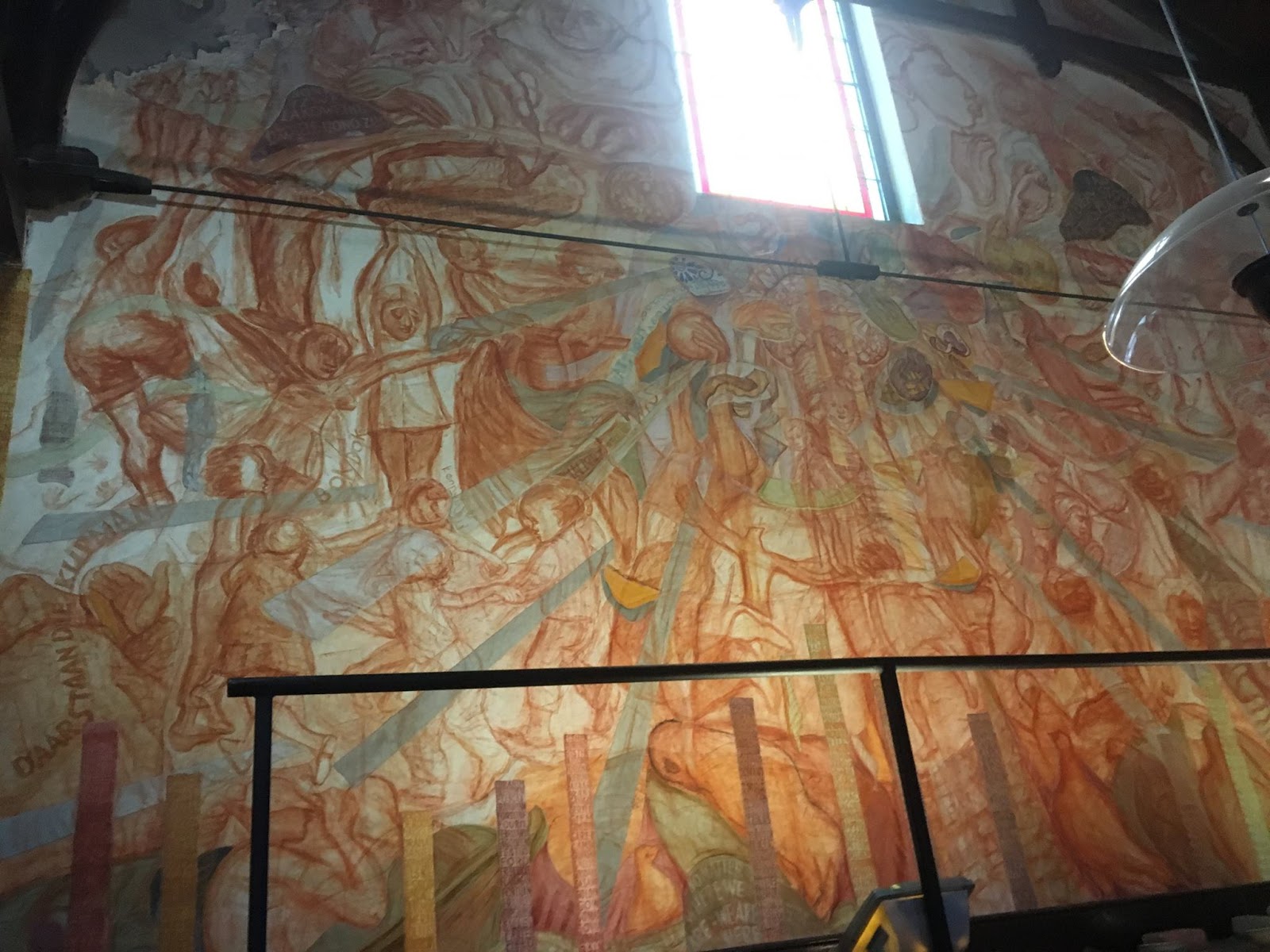
Mural at District 6 museum
In the past week we’ve transitioned from exploring Cape Town in South Africa to exploring Windhoek and our semester schedule in Namibia. I’ll start off with telling my experience with learning more about what Apartheid did to many communities of color from the District Six museum. Then I’ll move to talking a bit about Namibia and the budding possibilities that I’ve been able to see coming in my future.
While still in South Africa, we went to a museum called the District 6 Museum, and though its building is small, the gravity of its contents is not. The museum is a collection of donated items not just from the destroyed community of District 6, but the people who were forced to ‘relocate’ to another area so their community could be used for white homes – spoiler alert, they never did anything with the land after destroying the community that’d already been there. Our tour guide had his own stories from when he lived in District Six, and with them there was an air of pride about him that really stood out to me. He was proud because the district itself was filled with people of all kinds – race, religion, etc. – living together as harmonically as human beings can live with one another. This, in his opinion (and mine too), was what made the district a threat to the government, as they believed this could never happen in real life, or at least were selling that idea to their “fellow whites;” the most important ones at the time to sell this idea to, as they did have the easiest position within the structure of the country to do something about it.

Top view of District 6
His stories, along with the many others illustrated within the museum, were heart-breaking yes, but they didn’t break my heart in the same way other stories I’ve heard about Apartheid in the past few weeks have. Other stories have left me close to tears, or just flat out crying, as I hear them and/or read them, but I believe the stories of District Six had a different effect on me, because the storyteller was a man who experienced this atrocity and managed to leave me smiling after ending his story with a few jokes and some hope thrown in there for good measure; the government is currently working on a project that will rebuild District Six from the rubble that’s still there. The tour guide was a fun, happy, and naturally light-hearted spirit, a lot like who I used to be when I was younger. Also, the fact that he went through all this and still manages to make fun of it and be happy with himself and his life and the simple pleasures of it, gives me hope for myself. Hope that eventually, I’ll be able to do the same thing with some of the darker parts of my past, and move on to do something about them – within society – in the future. It’s one of the best experiences I’ve had so far, for that reason.
My future in Windhoek also seems brighter because of this, as I’m continuing to learn more about the area and the organizations that reside here, fighting the good fight for their groups of humanity who are being “screwed over” essentially by the government and society – my words. I look forward to learning more from the two organizations I’ve been focusing on as the semester goes on, and helping in any way I can – if they’ll have me. The first is an orphanage that goes by the name of Village Hope, and the other is an LGBTI advocacy group that goes by the name Outright Namibia.  

Visual lounge space in HIV exhibit at Slave Lodge
 

Wednesday, September 20, 2017

Week 3: The On-going History of Slavery in South Africa

By Adelina Alcaraz  
Our week started with a powerful tour informing us of the history of slavery in the Cape. As we went on our tour, we were informed that the places are ancestral grounds belonging to the Coy and Sun tribe. Common amongst colonization stories, when the colonizers came to Cape Town, they did not distinguish people by the various and divergent tribes, but simply by the color of their skin. It was better for colonizers to not use the Coy and Sun as slaves from the beginning. However, when slavery did come to the Cape, it came with a great force. Among the imported slaves were tens of thousands of children.
Small slave memorial in Cape Town

Later, our tour guides pointed out the surprisingly small memorials of slavery in Cape Town which exhibits the problem of being ignorant of the past. For example, there was a memorial of black blocks small enough to sit on. These block had words like slavery, resist, and a list of names to symbolize the horrors of the slave trade and following oppression in Cape Town. Although artistic, the message of the blocks is unclear to those that aren't familiar with that history therefore, is not efficient in educating others.

One of the most troubling memorials is a block in the shape of a tree trunk to symbolize the trees used to auction off slaves. This horrifyingly inhumane practice is ironically meant to be remembered by placing a circular block, not even big enough to sit comfortably on, in the middle of two busy roads, where people pass it daily, not even getting a glance at it. From this, we learned that ignorance of the past can not only threaten the future but also hurt and disrespect descendants of the oppressed.

After the tour, we were guided to an emotional HIV exhibit. We not only saw the pictures and stories of HIV survivors around the world, but were also introduced to an HIV survivor who is also a transgender woman, cancer survivor, former drug addict and sex worker. Her story of surviving so much trial proves her strength and amazing capability. Her main message to us was to break down stereotype of those living with HIV. They are not only capable of living a normal life, but strong in facing not just the HIV disease, but the harsh stigma put on them by the society they live in. Her story was inspirational and empowering to not only those living with HIV, but those being unjustly punished by society for not fitting into the box each society places every person in.

Some of us ended the day with a Swami yoga instructor. Interestingly, he identifies no religion, but is knowledgeable of many so that he may offer guidance to those that wish to connect the spirituality of yoga with her or his religion. The spirituality of yoga is something that mainstream yoga in the U. S. rarely mentions. One of the things the yoga instructor emphasized was the idea of selfishness in today’s world. He argued that selfishness is the base to the world’s problems and that happiness should come from making others happy. Coming from a society where self-care and helping yourself before you can help others is a common thought, it was interesting and frankly hard for some of us to accept. As for myself, I’m still struggling on what this means for complex situations, like what this looks like across cultures. Although the yoga instructor insisted this being a simple teaching, I think in practice it’s much more complex.
Photo from the HIV exhibit.

 
At the District 6 museum, we learned the story of someone who experienced inhumane relocation. He explained to us what it was like being forced out of his home during apartheid.
 
On Wednesday, we went to church, to school, and then to the Sex Workers Education and Advocacy Task Force. At each place were taught about love for each other and helping one another though things like acceptance and support. One of the most striking things to challenge my perspective was being introduced to the term sex worker, a more respectful way to address prostitutes. It was the idea that sex work can be just like any other work: a choice done willingly by the worker that should be protected by law instead of being criminalized. Unfortunately, a majority of the media, public, and politicians do not distinguish the difference between sex workers, those that choose their occupation, and human trafficking survivors, those forced into sex slavery.
 
The rest of the week involved moving into Windhoek, Namibia, a place we’ll call home for the following three months. Here, we reunited and met with the rest of the staff, or more appropriately labelled the rest of our family.

Monday, September 11, 2017

Week 1: Development & History of South Africa

By Mickey Liebrecht
Much of what we first learn in South Africa begins – like the history books within the schools of the country during Apartheid – in the early 1600s when the Dutch first colonized the region. This is helpful information and very much the beginning of the racial oppression, tension, and division within the country that eventually led to the tragic, wrongful events of Apartheid – which is the time period with which the development of South Africa to it’s modern state is mostly sourced from.
This chapter of History in South Africa – and Namibia – of atrocity started in WW2, when British troupes arrived in the country, claiming they were there to protect South Africa from the Germans. Then WW2 ended, and the British did not leave. They instead colonized the already colonized region, but also were appointed or appointed themselves into governing and law making positions. They then created the separation laws of Apartheid in 1948. In the Apartheid museum you’ll read that initially Apartheid was just meant to separate people so they could cater to their different needs – as whites would have different needs than blacks they would say – but as you read on and think about it, you realize this is complete and utter BS. At least that’s what I’ve seen as you get into the specific laws and policies the black, “colored”, and Asian communities were subjugated to. The history after this date is chalk full of pain and misery, some stories of human anguish that I never thought possible to be committed by a human being, happened to the most wonderful people I’ve spoken with whom are still living today. Even visiting museums such as the Apartheid, Hector Pieterson, and Constitutional Court are emotionally tolling as you read the descriptions of the events that took place and look at the guns, chains, and torturous devices used to hurt the people within the photos and now within my life; Antoinette Sithole was only 16 when she participated within the protest of June 16th 1976, which was initially meant to be peaceful and only a march against the use of Afrikaans as the teaching medium for black students. Things turned violent when the police shot at the students in attempt to stop and scatter them. Antoinette's little brother Hector was killed as a result of this, along with many others, and in the coming years the protests and rebellion was quiet. The people were healing from the wounds inflicted on that day, until students began to fight again in the ‘80s.
Antionette while being a woman harbouring immense emotional pain from her past, is without a doubt one of the funniest human beings I’ve ever met. She deserved better from life. However, in sharing her story with us, she opened our eyes to the horror and vulnerability her people were constantly exposed to during the time of Apartheid. It was a hard, but necessary lesson to learn. And useful not just for understanding the History and Development of South Africa as it is today, but also for understanding more of my own emotions to my own life’s horrors. Though none of my life was lived in intense poverty or racial Apartheid, I did lose a good friend of mine to violence when I was Antoinette's age in high school. I felt her loss on a more personal level due to this event I believe, and thus could understand more the ‘mental darkness’ that comes with such horrors and their many impacts on people’s lives. It meant a lot to me that she cared so much for me while I was with her, and that she and her husband shared the stories they did with us.
Fall 2017 class photo with Antoinette Sithole at the Hector Pieterson Memorial and Museum in Soweto.
In the background is Sam Nzima's, famous photo showing unconscious Hector being carried
by Makhubo, with Antoinette running alongside. 


Monday, November 21, 2016

Week Seven: Nujoma and the Namib

by Lolita Schalekamp and Hannah Johnson

Reflecting back on the week that just ended, we have to appreciate the various ways in which we’re able to learn here at CGEE. This week alone, among many other field trips, we had the opportunity to visit one of Namibia’s most important monuments and think critically about the problematic ways in which a nation’s history can be represented. Before the week’s end, we also got to travel into the world’s oldest desert to learn about sustainable living.

At beginning of the week, our group had the opportunity of visiting the Heroes’ Acre outside Windhoek. This monument honors the heroes and heroines of the liberation struggle in Namibia, and operates for the purpose of “fostering a spirit of patriotism and nationalism, and to pass on the legacy to the future generations of Namibia.” We learned that this site is not only a memorial, but also hosts many events, particularly army demonstrations. Heroes’ Acre currently contains 174 tombs for the courageous men and women in the fight for independence. Not all of the tombs are filled, but as the heroes pass away, spaces will be reserved for them.

One of the questions that arose from our tour was what are qualifications in choosing who gets to be buried at Heroes Acre? As our tour guide explained, the criteria was not always transparent, as many families of leaders in the liberation struggle would like for their loved ones to be buried at the monument. Indeed, this process has sparked controversy within some circles.

Statue of the Unknown Soldier at Heroes Acre
The monument itself consists of a marble obelisk and a bronze statue of the “Unknown Soldier.” Upon seeing the statue, its resemblance to Sam Nujoma is striking. Although our guide stated that the soldier is not modeled after anyone in particular, the statue has come under criticism for being a tribute to Sam Nujoma himself. Since Nujoma is the founding president of the independent nation, along with being the initiator of Heroes’ Acre, this theory seems relevant.

Another one of the group’s iniquities regarded the architecture of Heroes’ Acre. Compared with other monuments in Namibia, the architecture felt foreign. The grandiose nature of the obelisk is characteristic of Stalinist Empire style or Socialist Classicism. After some research, we learned that North Korea was given a N$60 million contract to build the monument. This has rightfully made many ask: where were the Namibian architects in the construction of their ‘national’ monument?

This leads to the next point: the collaboration of world leaders in the struggle for Namibian independence. As a part of Racism and Resistance class, we became increasingly aware of the parallel development of the SWAPO/SWANU political ideology alongside the PLAN military wing. North Korea’s support of the liberation movement is not as surprising as one might perceive. In fact, many communist nations such as the USSR, Cuba, and North Korea contributed aid to the Communist Party in Namibia, which in turn has strong ties to SWAPO’s formation. This could be interpreted as geopolitical strategy of Communist countries in the context of the Cold War, or from the Namibian perspective, a lack of support from international governing bodies such as the United Nations.

Namib Desert Environmental Education Trust (NaDEET)
As the weekend approached, we packed our sleeping bags, lathered ourselves in sunscreen, and trucked our way toward the desert where we had the privilege to stay at the Namib Desert Environmental Education Trust (NaDEET) Centre. NaDEET lies in the dune valley of the Namib Desert and serves as a place for people of all ages, but more specifically school children, to properly practice eco-sustainability. NaDEET is a non-profit, non governmental organization whose mission is to protect the natural environment of Namibia by educating its citizens to practice sustainable lifestyle. We were immediately greeted by the warm sun and soft sand, where we hiked over a few dunes to reach our base.  

Spectacular sand waves in the Namib Desert!
The entire weekend was full of fun and hands-on learning. We discussed sustainable energy and water, where we monitored our water use and discovered that the centre was fueled by solar energy, discussed waste management and nature conservation. Water conservation was one of the largest topics of conversation. It is undeniable that water is the basis of all life on Earth, however Namibia has a limited freshwater supply and labeled one of the most dry countries in sub-Saharan Africa. Being in Southern Africa, we have learned to be more mindful of our water use and waste. NaDEET introduced a variety of ways to reduce our water use, including implementing bucket showers. The bucket showers reduce shower time and water waste. We have returned to CGEE house with the mindset to take shorter showers and investigate what it would take to have dual flushing toilets. In fact, the average toilet flush uses over ten litres of water per flush. If we introduce a low flush or dual flush toilet in our home, we would reduce our water waste by 2-3 liters of water each flush. As discussed at NaDEET, in a five person household, this can lead to saving nearly 200 liters of water per week!

The delicious end result!
Our homemade pizzas cooking
in the solar ovens! 
The true fun began around lunch time, where we prepared food as a community and made homemade pizzas in the solar ovens. The fierce Namibian sun fueled the solar ovens and naturally, eliminates the use of gas, electricity, or wood and produces zero pollution (solar cookers baking our homemade pizzas and the end result shown in the pictures).

After a walking tour of the dunes, observing the tracks and droppings of the diverse ecology and wildlife in the desert, and sand boarding, we finally caught the breathtaking stars!  Namibia’s NamibRand Nature Reserve, which is one of Africa’s largest nature reserves, remains one of the naturally most dark places on Earth. NaDEET aims to protect the environment and educate guests, and this includes understanding how we have contributed to all forms of pollution. Attached is a link shared at NaDEET of a short video called “Losing the Dark” by the International Dark Sky Association regarding light pollution and solutions. https://youtu.be/dd82jaztFIo

CGEE students after a successful evening sand boarding
in the stunning Namib Desert.
Our group was split up along three different houses, therefore when the weekend came to a close we were elated to compare our water and electricity usage with our friends (a good ol’ competition was a great way to spark environmentally sustainable habits!) Upon returning to Windhoek, we reflected on ways we can promote sustainable living but also practicing what we learned. Some are proposing solar cooking to their internships to combat the issue of expensive electric bills as some of us are researching dual flush toilets. The program was the perfect balance between educational and entertaining!

In short, during our visit to Heroes’ Acre and NaDEET, we learned to think critically about issues of memorializing a country’s history, in addition to more contemporary questions on how to build a sustainable and environmentally conscious society. In both cases, there is an inherent politicization that is ultimately involved in the process, whether that be foreign outbidding in the construction of a national monument or access and availability of environmentally friendly practices. As we learned at NaDEET, the only way to truly make a difference as a socially conscious community is to actually practice what we learn; through an increase in knowledge comes a responsibility to create spaces of dialogue that address these issues.