Showing posts with label namib. Show all posts

Monday, November 21, 2016

Week Seven: Nujoma and the Namib

by Lolita Schalekamp and Hannah Johnson

Reflecting back on the week that just ended, we have to appreciate the various ways in which we’re able to learn here at CGEE. This week alone, among many other field trips, we had the opportunity to visit one of Namibia’s most important monuments and think critically about the problematic ways in which a nation’s history can be represented. Before the week’s end, we also got to travel into the world’s oldest desert to learn about sustainable living.

At beginning of the week, our group had the opportunity of visiting the Heroes’ Acre outside Windhoek. This monument honors the heroes and heroines of the liberation struggle in Namibia, and operates for the purpose of “fostering a spirit of patriotism and nationalism, and to pass on the legacy to the future generations of Namibia.” We learned that this site is not only a memorial, but also hosts many events, particularly army demonstrations. Heroes’ Acre currently contains 174 tombs for the courageous men and women in the fight for independence. Not all of the tombs are filled, but as the heroes pass away, spaces will be reserved for them.

One of the questions that arose from our tour was what are qualifications in choosing who gets to be buried at Heroes Acre? As our tour guide explained, the criteria was not always transparent, as many families of leaders in the liberation struggle would like for their loved ones to be buried at the monument. Indeed, this process has sparked controversy within some circles.

Statue of the Unknown Soldier at Heroes Acre
The monument itself consists of a marble obelisk and a bronze statue of the “Unknown Soldier.” Upon seeing the statue, its resemblance to Sam Nujoma is striking. Although our guide stated that the soldier is not modeled after anyone in particular, the statue has come under criticism for being a tribute to Sam Nujoma himself. Since Nujoma is the founding president of the independent nation, along with being the initiator of Heroes’ Acre, this theory seems relevant.

Another one of the group’s iniquities regarded the architecture of Heroes’ Acre. Compared with other monuments in Namibia, the architecture felt foreign. The grandiose nature of the obelisk is characteristic of Stalinist Empire style or Socialist Classicism. After some research, we learned that North Korea was given a N$60 million contract to build the monument. This has rightfully made many ask: where were the Namibian architects in the construction of their ‘national’ monument?

This leads to the next point: the collaboration of world leaders in the struggle for Namibian independence. As a part of Racism and Resistance class, we became increasingly aware of the parallel development of the SWAPO/SWANU political ideology alongside the PLAN military wing. North Korea’s support of the liberation movement is not as surprising as one might perceive. In fact, many communist nations such as the USSR, Cuba, and North Korea contributed aid to the Communist Party in Namibia, which in turn has strong ties to SWAPO’s formation. This could be interpreted as geopolitical strategy of Communist countries in the context of the Cold War, or from the Namibian perspective, a lack of support from international governing bodies such as the United Nations.

Namib Desert Environmental Education Trust (NaDEET)
As the weekend approached, we packed our sleeping bags, lathered ourselves in sunscreen, and trucked our way toward the desert where we had the privilege to stay at the Namib Desert Environmental Education Trust (NaDEET) Centre. NaDEET lies in the dune valley of the Namib Desert and serves as a place for people of all ages, but more specifically school children, to properly practice eco-sustainability. NaDEET is a non-profit, non governmental organization whose mission is to protect the natural environment of Namibia by educating its citizens to practice sustainable lifestyle. We were immediately greeted by the warm sun and soft sand, where we hiked over a few dunes to reach our base.  

Spectacular sand waves in the Namib Desert!
The entire weekend was full of fun and hands-on learning. We discussed sustainable energy and water, where we monitored our water use and discovered that the centre was fueled by solar energy, discussed waste management and nature conservation. Water conservation was one of the largest topics of conversation. It is undeniable that water is the basis of all life on Earth, however Namibia has a limited freshwater supply and labeled one of the most dry countries in sub-Saharan Africa. Being in Southern Africa, we have learned to be more mindful of our water use and waste. NaDEET introduced a variety of ways to reduce our water use, including implementing bucket showers. The bucket showers reduce shower time and water waste. We have returned to CGEE house with the mindset to take shorter showers and investigate what it would take to have dual flushing toilets. In fact, the average toilet flush uses over ten litres of water per flush. If we introduce a low flush or dual flush toilet in our home, we would reduce our water waste by 2-3 liters of water each flush. As discussed at NaDEET, in a five person household, this can lead to saving nearly 200 liters of water per week!

The delicious end result!
Our homemade pizzas cooking
in the solar ovens! 
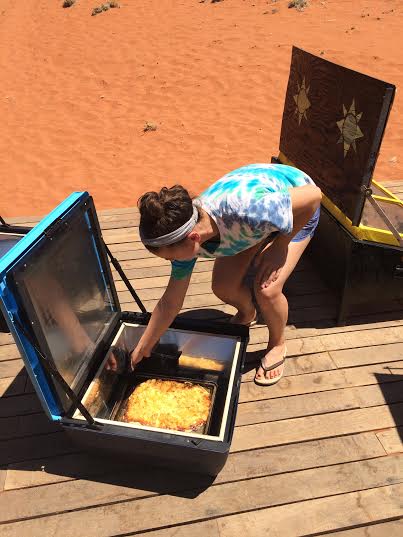
The true fun began around lunch time, where we prepared food as a community and made homemade pizzas in the solar ovens. The fierce Namibian sun fueled the solar ovens and naturally, eliminates the use of gas, electricity, or wood and produces zero pollution (solar cookers baking our homemade pizzas and the end result shown in the pictures).

After a walking tour of the dunes, observing the tracks and droppings of the diverse ecology and wildlife in the desert, and sand boarding, we finally caught the breathtaking stars!  Namibia’s NamibRand Nature Reserve, which is one of Africa’s largest nature reserves, remains one of the naturally most dark places on Earth. NaDEET aims to protect the environment and educate guests, and this includes understanding how we have contributed to all forms of pollution. Attached is a link shared at NaDEET of a short video called “Losing the Dark” by the International Dark Sky Association regarding light pollution and solutions. https://youtu.be/dd82jaztFIo

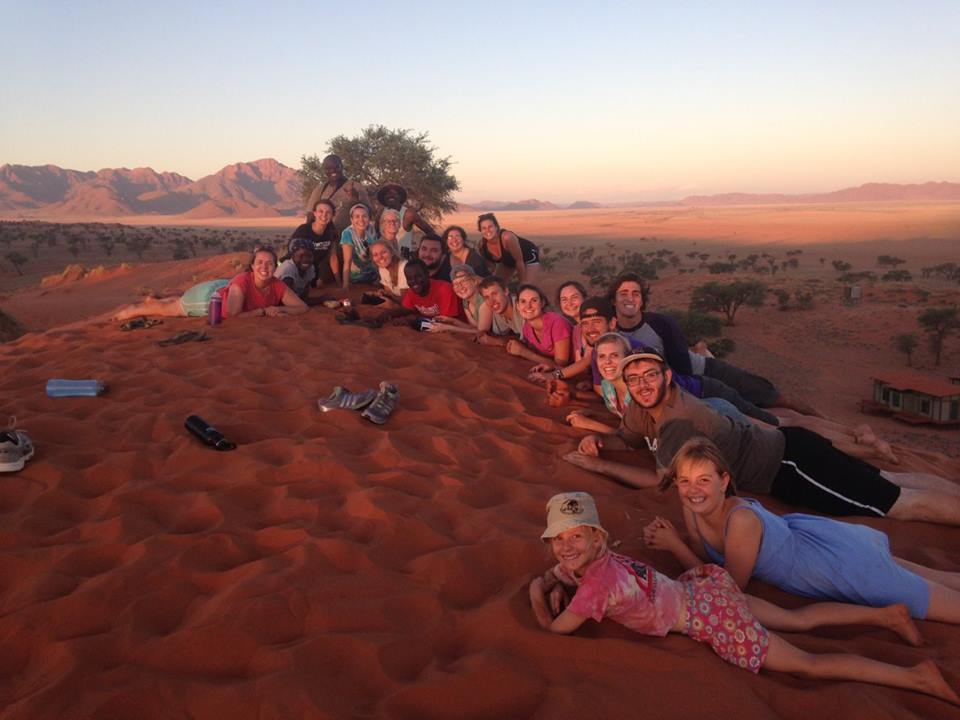
CGEE students after a successful evening sand boarding
in the stunning Namib Desert.
Our group was split up along three different houses, therefore when the weekend came to a close we were elated to compare our water and electricity usage with our friends (a good ol’ competition was a great way to spark environmentally sustainable habits!) Upon returning to Windhoek, we reflected on ways we can promote sustainable living but also practicing what we learned. Some are proposing solar cooking to their internships to combat the issue of expensive electric bills as some of us are researching dual flush toilets. The program was the perfect balance between educational and entertaining!

In short, during our visit to Heroes’ Acre and NaDEET, we learned to think critically about issues of memorializing a country’s history, in addition to more contemporary questions on how to build a sustainable and environmentally conscious society. In both cases, there is an inherent politicization that is ultimately involved in the process, whether that be foreign outbidding in the construction of a national monument or access and availability of environmentally friendly practices. As we learned at NaDEET, the only way to truly make a difference as a socially conscious community is to actually practice what we learn; through an increase in knowledge comes a responsibility to create spaces of dialogue that address these issues.

Wednesday, March 23, 2016

Week Seven: The Forgotten Genocide & (Sweaty) Sustainability Under the Desert Sun

by: Emily Simpson, Ashly Brun & Beatrice Misher

The Forgotten Genocide

Have you ever heard of the Herero Genocide? Chances are you probably have not. Understanding the reasons why this history is often neglected in our classrooms  is something that we have had to come to terms with. This week in our history class, we spoke to Uranaani Mantundu, a genocide scholar, whose ancestors escaped the very genocide we are discussing.

According to Mr Mantundu, The Herero genocide occurred  between 1904 and 1909, but is often referred to as the German-Herero colonization. The ideology behind German settler colonialism stemmed from the idea of spreading the wealth and seed of Germans to the land known today as the Erongo region of central Namibia. The German colonization of South West Africa was built on these colonialist ideas and also served as a response to overpopulation and poverty of Germany in the late 1800s. After a period of time of  what Mr Mantundu called  “slow colonization,” the settlers became restless for their promised land. However, central Namibia was already home to the established empire of the Ovaherero people. In the beginning, the Herero people maintained control over their land by renting it out to German settlers. The Germans violently sought to take over this land through means such as ambush attacks on the Herero people and rape of Herero women. Under General von Trotha, the German colonists began the systematic annihilation of the Ovaherero people. As a form of resistance, the Ovaherero people fought back to reclaim their land, but were ultimately  victims of genocide. Through a propaganda campaign in Germany portraying the Herero people as dangerous savages, a wave of racist sentiment spread throughout the country resulting in the official declaration of war against the Herero people. As a result, von Trotha issued an extermination order to kill any Herero man, woman, or child, armed or not, who was found within German colonial territory. Any Herero person who was not killed during the war was subsequently rounded up into concentration camps, some of which were labor camps and some, like Shark Island off the coast of the town of Luderitz, were strictly death camps. By the end of the genocide in 1909, approximately 65,000 Herero people had been killed. Many still lay in unidentified mass graves that are used today as ATV tracks for tourists in the Swakopmund area.

After this lesson and our new knowledge of this genocide, the German influence here in Windhoek, such as street signs in German, made us think harder about the historical context of the city we are living in. Today, the Herero people are asking the German government to acknowledge this genocide and pay reparations of $2 billion. According to Mr. Matundu, in the US, 48 of 50 states have officially recognized the Armenian genocide, yet none have done so for Namibia. While horrifying, the silence of this genocide was not surprising given the western lense through which our history is taught. Why do we selectively choose whose genocides to remember? There is a specific narrative chosen that neglects the stories of black and brown bodies, and their stolen land. Only through decolonizing our minds can we acknowledge forgotten history, and allow the voices of the oppressed to be heard.

(Sweaty) Sustainability Under the Desert Sun

The following weekend we traveled to the Namib Desert Environmental Education Trust (NaDEET) to camp sustainably in the middle of the oldest desert in the world. Upon arriving, we made our way to the main building for a solar cooked dinner and a brief orientation of NaDEET. Viktoria, the founder, explained that NaDEET is focused on providing environmental education to Namibians and promoting sustainable lifestyles. In addition to education, Viktoria also explained that NaDEET believes in practicing what they preach, and therefore the entire center is as sustainable as possible. It is fully equipped with solar cookers and ovens, an extensive recycling and compost system, solar electricity, and bucket showers to promote water conservation. I was amazed by NaDEET’s ability to build a nearly 100% sustainable organization in the middle of an inhospitable desert with limited access to necessary resources. If NaDEET can do it so well, why can’t the rest of the world?
9027d287-5c34-4236-8f0c-469484bee786.jpg
As the sun burns the back of her legs, Beatrice
realizes that the same sun can be used to
beautifully cook a vegetarian pizza.
The next day, we woke up early to embark on a dune hike before the scorching heat took control. As we crawled up the bright orange sand dunes, we stopped to identify different tracks in the sand and learn about the survival mechanisms of the animals and insects. The sun was scorching by the time we finished up our hike, creating perfect conditions to cook our lunch in the solar ovens. After feasting on our pizzas, we spent the rest of the day hiding from the heat, planting native trees, and experiencing our first Namibian sun-downer, which involved us dune boarding as the sun set. It was the perfect ending to our long and educational day-- an evening full of laughter, sand-beards, and the reminder that the natural world can provide us with overwhelming amounts of joy. We ended the day with an astronomy lesson as we gazed up at Africa’s first International Dark Sky Reserve, learning about different constellations and squealing over every shooting star. 

As an environmental studies major, I've thought a lot about how to effectively demonstrate the need to live sustainably, and I've become very frustrated by my lack of a solution. However, this weekend at NaDEET helped me realize a major theme in promoting environmental consciousness: access. In order to get to NaDEET, we drove through dozens of dried-up river beds and hiked through sand dunes that provided views of a water-empty landscape, demonstrating that we did not have easy and plentiful access to water. Consequently, water instantly became more valuable and we all became conscious of our water use. The location of NaDEET, and the limited access to water that comes along with it, makes it the perfect place to teach water conservation and other sustainable practices. But the instant we gain more access to resources, we forget the importance of conservation. 

10565206_10153632678973935_892668656047346881_n.jpg
Ohana in the desert
This is a large issue with conservation at home in the US, and also at our house in Windhoek. In most places in the United States, there is an abundant access to water, causing people to mindlessly run the tap. Even in dry areas, such as the Southwest, we have manipulated natural waterways to provide an endless supply of water to deserts. This has seemingly provided us with too much access to water, creating a disconnect between us and our natural resources, and thus diminishing our value of water. The same is true in Windhoek, which is in the middle of a huge water crisis. Despite the drought, water magically pours out of our faucets, falsely making it seem as if we have unlimited access to water. This contradiction can make it extremely challenging to understand the value of resources.

But thanks to NaDEET, we were fortunate enough to fully understand the importance of sustainable living. Therefore, when we arrived back at our home in Windhoek, we all got together for our community meeting and discussed our plans for living more sustainable lives. If NaDEET is able to inspire this same reaction in all their visitors, they are effectively changing the environmental mindset of Namibia.

P.S. We also visited the water treatment plant here in Windhoek that transforms our sewage into drinking water but we are legally bound to not disclose this information. Bye.