Showing posts with label sustainability. Show all posts

Sunday, December 3, 2017

Amidst the Stress and Sand

By Maddie Dilday
As we approach our last few weeks in Namibia, we are all doing our best to finish final papers, pull our integrative projects together, and still enjoy our time in this beautiful country. While this can be a very enjoyable experience, I think almost everyone is feeling some sort of stress. But in the middle of all this stress, comes our final group trip to NaDEET. NaDEET is short for Namib Desert Environmental Education Trust. Essentially, it is a small oasis in the middle of the Namib Desert Nature Preserve, where they teach about environmentally sustainable living, all while living out this life. And for a few short days we got to live it out with them.
 
There are 3 major moments throughout the trip that I know will stay with me. The first of which is the dune walk that we took just outside of NaDEET. In total the hike was about 6 km, 3 both way, and we walked throughout the dunes outside of the NaDEET. On this walk we were able to see the amount of biodiversity that the dunes of Namibia hold. The majority of the diversity is on a small scale, specifically they have a large diversity in the types of bugs that the dunes hold. I found this fascinating as biodiversity is a topic that I have often heard about in class, but that I rarely have had the chance to see. Although the creepy crawlies were just that, creepy and crawly, the dune walk was an amazing experience that I am hoping to have the opportunity to do again once I am back in the United States.


Above is a picture of a Dancing White Lady Spider that was
seen on the dune walk. It received this name due to the
"drumming" patter it leaves in the sand in the morning.

The next activity on the itinerary for the weekend that blew my mind was the drive to a nearby mountain, as well as the hike up the mountain. The drive was gorgeous, it was one of those moments where you are stunned by the beauty that Earth holds, and you think about just how small you are, and how much of this beauty that you have yet to see. Having the opportunity to see the Namib Desert in this way is one of the highlights of my entire trip and I hope that I am one day able to return to this beautiful country.

 
The final activity that we had at NaDEET was by far my favorite. The entire group went out to the top of a near by dune, and we star gazed for about an hour. NamibRand is one of the few International Dark Sky reserves, and a top tier reserve at that. As an Astronomy major, having the chance to see the night sky with such clarity was out of this world. I wish I had been able to capture the view of the stars, galaxies and dust that could clearly be seen in the dark night sky, but unfortunately my phone's camera isn’t strong enough. But, it is an image that I will remember for the rest of my life.
This picture was taken on the drive to the mountain range.
This country's beauty just does not end.


Overall, NaDEET was a interesting and enjoyable break from the stress of the final papers that are piling up at the end of the semester. Although we only have 2 weeks left, I am sure that they will be packed with as many adventures as possible.


Monday, November 21, 2016

Week Seven: Nujoma and the Namib

by Lolita Schalekamp and Hannah Johnson

Reflecting back on the week that just ended, we have to appreciate the various ways in which we’re able to learn here at CGEE. This week alone, among many other field trips, we had the opportunity to visit one of Namibia’s most important monuments and think critically about the problematic ways in which a nation’s history can be represented. Before the week’s end, we also got to travel into the world’s oldest desert to learn about sustainable living.

At beginning of the week, our group had the opportunity of visiting the Heroes’ Acre outside Windhoek. This monument honors the heroes and heroines of the liberation struggle in Namibia, and operates for the purpose of “fostering a spirit of patriotism and nationalism, and to pass on the legacy to the future generations of Namibia.” We learned that this site is not only a memorial, but also hosts many events, particularly army demonstrations. Heroes’ Acre currently contains 174 tombs for the courageous men and women in the fight for independence. Not all of the tombs are filled, but as the heroes pass away, spaces will be reserved for them.

One of the questions that arose from our tour was what are qualifications in choosing who gets to be buried at Heroes Acre? As our tour guide explained, the criteria was not always transparent, as many families of leaders in the liberation struggle would like for their loved ones to be buried at the monument. Indeed, this process has sparked controversy within some circles.

Statue of the Unknown Soldier at Heroes Acre
The monument itself consists of a marble obelisk and a bronze statue of the “Unknown Soldier.” Upon seeing the statue, its resemblance to Sam Nujoma is striking. Although our guide stated that the soldier is not modeled after anyone in particular, the statue has come under criticism for being a tribute to Sam Nujoma himself. Since Nujoma is the founding president of the independent nation, along with being the initiator of Heroes’ Acre, this theory seems relevant.

Another one of the group’s iniquities regarded the architecture of Heroes’ Acre. Compared with other monuments in Namibia, the architecture felt foreign. The grandiose nature of the obelisk is characteristic of Stalinist Empire style or Socialist Classicism. After some research, we learned that North Korea was given a N$60 million contract to build the monument. This has rightfully made many ask: where were the Namibian architects in the construction of their ‘national’ monument?

This leads to the next point: the collaboration of world leaders in the struggle for Namibian independence. As a part of Racism and Resistance class, we became increasingly aware of the parallel development of the SWAPO/SWANU political ideology alongside the PLAN military wing. North Korea’s support of the liberation movement is not as surprising as one might perceive. In fact, many communist nations such as the USSR, Cuba, and North Korea contributed aid to the Communist Party in Namibia, which in turn has strong ties to SWAPO’s formation. This could be interpreted as geopolitical strategy of Communist countries in the context of the Cold War, or from the Namibian perspective, a lack of support from international governing bodies such as the United Nations.

Namib Desert Environmental Education Trust (NaDEET)
As the weekend approached, we packed our sleeping bags, lathered ourselves in sunscreen, and trucked our way toward the desert where we had the privilege to stay at the Namib Desert Environmental Education Trust (NaDEET) Centre. NaDEET lies in the dune valley of the Namib Desert and serves as a place for people of all ages, but more specifically school children, to properly practice eco-sustainability. NaDEET is a non-profit, non governmental organization whose mission is to protect the natural environment of Namibia by educating its citizens to practice sustainable lifestyle. We were immediately greeted by the warm sun and soft sand, where we hiked over a few dunes to reach our base.  

Spectacular sand waves in the Namib Desert!
The entire weekend was full of fun and hands-on learning. We discussed sustainable energy and water, where we monitored our water use and discovered that the centre was fueled by solar energy, discussed waste management and nature conservation. Water conservation was one of the largest topics of conversation. It is undeniable that water is the basis of all life on Earth, however Namibia has a limited freshwater supply and labeled one of the most dry countries in sub-Saharan Africa. Being in Southern Africa, we have learned to be more mindful of our water use and waste. NaDEET introduced a variety of ways to reduce our water use, including implementing bucket showers. The bucket showers reduce shower time and water waste. We have returned to CGEE house with the mindset to take shorter showers and investigate what it would take to have dual flushing toilets. In fact, the average toilet flush uses over ten litres of water per flush. If we introduce a low flush or dual flush toilet in our home, we would reduce our water waste by 2-3 liters of water each flush. As discussed at NaDEET, in a five person household, this can lead to saving nearly 200 liters of water per week!

The delicious end result!
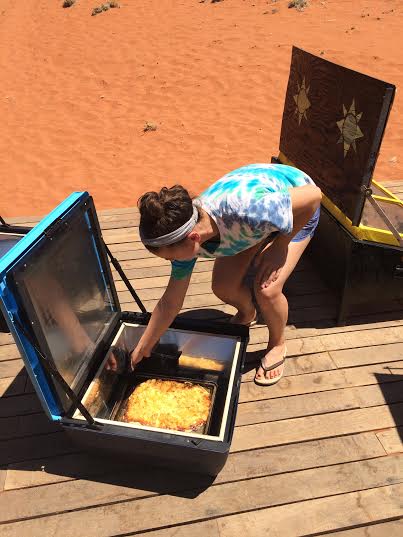
Our homemade pizzas cooking
in the solar ovens! 
The true fun began around lunch time, where we prepared food as a community and made homemade pizzas in the solar ovens. The fierce Namibian sun fueled the solar ovens and naturally, eliminates the use of gas, electricity, or wood and produces zero pollution (solar cookers baking our homemade pizzas and the end result shown in the pictures).

After a walking tour of the dunes, observing the tracks and droppings of the diverse ecology and wildlife in the desert, and sand boarding, we finally caught the breathtaking stars!  Namibia’s NamibRand Nature Reserve, which is one of Africa’s largest nature reserves, remains one of the naturally most dark places on Earth. NaDEET aims to protect the environment and educate guests, and this includes understanding how we have contributed to all forms of pollution. Attached is a link shared at NaDEET of a short video called “Losing the Dark” by the International Dark Sky Association regarding light pollution and solutions. https://youtu.be/dd82jaztFIo

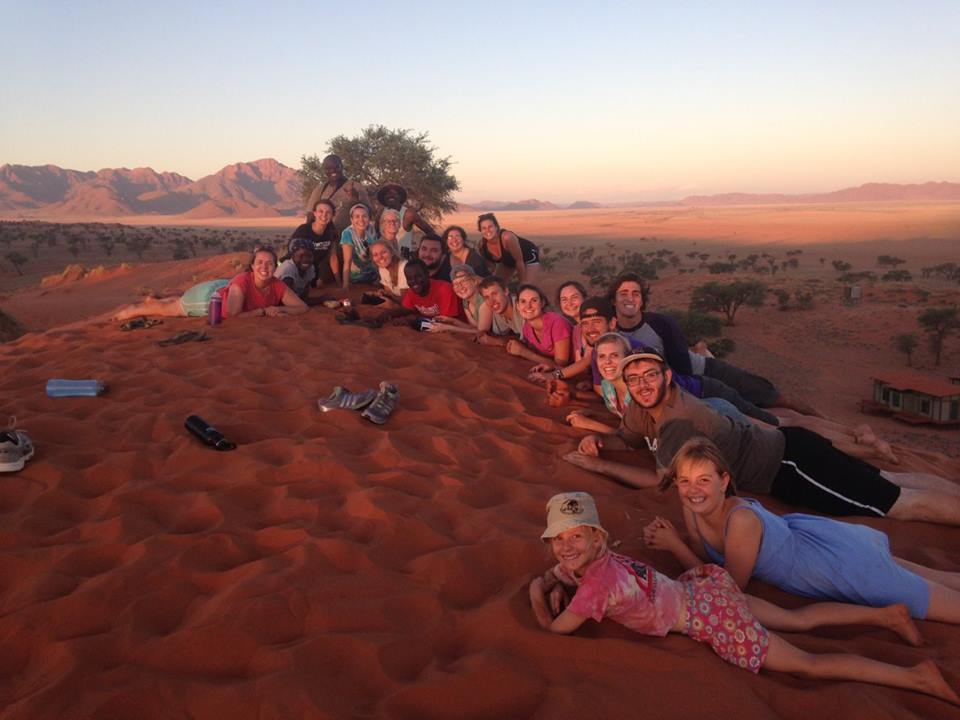
CGEE students after a successful evening sand boarding
in the stunning Namib Desert.
Our group was split up along three different houses, therefore when the weekend came to a close we were elated to compare our water and electricity usage with our friends (a good ol’ competition was a great way to spark environmentally sustainable habits!) Upon returning to Windhoek, we reflected on ways we can promote sustainable living but also practicing what we learned. Some are proposing solar cooking to their internships to combat the issue of expensive electric bills as some of us are researching dual flush toilets. The program was the perfect balance between educational and entertaining!

In short, during our visit to Heroes’ Acre and NaDEET, we learned to think critically about issues of memorializing a country’s history, in addition to more contemporary questions on how to build a sustainable and environmentally conscious society. In both cases, there is an inherent politicization that is ultimately involved in the process, whether that be foreign outbidding in the construction of a national monument or access and availability of environmentally friendly practices. As we learned at NaDEET, the only way to truly make a difference as a socially conscious community is to actually practice what we learn; through an increase in knowledge comes a responsibility to create spaces of dialogue that address these issues.

Saturday, April 30, 2016

Week Thirteen: Decolonizing our Minds in the “Little Germany” of Namibia

by Luke Beasley, Olivia Cook, and Siri Ericson

Last weekend was spent in the coastal city, Swakopmund, studying foreign investment, colonialism, and the 1904-1908 genocide. The city provided a stark contrast from Windhoek with its distinctly German colonial architecture, cool and humid weather, and array of coffee shops. Overall, our week was filled with new, challenging, and eye-opening experiences as we toured the Walvis Bay Export Processing Zone, Marine Denkmal monument, NamPort, Namibian Dolphin Project, and more.

Here is the controversial Marine
Denkmal monument commemo-
rating German soldiers who died
during the German colonization.
Our first full day in Swakopmund was spent with the political activist, Laidlaw Peringanda. Peringanda took us to the Marine Denkmal monument, a monument that stands in the center of town commemorating German soldiers who died during German colonization. The statue has been criticized for listing the names of German soldiers that committed atrocities against the indigenous peoples and has recently been doused in red paint symbolizing the blood of the thousands of people that were killed by the Germans. Although Peringanda and other activists have lobbied for its removal, the government and community have remained largely resistant to these demands. Throughout the tour, we were continually reminded of the intricate history between Germany and Namibia and the legacy of colonialism that exists today. As we learned about the brutal colonization and genocide of indigenous peoples, we were uncomfortable watching tourists smile and take photos before these statutes without recognition of the violence and injustices these statues represent. 

In this photo you can see the unmarked gravesites of the
OvaHerero/OvaMbanderu people who died during the genocide
of 1904-1908. In the background you can see houses upwards
of 6 million dollars overlooking the mass graves.
Continuing with our critical, decolonial, activist-led tour of Swakopmund, we walked through the gravesite of thousands of OvaHerero/OvaMbanderu people who were killed in the 1904-1908 genocide. The gravesite was clearly divided between a German gravesite neatly marked with tombstones and flowers and a plot of land where the indigenous people had been buried without tombstones. Te mounds of dirt where people were buried almost a century ago can still be seen. There is one single monument commemorating the OvaHerero/OvaMbanderu people who died under “mysterious circumstances”, signifying the government’s slow response in acknowledging the genocide that took place, and another monument in the corner of the gravesite, as far from the German housing settlement as possible. Walking through the gravesite, we imagined what it would be like to live in German houses upwards of 6 million dollars, built over indigenous land and graves, overlooking the graves of thousands of people who died in the genocide. As ATV’s fly by the gravesite without having to be confronted by an inconvenient history, we wondered how individuals teach themselves about this history, as the history of genocide and colonization is largely erased by the public school system and erased as homes are literally built over mass graves that remain unprotected by the government. 

Here is one of the large cargo
vessels that transports goods
from all over the world. I felt
incredibly small next to its
physical size of the vessel and
global implications of trade.
The next day, we started our foggy and overcast Friday morning traveling to the nearby town of Walvis Bay to visit the management company for the Export Processing Zone (EPZ). An EPZ is a free trade zone where companies are allowed to avoid paying taxes to the government on the condition that they are manufacturing a product and exporting the entire product. The idea behind an EPZ is to bring foreign investment into the country in hopes of developing it more by providing favorable conditions for business investors. While there is significant investment coming into the EPZ, many argue that it only minimally benefits Namibia. Our speaker, Jan Kruger, mentioned the EPZ only creates  300 jobs, and the government receives no money from taxes. Namibia’s high unemployment makes 300 new jobs a positive, but for a project that is supposed to help “develop” Namibia it is relatively insignificant. After the presentation about Namibia’s EPZ we had a tour of Namport, a large port in Walvis Bay where goods are loaded and unloaded from container vessels that travel distances ranging from South Africa to Europe. Something we noticed at Namport was dredging, a process of moving sand from the seabed to improve functionality of waterways for the port’s ships and to expand the port. It was very clear that this was an industrial zone from rows upon rows of shipping containers that are usually unloaded and reloaded onto cargo ships within 24 to 48 hours of arrival. Namport’s physical size is very large, but its influence reaches far into central Africa; many of the goods that pass through Namport are sent to landlocked countries in Africa.

Here is the Namibian Dolphin
project. It is a small little
building on the waterfront in
Walvis Bay near a couple little
shops and a nice cafe. Our
speaker was from Ireland
and has been in Namibia
for a year studying dolphins
and the environment.

After our tour, we enjoyed a walk along a beautiful lagoon and hundreds of flamingos. The lagoon is a UNESCO World Heritage Site, but slightly north is the industrial zone that creates an ugly backdrop unfitting to the natural beauty of the lagoon. While the development does not aesthetically complement the flamingos, it has also harmed the environment and slowly encroached on the Heritage Site. Later when we visited the Namibian Dolphin Project to learn about Namibian dolphins and human impact in the area. For example, we learned about how the constant noise of dredging has harmed the dolphins’ abilities to rely on sound to communicate and hunt. Overall, the day was full of interesting visits and we experienced the juxtaposition between the coast’s industry and nature. We learned about two points of view about industry in Namibia: Economically, the port has provided jobs vital to imports for Southern Africa, but environmentally the industry that is helping the economic environment is damaging the natural one. 

On Saturday, we were given a free day to do what we wanted around Swakopmund. About half the group decided to conquer our fears and go skydiving. It was a nervous twenty minute flight up to 10,000 feet where we were quickly moved to the door with our guide. In a heart-stopping and adrenaline-filled 30 seconds we fell for thousands of feet before our parachute deployed. As the parachute slowed our momentum and we drifted to the ground and were able to fully appreciate the magnificent view that the Namib Desert meeting the Atlantic Ocean provided. It was an incredible ending to a trip that in a few short days gave us so many varied and valuable learning experiences.

Thursday, April 28, 2016

Week Ten: Confronting Contradictions

by: Sydney Wipperfurth, Rich Wehman III, Emily Simpson

Following our rewarding weeklong rural homestay, the CGEE students were off for another Namibian adventure! Our group had the privilege of visiting Etosha National Park, which is located in northwestern Namibia and widely considered to be one of the world’s finest game reserves. In the company of Ovambo traders (who probably discovered this region before the Europeans, but who writes history amirite?), Europeans Charles Andersson and Francis Galton “first discovered” the region in 1851 (http://www.etoshanationalpark.org/history). Etosha is loosely translated as “Great White Place” in the Ovambo language because of a massive mineral pan, part of the Kalahari Basin that covers around 25% of the national park. Renowned as one of Africa’s finest conservation areas, Etosha serves as a refuge for large herds of plains’ animals, several rare and endangered species, and richly diverse birdlife. This beautiful national park has a plethora of springs and waterholes where an abundance of wildlife typically congregates. The animals of Etosha are of the southern savanna plains of Africa, and large herds of springbok, zebra, gemsbok, blue wildebeest, giraffe, and elephant roam the plains. The numbers of animals can vary considerably depending on factors such as migration patterns, the condition of the veld, and the availability of water. 

One highlight of the trip would have to be when our group visited the Okaukuejo waterhole, noted as one of the best watering holes during the dry season. All of the students saw elephants, springbok, Burchell’s zebra, and giraffe, amongst others, during our short, yet eventful visit to the site. Perhaps the most exhilarating moment of the game drives occurred when the group spotted a cheetah far off into the distance. Although Namibia boasts one of the world’s largest populations of free roaming cheetah, there are a relatively small number of them found in Etosha. Our group was fortunate enough to witness this beautiful animal gracefully trot towards our vehicle, truly a breathtaking experience!
Etosha National Park during the drought in Namibia

After our game drives, we arrived at the Mokuti Lodge, where we would be staying for the night; our group was welcomed with wet towels and glasses of grape juice (the wet towels were welcome relief from the brutal heat making us feel like we were melting). After entering the front doors, we discovered the lodge was outrageously extravagant. A vast juxtaposition to our experience a week prior, when we got off of the vans in Outapi, Namibia to the warm and welcoming smiles of our rural host-families. This juxtaposition stemmed from the extreme differences in resource availability and resource accessibility. Our rural homestay families, while there was variance, had significantly limited access to basic amenities like running water or electricity, if any at all. The Mokuti Lodge had air conditioning, running water, electricity, television, a pool, and a full, expensive, buffet for dinner, to name a few.

The differences in these environments stirred many conversations, questioning and critiquing the privilege that each of us possess. Although we understand that the program usually stays at a campsite in Etosha and that there were no spots open, the fact that we had the ability to stay in the lodges shows the mobility and privilege we have access to. We were able to choose to live the life of our families in rural Namibia, however, a week later, were able to leave that environment and exchange it for a much more excessive lifestyle in Etosha. The ability to make this transition felt heavy as we reflected our incredible experiences at our homestays and on the stark contrast between the two lifestyles we were living. 

Richard taking a little nap
so he has enough energy to
look at the beauty of
Etosha National Park!
Furthermore, our stay at the lodge highlighted an excessive use of resources, namely water, providing a dramatic contrast between our previous week at our homestays. For instance, during our homestays, many students noticed that their families use water extremely sparingly, ensuring that every single drop is being used. Given the current drought that is affecting Southern Africa, our families did not have much of an option for their water use. However, we were surrounded by water when we arrived at our lodge. All of our rooms had large, luxurious showers, seemingly enticing all visitors to take lengthy showers (tip to the folks back home: shorten your showers!) Additionally, the lodge had TWO pools, filled with the same water that had been so precious and valuable to us just one day ago.

However, we did not experience a dramatic ecosystem change from our homestays to Etosha. If anything, Outapi, with its green grasses and trees, seemed to have more water than the dry landscape of Etosha. So where was all this water coming from? I cannot even begin to imagine how much water is consumed per day at the lodge, and consequently how quickly the groundwater is being depleted. Given everything we have learned about the drought severity in Namibia, this groundwater depletion is especially concerning. Yet this resource depletion is the reality for many tourist destinations, where lodges are focused on ensuring that visitors are comfortable- even at the cost of the environment. 

An intentional community of elephants in Etosha National Park
In the context of Etosha, this reality is especially frustrating, since Etosha provides visitors with an opportunity to appreciate nature and all the wildlife diversity it has to offer. Etosha itself is notable for its conservation efforts, and yet visitors oftentimes live in a contradictory manner. This inconsistency makes it seems as if we are only focused on protecting ecosystems when it is for our own benefit, such as the recreational opportunities provided by game reserves.

These spaces we were existing in were complicated and contradictory. They forced us to reflect on and complicate our environment. But doing so is never an easy task. Although our environment was physically comfortable, confronting these contradictions is extremely uncomfortable and emotionally heavy. But it is also important to acknowledge these feelings, so that we are better able to understand our role in this world.

Wednesday, March 23, 2016

Week Seven: The Forgotten Genocide & (Sweaty) Sustainability Under the Desert Sun

by: Emily Simpson, Ashly Brun & Beatrice Misher

The Forgotten Genocide

Have you ever heard of the Herero Genocide? Chances are you probably have not. Understanding the reasons why this history is often neglected in our classrooms  is something that we have had to come to terms with. This week in our history class, we spoke to Uranaani Mantundu, a genocide scholar, whose ancestors escaped the very genocide we are discussing.

According to Mr Mantundu, The Herero genocide occurred  between 1904 and 1909, but is often referred to as the German-Herero colonization. The ideology behind German settler colonialism stemmed from the idea of spreading the wealth and seed of Germans to the land known today as the Erongo region of central Namibia. The German colonization of South West Africa was built on these colonialist ideas and also served as a response to overpopulation and poverty of Germany in the late 1800s. After a period of time of  what Mr Mantundu called  “slow colonization,” the settlers became restless for their promised land. However, central Namibia was already home to the established empire of the Ovaherero people. In the beginning, the Herero people maintained control over their land by renting it out to German settlers. The Germans violently sought to take over this land through means such as ambush attacks on the Herero people and rape of Herero women. Under General von Trotha, the German colonists began the systematic annihilation of the Ovaherero people. As a form of resistance, the Ovaherero people fought back to reclaim their land, but were ultimately  victims of genocide. Through a propaganda campaign in Germany portraying the Herero people as dangerous savages, a wave of racist sentiment spread throughout the country resulting in the official declaration of war against the Herero people. As a result, von Trotha issued an extermination order to kill any Herero man, woman, or child, armed or not, who was found within German colonial territory. Any Herero person who was not killed during the war was subsequently rounded up into concentration camps, some of which were labor camps and some, like Shark Island off the coast of the town of Luderitz, were strictly death camps. By the end of the genocide in 1909, approximately 65,000 Herero people had been killed. Many still lay in unidentified mass graves that are used today as ATV tracks for tourists in the Swakopmund area.

After this lesson and our new knowledge of this genocide, the German influence here in Windhoek, such as street signs in German, made us think harder about the historical context of the city we are living in. Today, the Herero people are asking the German government to acknowledge this genocide and pay reparations of $2 billion. According to Mr. Matundu, in the US, 48 of 50 states have officially recognized the Armenian genocide, yet none have done so for Namibia. While horrifying, the silence of this genocide was not surprising given the western lense through which our history is taught. Why do we selectively choose whose genocides to remember? There is a specific narrative chosen that neglects the stories of black and brown bodies, and their stolen land. Only through decolonizing our minds can we acknowledge forgotten history, and allow the voices of the oppressed to be heard.

(Sweaty) Sustainability Under the Desert Sun

The following weekend we traveled to the Namib Desert Environmental Education Trust (NaDEET) to camp sustainably in the middle of the oldest desert in the world. Upon arriving, we made our way to the main building for a solar cooked dinner and a brief orientation of NaDEET. Viktoria, the founder, explained that NaDEET is focused on providing environmental education to Namibians and promoting sustainable lifestyles. In addition to education, Viktoria also explained that NaDEET believes in practicing what they preach, and therefore the entire center is as sustainable as possible. It is fully equipped with solar cookers and ovens, an extensive recycling and compost system, solar electricity, and bucket showers to promote water conservation. I was amazed by NaDEET’s ability to build a nearly 100% sustainable organization in the middle of an inhospitable desert with limited access to necessary resources. If NaDEET can do it so well, why can’t the rest of the world?
9027d287-5c34-4236-8f0c-469484bee786.jpg
As the sun burns the back of her legs, Beatrice
realizes that the same sun can be used to
beautifully cook a vegetarian pizza.
The next day, we woke up early to embark on a dune hike before the scorching heat took control. As we crawled up the bright orange sand dunes, we stopped to identify different tracks in the sand and learn about the survival mechanisms of the animals and insects. The sun was scorching by the time we finished up our hike, creating perfect conditions to cook our lunch in the solar ovens. After feasting on our pizzas, we spent the rest of the day hiding from the heat, planting native trees, and experiencing our first Namibian sun-downer, which involved us dune boarding as the sun set. It was the perfect ending to our long and educational day-- an evening full of laughter, sand-beards, and the reminder that the natural world can provide us with overwhelming amounts of joy. We ended the day with an astronomy lesson as we gazed up at Africa’s first International Dark Sky Reserve, learning about different constellations and squealing over every shooting star. 

As an environmental studies major, I've thought a lot about how to effectively demonstrate the need to live sustainably, and I've become very frustrated by my lack of a solution. However, this weekend at NaDEET helped me realize a major theme in promoting environmental consciousness: access. In order to get to NaDEET, we drove through dozens of dried-up river beds and hiked through sand dunes that provided views of a water-empty landscape, demonstrating that we did not have easy and plentiful access to water. Consequently, water instantly became more valuable and we all became conscious of our water use. The location of NaDEET, and the limited access to water that comes along with it, makes it the perfect place to teach water conservation and other sustainable practices. But the instant we gain more access to resources, we forget the importance of conservation. 

10565206_10153632678973935_892668656047346881_n.jpg
Ohana in the desert
This is a large issue with conservation at home in the US, and also at our house in Windhoek. In most places in the United States, there is an abundant access to water, causing people to mindlessly run the tap. Even in dry areas, such as the Southwest, we have manipulated natural waterways to provide an endless supply of water to deserts. This has seemingly provided us with too much access to water, creating a disconnect between us and our natural resources, and thus diminishing our value of water. The same is true in Windhoek, which is in the middle of a huge water crisis. Despite the drought, water magically pours out of our faucets, falsely making it seem as if we have unlimited access to water. This contradiction can make it extremely challenging to understand the value of resources.

But thanks to NaDEET, we were fortunate enough to fully understand the importance of sustainable living. Therefore, when we arrived back at our home in Windhoek, we all got together for our community meeting and discussed our plans for living more sustainable lives. If NaDEET is able to inspire this same reaction in all their visitors, they are effectively changing the environmental mindset of Namibia.

P.S. We also visited the water treatment plant here in Windhoek that transforms our sewage into drinking water but we are legally bound to not disclose this information. Bye.