Showing posts with label swakopmund. Show all posts

Tuesday, May 29, 2018

Our Last Trip Out of Town

By Hal W.

We jumped into our CGEE van as a group for the last time last Thursday. This weekend we went to Swakopmund and Walvis Bay, two coastal towns on the mighty Atlantic ocean. The sun was shining and the air smelled like salt water. Swakopmund is a beautiful city, it is one of the main tourist attractions in Namibia, for both foreigners and native Namibians. I have learned throughout my semester here that Swakopmund is where a lot of Namibians go for vacations and holidays. Swakopmund has a busy season stretching from November to January. We were obviously not there during this time, so the city was often quiet.   
The controversial statue commemorating German soilders
We arrived mid-day on thursday. After lunch at the Art Cafe in downtown Swakopmund we met up with Laidlaw Peringanda who gave us a tour and history of the area. Swakopmund is similar to Luderitz in it’s dark history. Both coastal towns had concentration camps that held local Namibian tribes. They both also struggle with the recognition of these mass killings. In Swakopmund there is a monument commemorating the German soldiers who died in the area. These soldiers were also the oppressors and murderers of thousands of Herero and Nama people in the early 1900’s. The statue was defaced with red paint by local activists to bring awareness to the killings. Laidlaw is a local activist who has been trying to get Namibian and German officials to recognize the genocide, but has met much resistance. He has been offered bribes and threats because of his work to expose the true history of the area.  
Lamont telling us about the unmarked graves
Afterwards we went to a local graveyard. The graves of the white people were decorated with flowers and marble slabs, and a brick path meandered between them. Off away from the white section there was a single epitaph for the native people who died at the hands of the Germans. The plaque said that the natives died under “mysterious circumstances”, a clear example of the ignorance of the whites towards what has happened here.
Laidlaw and Lamont in front of Laidlaw's office in the DRC
 After the stop at the graveyard, Laidlaw took us to the township Mondesa, outside of Swakopmund, to the informal settlement called the DRC (Democratic Resettlement Community). He used to live in the DRC and now uses his old home as an office to teach people about the genocide. The office has pictures of dying and wounded Namibians from the time of the genocide. Laidlaw Peringanda is one of the few activists in the area who is trying to shed light on Swakopmund’s dark history.

We ended the day on a lighter note with an extravagant dinner on the shore at “The Tug” restaurant. I ordered a delicious seafood platter, and we drank wine and made merry until the sun went down.
The following day, Friday, we drove to Walvis Bay to have a tour of a fish processing plant called Seaworks. We geared up in white coats, big rubber boots, and hairnets and were taken throughout the building by Douglass, a higher up in the Walvis Bay fishing industry. The tour was interesting and informative, despite the fish smell and the cold working areas. Seaworks employs a lot of Namibians. The line workers, who would descale, chop, clean, and cut the fish were almost all women. While the forklifts, heavy machinery and supervisor positions were almost all men. The discrepancy between the two genders was clear. The role of gender in Namibian culture is strong, specifically the belief that men  and women are built to do different types of work, men doing heavy labor and women doing the more meticulous tasks.
Line workers [predominantly women] at the fish plant
 
After Seaworks we went down to the shore in Walvis Bay where we had lunch and looked out over the water, watching the tour boats come in and out of the port. After lunch we went to the Namibian Dolphin Project, a small, one-room building on the shore. We talked with the researchers there who were studying the dolphins of the area. They told us about the diverse range of animals they get in the area, and how the fishing and tourist industry often can hurt or confuse the animals. They have documented cases of dolphins getting too close to tour boats and getting badly wounded from the propeller of the motor. They are the only ones in Namibia who are studying these majestic creatures.
A handstand was needed at the top of Dune 7
After the Dolphin project we hopped into the van and drove to Dune 7. Dune seven is a famous dune outside of Walvis Bay. We had our traditional race up the dune, which I won. Being at the top of the dune was surreal and beautiful, the sand stretched all around us and we could see for miles. If you ever get the chance to go to Namibia, Dune 7 should be a top priority.
We ended the day by cooking a nice meal at home, our accomodation was slightly under-equipped for cooking but I made do. After the meal we all settled in and reminisced on the past two days, as well as making plans for our free Saturday.

Largest Quartz crystal cluster on display in the world
The next day we did not have anything planned for the group, so we all went our separate ways to a degree. Me and Alexis visited the Aquarium, the Gemstone museum, and a place we stumbled upon and named “Camel Land”. We were walking down a trail outside of town when we ran into around 30 camels grazing in the brush. It was an unexpected but very cool experience. The Aquarium is small but cool, it was nice to see what kind of creatures are just a mere hundred meters from where we were staying. But, the most fun thing we found on Saturday was the Gemstone museum. I am a sucker for gems and minerals so I was in awe as we browsed through the huge deposits of Amethyst, Malachite, Quartz, Sulphur, and Tourmaline. 
We wrapped up our time in Swakopmund with a reflection the following morning. We discussed the hardships people like Laidlaw have endured, while also talking about how we have a duty to continue the fight, even after we return home from Namibia. Swakopmund is a beautiful, salty, amazing, and historic town. I recommend it for a relaxing vacation on the ocean. But also I challenge any visitor to learn the true history of this place, the good and the bad.
The misty pier in Swakopmund, it was so foggy we couldn't see the shore when we
went to the end
 

Wednesday, November 29, 2017

Exploring waste management, Islam, and Swakopmund


By Michelle Andersen
 
20171106_094649.jpg
Windhoek waste management site
My week started with a visit to the waste management site with our environmental class. We got a talk from the leader of education, Estelle, and learned of her struggles as the only one in her department. The rest of her team and most of their resources were moved to a different government office, so she has issues getting educational materials about waste management to the local people. From what she told us, it seems as if the people do not know about the recycling program or the difference between the various types of waste bins. With a lack of resources, she is fighting an uphill battle. When we went to the waste site, the gorgeous backdrop of the mountains was covered by the piles of trash. They try to do some sorting of recyclable items on site but it can be a challenge. Most of the waste is simply flattened and covered with sand to keep it from blowing away. Waste management is a huge problem in Namibia with the lack of necessary infrastructure and education.

For religion class, we learned about one of Namibia’s minority religions, Islam. We discussed the five pillars; fasting, alms giving, praying five times a day, declaration of faith, and the pilgrimage to Mecca, if you can afford to. We got to visit the school that April, our Professor Lamont’s wife, is opening soon that is built on land that the mosque owns. April told us about her curriculum, values, and hopes for the school. The Sheikh Imam furthered our discussion by going into detail about the history behind the small Muslim population in Namibia, the effects of this, and Islamic beliefs. Islam is considered a way of life and should be reflected in a person’s every action. We ended with a tour around the mosque and seeing one of the daily prayers.
20171109_142346.jpg
Controversial monument depicting the German soldiers
who dies during the genocide

Additionally, this week we traveled to Swakopmund and Walvis Bay to learn about the historical and current issues there. Our tour guide was Laidlaw Peringanda, who is a Herero activist who is passionate about the Herero-Nama genocide by the Germans. In the town square, there is a monument to the German soldiers who died committing the genocide. The local Germans and their government are denying that there is a problem with this statue and refuse to take it down. Next, we went downtown to visit the cemetery,  where there is a large section of unmarked graves of those Herero and Nama people who were murdered during the genocides. The German government donated a plaque which refers to their deaths due to "mysterious circumstances," despite the heavy photographic and official documentation of a genocide order. There is even a wall surrounding the cemetery because people were building houses on graves. From Laidlaw’s tour we expanded what we learned in Lüderitz and saw again the lack of proper memorialization for the losses of the local people. 
 
20171109_144237.jpg
Namibian peoples memorial from the Germans referencing the
genocide as deaths due to "mysterious circumstances"
 We also took a tour of a fishing factory, which is a major part of the local economy. The factory is not running until Monday because no fishing is allowed during October to let the fish population to replenish. The ministry was late with announcing what each factory's new fishing maximum quota would be, which caused the delay. During October, the factory pays for employees to travel home as well as providing a bonus. There is competition from foreign boats who do not follow the same rules but they are not allowed to have a factory on-shore unless 51% of the employees are Namibians. From what our tour guide told us, it sounds like there are many regulations in place to try and create sustainable fishing as well as proper treatment for Namibians.

Later that day our group hiked the tallest dune in Namibia, Dune 7. It was a struggle to get up but the view was worth it. Overall, it was a great trip filled with discussions of social issues, the economy, and seeing the natural beauty in the area. This week covered a lot from environmental waste issues, Islam in Namibia, and the history in Swakopmund.
20171110_171732.jpg
Dune 7
 

From Ocean to Ocean

By Caroline Pratt
Appreciating the Durban skyline
Still recovering from the busy month of October, I was exhausted and excited about the last few trips of the semester. While all of the CGEE trips are great, some independent travel has made my study abroad experience so much more impactful. Last weekend I traveled to Durban, South Africa. One of the other students and I caught a plane after class on Friday and made our way to a city so different from Windhoek. Durban, a common tourist destination for South Africans, was like no other South African city we had visited so far. It was so diverse and full of surfers and beach goers. Walking around, I felt just like I was walking down the boardwalk of California. While we were just there for the weekend, we filled our time with people watching, eating the local cuisines like Bunny Chow (half a loaf of bread filled with curry, one of the most filling meals of my life), and spending time on the beautiful Indian ocean. We also visited the Moses Mabhida Stadium, constructed for the 2010 world cup, and the Ushaka Marine world, the largest aquarium in Africa. It was incredible to have the freedom the explore the city independently and see an entirely different part of South Africa, far different than what we had seen in Joburg, the Eastern Cape, or Cape Town.
 
Coming back on Monday, there was no time to waste with classes and internship Tuesday and Wednesday before the entire group left for Swakopmund. One of my highlights of the week though was visiting the local Mosque in religion. Being Catholic and never having the experience of going to a Mosque before, it was eye opening to see a place of worship that functioned very differently than my own. We spent most of the lecture learning about the history of Islam in Namibia and about the teachings of Islam. With the Muslim community making up such a small percentage of the Namibia population, it was cool to see how they functioned as a minority religion.
 

Becca and I enjoying the Swakopmund Atlantic Ocean
Come Thursday the group headed to Swakopmund, a coastal town on the Atlantic Ocean, known for its German architecture and beautiful beaches. On our first day, we took a tour around town where we saw the many lasting memorabilia to German colonialism. In the center of town, we saw a giant sculpture commemorating the fallen German soldiers and went to the glamourous German cemetery, located just next to the large resting place of the Herero and Nama that died during the genocide, with graves unmarked. In the very corner of the cemetery is the monument to the Hereros and Namas that was removed a few years prior because it ‘smelled’ and was moved back after it received some push back. We then saw the townships and where most of the population of Swakop lives. Laidlaw Peringanda, our tour guide and artists/activist, did a great job of providing a holistic view of Swakop and we saw it for what it was instead of the German tourist town that looks like it could be straight out of the German section of Epcot.
The second day of our trip we spent learning all about foreign investment in Namibia and conservation. We visited Sea Works, a Namibian run fishing factory. We learned about all of the laws and regulations put in place to ensure Namibia benefits from the industry such as 51% of all industry must be Namibian owned. Unfortunately, we went while the factory was closed because Namibia has a law that there can be no fishing done during the month of October. This was great though because it allowed time for employees to return home and still received compensation. Later that day we went to the Namibian Dolphin Project where the two employees were working to do research and help the local industries. 


Group photo during our ATV Dune trip in Swakopmund
On our free day, the entire team went ATVing all around the dunes and I spent the rest of the day enjoying life on the Atlantic. It was truly a week to remember, from the Indian ocean to the Atlantic in just seven days. Study abroad is something.

Saturday, April 30, 2016

Week Thirteen: Decolonizing our Minds in the “Little Germany” of Namibia

by Luke Beasley, Olivia Cook, and Siri Ericson

Last weekend was spent in the coastal city, Swakopmund, studying foreign investment, colonialism, and the 1904-1908 genocide. The city provided a stark contrast from Windhoek with its distinctly German colonial architecture, cool and humid weather, and array of coffee shops. Overall, our week was filled with new, challenging, and eye-opening experiences as we toured the Walvis Bay Export Processing Zone, Marine Denkmal monument, NamPort, Namibian Dolphin Project, and more.

Here is the controversial Marine
Denkmal monument commemo-
rating German soldiers who died
during the German colonization.
Our first full day in Swakopmund was spent with the political activist, Laidlaw Peringanda. Peringanda took us to the Marine Denkmal monument, a monument that stands in the center of town commemorating German soldiers who died during German colonization. The statue has been criticized for listing the names of German soldiers that committed atrocities against the indigenous peoples and has recently been doused in red paint symbolizing the blood of the thousands of people that were killed by the Germans. Although Peringanda and other activists have lobbied for its removal, the government and community have remained largely resistant to these demands. Throughout the tour, we were continually reminded of the intricate history between Germany and Namibia and the legacy of colonialism that exists today. As we learned about the brutal colonization and genocide of indigenous peoples, we were uncomfortable watching tourists smile and take photos before these statutes without recognition of the violence and injustices these statues represent. 

In this photo you can see the unmarked gravesites of the
OvaHerero/OvaMbanderu people who died during the genocide
of 1904-1908. In the background you can see houses upwards
of 6 million dollars overlooking the mass graves.
Continuing with our critical, decolonial, activist-led tour of Swakopmund, we walked through the gravesite of thousands of OvaHerero/OvaMbanderu people who were killed in the 1904-1908 genocide. The gravesite was clearly divided between a German gravesite neatly marked with tombstones and flowers and a plot of land where the indigenous people had been buried without tombstones. Te mounds of dirt where people were buried almost a century ago can still be seen. There is one single monument commemorating the OvaHerero/OvaMbanderu people who died under “mysterious circumstances”, signifying the government’s slow response in acknowledging the genocide that took place, and another monument in the corner of the gravesite, as far from the German housing settlement as possible. Walking through the gravesite, we imagined what it would be like to live in German houses upwards of 6 million dollars, built over indigenous land and graves, overlooking the graves of thousands of people who died in the genocide. As ATV’s fly by the gravesite without having to be confronted by an inconvenient history, we wondered how individuals teach themselves about this history, as the history of genocide and colonization is largely erased by the public school system and erased as homes are literally built over mass graves that remain unprotected by the government. 

Here is one of the large cargo
vessels that transports goods
from all over the world. I felt
incredibly small next to its
physical size of the vessel and
global implications of trade.
The next day, we started our foggy and overcast Friday morning traveling to the nearby town of Walvis Bay to visit the management company for the Export Processing Zone (EPZ). An EPZ is a free trade zone where companies are allowed to avoid paying taxes to the government on the condition that they are manufacturing a product and exporting the entire product. The idea behind an EPZ is to bring foreign investment into the country in hopes of developing it more by providing favorable conditions for business investors. While there is significant investment coming into the EPZ, many argue that it only minimally benefits Namibia. Our speaker, Jan Kruger, mentioned the EPZ only creates  300 jobs, and the government receives no money from taxes. Namibia’s high unemployment makes 300 new jobs a positive, but for a project that is supposed to help “develop” Namibia it is relatively insignificant. After the presentation about Namibia’s EPZ we had a tour of Namport, a large port in Walvis Bay where goods are loaded and unloaded from container vessels that travel distances ranging from South Africa to Europe. Something we noticed at Namport was dredging, a process of moving sand from the seabed to improve functionality of waterways for the port’s ships and to expand the port. It was very clear that this was an industrial zone from rows upon rows of shipping containers that are usually unloaded and reloaded onto cargo ships within 24 to 48 hours of arrival. Namport’s physical size is very large, but its influence reaches far into central Africa; many of the goods that pass through Namport are sent to landlocked countries in Africa.

Here is the Namibian Dolphin
project. It is a small little
building on the waterfront in
Walvis Bay near a couple little
shops and a nice cafe. Our
speaker was from Ireland
and has been in Namibia
for a year studying dolphins
and the environment.

After our tour, we enjoyed a walk along a beautiful lagoon and hundreds of flamingos. The lagoon is a UNESCO World Heritage Site, but slightly north is the industrial zone that creates an ugly backdrop unfitting to the natural beauty of the lagoon. While the development does not aesthetically complement the flamingos, it has also harmed the environment and slowly encroached on the Heritage Site. Later when we visited the Namibian Dolphin Project to learn about Namibian dolphins and human impact in the area. For example, we learned about how the constant noise of dredging has harmed the dolphins’ abilities to rely on sound to communicate and hunt. Overall, the day was full of interesting visits and we experienced the juxtaposition between the coast’s industry and nature. We learned about two points of view about industry in Namibia: Economically, the port has provided jobs vital to imports for Southern Africa, but environmentally the industry that is helping the economic environment is damaging the natural one. 

On Saturday, we were given a free day to do what we wanted around Swakopmund. About half the group decided to conquer our fears and go skydiving. It was a nervous twenty minute flight up to 10,000 feet where we were quickly moved to the door with our guide. In a heart-stopping and adrenaline-filled 30 seconds we fell for thousands of feet before our parachute deployed. As the parachute slowed our momentum and we drifted to the ground and were able to fully appreciate the magnificent view that the Namib Desert meeting the Atlantic Ocean provided. It was an incredible ending to a trip that in a few short days gave us so many varied and valuable learning experiences.

Wednesday, March 23, 2016

Week Seven: The Forgotten Genocide & (Sweaty) Sustainability Under the Desert Sun

by: Emily Simpson, Ashly Brun & Beatrice Misher

The Forgotten Genocide

Have you ever heard of the Herero Genocide? Chances are you probably have not. Understanding the reasons why this history is often neglected in our classrooms  is something that we have had to come to terms with. This week in our history class, we spoke to Uranaani Mantundu, a genocide scholar, whose ancestors escaped the very genocide we are discussing.

According to Mr Mantundu, The Herero genocide occurred  between 1904 and 1909, but is often referred to as the German-Herero colonization. The ideology behind German settler colonialism stemmed from the idea of spreading the wealth and seed of Germans to the land known today as the Erongo region of central Namibia. The German colonization of South West Africa was built on these colonialist ideas and also served as a response to overpopulation and poverty of Germany in the late 1800s. After a period of time of  what Mr Mantundu called  “slow colonization,” the settlers became restless for their promised land. However, central Namibia was already home to the established empire of the Ovaherero people. In the beginning, the Herero people maintained control over their land by renting it out to German settlers. The Germans violently sought to take over this land through means such as ambush attacks on the Herero people and rape of Herero women. Under General von Trotha, the German colonists began the systematic annihilation of the Ovaherero people. As a form of resistance, the Ovaherero people fought back to reclaim their land, but were ultimately  victims of genocide. Through a propaganda campaign in Germany portraying the Herero people as dangerous savages, a wave of racist sentiment spread throughout the country resulting in the official declaration of war against the Herero people. As a result, von Trotha issued an extermination order to kill any Herero man, woman, or child, armed or not, who was found within German colonial territory. Any Herero person who was not killed during the war was subsequently rounded up into concentration camps, some of which were labor camps and some, like Shark Island off the coast of the town of Luderitz, were strictly death camps. By the end of the genocide in 1909, approximately 65,000 Herero people had been killed. Many still lay in unidentified mass graves that are used today as ATV tracks for tourists in the Swakopmund area.

After this lesson and our new knowledge of this genocide, the German influence here in Windhoek, such as street signs in German, made us think harder about the historical context of the city we are living in. Today, the Herero people are asking the German government to acknowledge this genocide and pay reparations of $2 billion. According to Mr. Matundu, in the US, 48 of 50 states have officially recognized the Armenian genocide, yet none have done so for Namibia. While horrifying, the silence of this genocide was not surprising given the western lense through which our history is taught. Why do we selectively choose whose genocides to remember? There is a specific narrative chosen that neglects the stories of black and brown bodies, and their stolen land. Only through decolonizing our minds can we acknowledge forgotten history, and allow the voices of the oppressed to be heard.

(Sweaty) Sustainability Under the Desert Sun

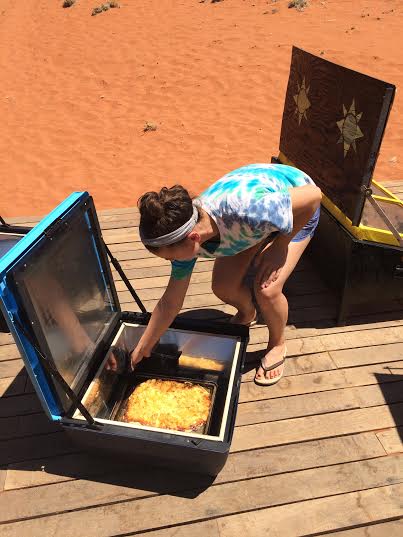
The following weekend we traveled to the Namib Desert Environmental Education Trust (NaDEET) to camp sustainably in the middle of the oldest desert in the world. Upon arriving, we made our way to the main building for a solar cooked dinner and a brief orientation of NaDEET. Viktoria, the founder, explained that NaDEET is focused on providing environmental education to Namibians and promoting sustainable lifestyles. In addition to education, Viktoria also explained that NaDEET believes in practicing what they preach, and therefore the entire center is as sustainable as possible. It is fully equipped with solar cookers and ovens, an extensive recycling and compost system, solar electricity, and bucket showers to promote water conservation. I was amazed by NaDEET’s ability to build a nearly 100% sustainable organization in the middle of an inhospitable desert with limited access to necessary resources. If NaDEET can do it so well, why can’t the rest of the world?
9027d287-5c34-4236-8f0c-469484bee786.jpg
As the sun burns the back of her legs, Beatrice
realizes that the same sun can be used to
beautifully cook a vegetarian pizza.
The next day, we woke up early to embark on a dune hike before the scorching heat took control. As we crawled up the bright orange sand dunes, we stopped to identify different tracks in the sand and learn about the survival mechanisms of the animals and insects. The sun was scorching by the time we finished up our hike, creating perfect conditions to cook our lunch in the solar ovens. After feasting on our pizzas, we spent the rest of the day hiding from the heat, planting native trees, and experiencing our first Namibian sun-downer, which involved us dune boarding as the sun set. It was the perfect ending to our long and educational day-- an evening full of laughter, sand-beards, and the reminder that the natural world can provide us with overwhelming amounts of joy. We ended the day with an astronomy lesson as we gazed up at Africa’s first International Dark Sky Reserve, learning about different constellations and squealing over every shooting star. 

As an environmental studies major, I've thought a lot about how to effectively demonstrate the need to live sustainably, and I've become very frustrated by my lack of a solution. However, this weekend at NaDEET helped me realize a major theme in promoting environmental consciousness: access. In order to get to NaDEET, we drove through dozens of dried-up river beds and hiked through sand dunes that provided views of a water-empty landscape, demonstrating that we did not have easy and plentiful access to water. Consequently, water instantly became more valuable and we all became conscious of our water use. The location of NaDEET, and the limited access to water that comes along with it, makes it the perfect place to teach water conservation and other sustainable practices. But the instant we gain more access to resources, we forget the importance of conservation. 

10565206_10153632678973935_892668656047346881_n.jpg
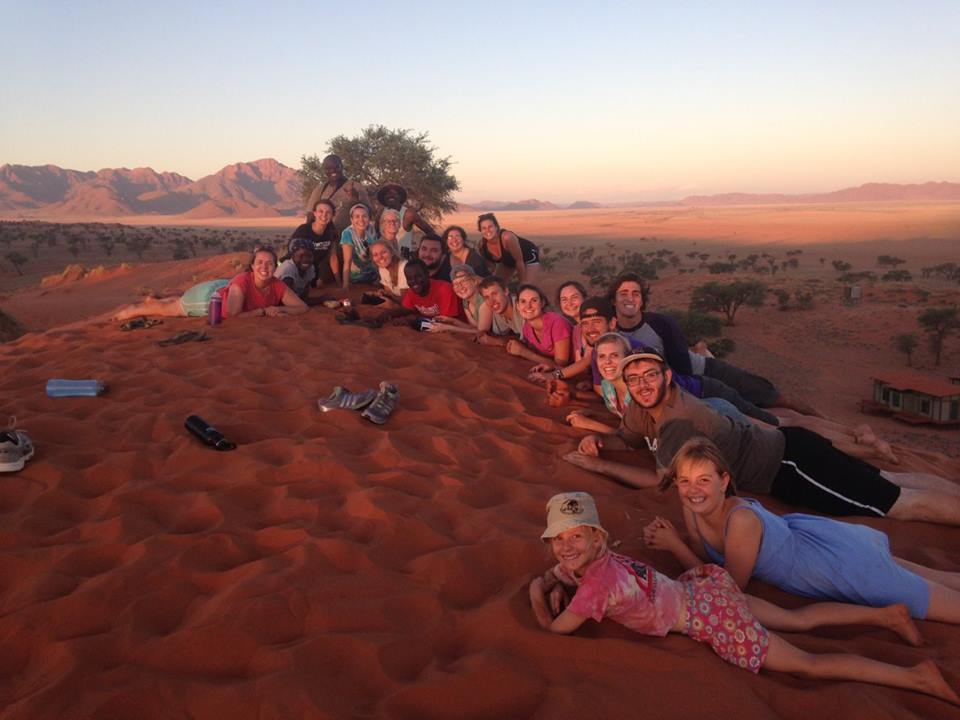
Ohana in the desert
This is a large issue with conservation at home in the US, and also at our house in Windhoek. In most places in the United States, there is an abundant access to water, causing people to mindlessly run the tap. Even in dry areas, such as the Southwest, we have manipulated natural waterways to provide an endless supply of water to deserts. This has seemingly provided us with too much access to water, creating a disconnect between us and our natural resources, and thus diminishing our value of water. The same is true in Windhoek, which is in the middle of a huge water crisis. Despite the drought, water magically pours out of our faucets, falsely making it seem as if we have unlimited access to water. This contradiction can make it extremely challenging to understand the value of resources.

But thanks to NaDEET, we were fortunate enough to fully understand the importance of sustainable living. Therefore, when we arrived back at our home in Windhoek, we all got together for our community meeting and discussed our plans for living more sustainable lives. If NaDEET is able to inspire this same reaction in all their visitors, they are effectively changing the environmental mindset of Namibia.

P.S. We also visited the water treatment plant here in Windhoek that transforms our sewage into drinking water but we are legally bound to not disclose this information. Bye.

Monday, November 9, 2015

Week Seven: To Swim in the Storm

By: Annie Dierberger


The view from standing on the dock.
The desert lying just beyond the ocean in the distance.
It was the first Thursday we arrived in Swakopmund, a beautiful city on the coast of Western Namibia, and our frantically absorbing eyes matched the tapping excitement of our feet. For the previous two weeks we had been daydreaming about our trip to Swakopmund, an escape from classes and a routine that we had yearned for at the start of the trip but now craved the absolute abruptness of adventure. That night for dinner we sat in Jetty 1905, a restaurant that sat on the edge of a long wooden dock amidst the ocean. Through the glass of the wall behind us the waves crashed violently below a sky of grey that seemed to disguise itself into the ocean. The weather was dark and ominous and being seated in the middle of the mayhem while classical music played around us felt like someone picking flowers in a warzone. I followed by gaze back to the murmur of conversation within the guests and then up to the bustling movements of the waitresses and waiters. There was a different kind of pandemonium happening inside, a one thickly veiled in misconception. The bright lighting and clinking of glasses seemed to assure me that the roaring ocean just below us was just a figment of my imagination. I swiveled behind me and sure enough, there it was. I looked around the room to see if anyone else was noticing what was happening just outside of the thin glass but there eyes seemed stuck within the confines of the luxury around them. It wouldn’t be until Sunday afternoon until I thought of this night again.

Within the next couple of days we would take full advantage of our fleeting vacation around us. Many people in Windhoek had told us about the town’s stunning beauty but seeing the startling contrast of the vast ocean on one side and the blazing desert on the other was truly magnificent.
Us climbing Dune 7

On Saturday we ventured out and climbed Dune 7, no let me rephrase that, we crawled like confused infants up Dune 7 and then continued to act like children at the top. As we all tumbled down as ungracefully as possible and acquired what seemed to be most of the sand of the desert in our hair and mouth, life at the moment was playing our own sorts of classical music. Sure it was mixed with our shrilling shrieks and belly flopping grunts, but it was a song of bliss nonetheless. As I looked around and saw all of my friends, once tentative strangers in the airport but now close companions, all laughing with giant grins on all of their faces, I couldn’t help but feeling fortunate for our friendship. The tune continued playing as we went ATV’ing the next day in the dunes. All eight of us traveling in a line through miles of sand, and our R.A. Attila trailing dangerously far behind with his scarf billowing through the wind, his upright posture and slow speed making him look like an elderly person on a motorized scooter, weaving through the streets of Paris.


That night we all went to bed smiling from a satisfactory day, a day that was filled with events offered on the front page pamphlet of Swakopmund. The following day we would experience things that weren’t commercialized for the average visitor, things that required a detour off of the main road. It began with a tour through Modesa, the main township in Swakopmund. For those who are unaware what a township is, I will regretfully inform you that they are a commonality throughout Africa. Townships were segregated areas of living for basically everyone who didn’t have white skin during the Apartheid era and yes, they still exist today. The houses consist of three or four rooms and the farther in the township you venture, the smaller the houses become till your eyes are squinting from both the sun and the reflecting tin of shacks. SWAPO flags fly proudly and people greet you warmly, but viewing the conditions that were emplaced forty years ago still continue in the present brings a certain sadness that melts into anger. We were shown the empty houses that sit in the distance, substantially larger and according to the people, substantially so far more expensive that no one can even afford to live in them. How cruel that an empty promise can be your next door neighbor and how different the music can begun to be heard. 
Unfortunately, throughout this trip, it’s been the same realization: that while there is beauty that surrounds us, there is immense despair in both the history and the present. That here, like in life, you can choose to ignore the harsh reality of things if you wish, and listen to that classical music while completely avoiding the storm outside. And that the sad truth is... many people do.

That Sunday afternoon I thought back to the first Thursday we arrived in Swakopmund, sitting in the restaurant we sat stretched on a long dock amidst the ocean. I thought about people and how they differ. How there are those who choose to ignore the storm that is roaring just beside them. How there are those who intensify and add havoc, and those who see it but only talk about it. William Blake once said, “Without contraries is no progression. Attraction and repulsion, reason and energy, love and hate, are necessary to human existence.” I believe it’s a bit like sitting amidst the ocean studying the waves and their intricacies and then doing the same within the scorching desert. They are there to show the gap of difference between their existence and it’s up to us to bring these places that act as two different worlds together. That instead of having one road that shows the pleasant and another which shows the pain, we must walk the same one together. That there is a song that all should hear and it is the song of justice, so please excuse me while I stop talking, unplug the classical music from the wall and dive headfirst into this ocean instead.