Showing posts with label desert. Show all posts

Monday, November 21, 2016

Week Seven: Nujoma and the Namib

by Lolita Schalekamp and Hannah Johnson

Reflecting back on the week that just ended, we have to appreciate the various ways in which we’re able to learn here at CGEE. This week alone, among many other field trips, we had the opportunity to visit one of Namibia’s most important monuments and think critically about the problematic ways in which a nation’s history can be represented. Before the week’s end, we also got to travel into the world’s oldest desert to learn about sustainable living.

At beginning of the week, our group had the opportunity of visiting the Heroes’ Acre outside Windhoek. This monument honors the heroes and heroines of the liberation struggle in Namibia, and operates for the purpose of “fostering a spirit of patriotism and nationalism, and to pass on the legacy to the future generations of Namibia.” We learned that this site is not only a memorial, but also hosts many events, particularly army demonstrations. Heroes’ Acre currently contains 174 tombs for the courageous men and women in the fight for independence. Not all of the tombs are filled, but as the heroes pass away, spaces will be reserved for them.

One of the questions that arose from our tour was what are qualifications in choosing who gets to be buried at Heroes Acre? As our tour guide explained, the criteria was not always transparent, as many families of leaders in the liberation struggle would like for their loved ones to be buried at the monument. Indeed, this process has sparked controversy within some circles.

Statue of the Unknown Soldier at Heroes Acre
The monument itself consists of a marble obelisk and a bronze statue of the “Unknown Soldier.” Upon seeing the statue, its resemblance to Sam Nujoma is striking. Although our guide stated that the soldier is not modeled after anyone in particular, the statue has come under criticism for being a tribute to Sam Nujoma himself. Since Nujoma is the founding president of the independent nation, along with being the initiator of Heroes’ Acre, this theory seems relevant.

Another one of the group’s iniquities regarded the architecture of Heroes’ Acre. Compared with other monuments in Namibia, the architecture felt foreign. The grandiose nature of the obelisk is characteristic of Stalinist Empire style or Socialist Classicism. After some research, we learned that North Korea was given a N$60 million contract to build the monument. This has rightfully made many ask: where were the Namibian architects in the construction of their ‘national’ monument?

This leads to the next point: the collaboration of world leaders in the struggle for Namibian independence. As a part of Racism and Resistance class, we became increasingly aware of the parallel development of the SWAPO/SWANU political ideology alongside the PLAN military wing. North Korea’s support of the liberation movement is not as surprising as one might perceive. In fact, many communist nations such as the USSR, Cuba, and North Korea contributed aid to the Communist Party in Namibia, which in turn has strong ties to SWAPO’s formation. This could be interpreted as geopolitical strategy of Communist countries in the context of the Cold War, or from the Namibian perspective, a lack of support from international governing bodies such as the United Nations.

Namib Desert Environmental Education Trust (NaDEET)
As the weekend approached, we packed our sleeping bags, lathered ourselves in sunscreen, and trucked our way toward the desert where we had the privilege to stay at the Namib Desert Environmental Education Trust (NaDEET) Centre. NaDEET lies in the dune valley of the Namib Desert and serves as a place for people of all ages, but more specifically school children, to properly practice eco-sustainability. NaDEET is a non-profit, non governmental organization whose mission is to protect the natural environment of Namibia by educating its citizens to practice sustainable lifestyle. We were immediately greeted by the warm sun and soft sand, where we hiked over a few dunes to reach our base.  

Spectacular sand waves in the Namib Desert!
The entire weekend was full of fun and hands-on learning. We discussed sustainable energy and water, where we monitored our water use and discovered that the centre was fueled by solar energy, discussed waste management and nature conservation. Water conservation was one of the largest topics of conversation. It is undeniable that water is the basis of all life on Earth, however Namibia has a limited freshwater supply and labeled one of the most dry countries in sub-Saharan Africa. Being in Southern Africa, we have learned to be more mindful of our water use and waste. NaDEET introduced a variety of ways to reduce our water use, including implementing bucket showers. The bucket showers reduce shower time and water waste. We have returned to CGEE house with the mindset to take shorter showers and investigate what it would take to have dual flushing toilets. In fact, the average toilet flush uses over ten litres of water per flush. If we introduce a low flush or dual flush toilet in our home, we would reduce our water waste by 2-3 liters of water each flush. As discussed at NaDEET, in a five person household, this can lead to saving nearly 200 liters of water per week!

The delicious end result!
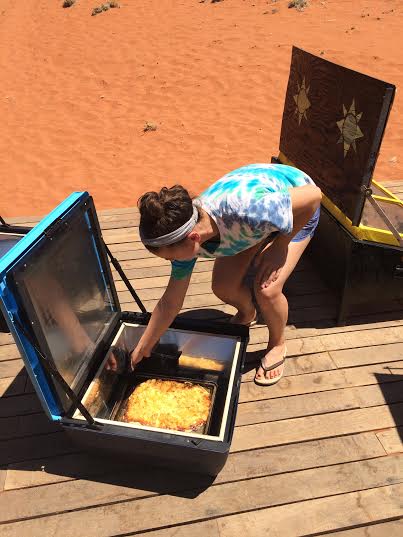
Our homemade pizzas cooking
in the solar ovens! 
The true fun began around lunch time, where we prepared food as a community and made homemade pizzas in the solar ovens. The fierce Namibian sun fueled the solar ovens and naturally, eliminates the use of gas, electricity, or wood and produces zero pollution (solar cookers baking our homemade pizzas and the end result shown in the pictures).

After a walking tour of the dunes, observing the tracks and droppings of the diverse ecology and wildlife in the desert, and sand boarding, we finally caught the breathtaking stars!  Namibia’s NamibRand Nature Reserve, which is one of Africa’s largest nature reserves, remains one of the naturally most dark places on Earth. NaDEET aims to protect the environment and educate guests, and this includes understanding how we have contributed to all forms of pollution. Attached is a link shared at NaDEET of a short video called “Losing the Dark” by the International Dark Sky Association regarding light pollution and solutions. https://youtu.be/dd82jaztFIo

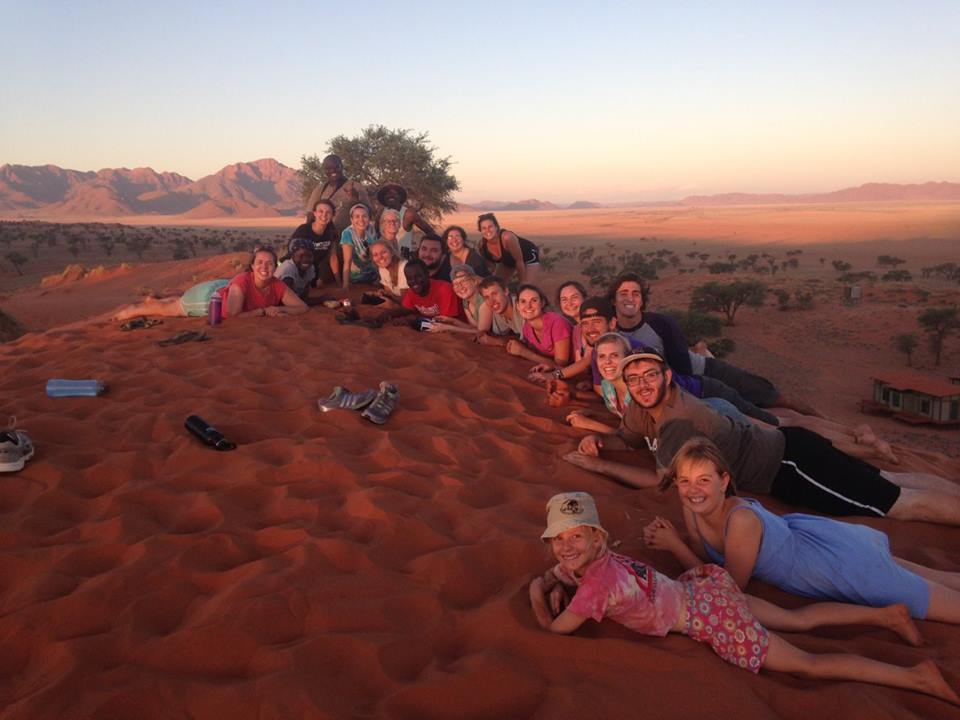
CGEE students after a successful evening sand boarding
in the stunning Namib Desert.
Our group was split up along three different houses, therefore when the weekend came to a close we were elated to compare our water and electricity usage with our friends (a good ol’ competition was a great way to spark environmentally sustainable habits!) Upon returning to Windhoek, we reflected on ways we can promote sustainable living but also practicing what we learned. Some are proposing solar cooking to their internships to combat the issue of expensive electric bills as some of us are researching dual flush toilets. The program was the perfect balance between educational and entertaining!

In short, during our visit to Heroes’ Acre and NaDEET, we learned to think critically about issues of memorializing a country’s history, in addition to more contemporary questions on how to build a sustainable and environmentally conscious society. In both cases, there is an inherent politicization that is ultimately involved in the process, whether that be foreign outbidding in the construction of a national monument or access and availability of environmentally friendly practices. As we learned at NaDEET, the only way to truly make a difference as a socially conscious community is to actually practice what we learn; through an increase in knowledge comes a responsibility to create spaces of dialogue that address these issues.

Wednesday, March 23, 2016

Week Seven: The Forgotten Genocide & (Sweaty) Sustainability Under the Desert Sun

by: Emily Simpson, Ashly Brun & Beatrice Misher

The Forgotten Genocide

Have you ever heard of the Herero Genocide? Chances are you probably have not. Understanding the reasons why this history is often neglected in our classrooms  is something that we have had to come to terms with. This week in our history class, we spoke to Uranaani Mantundu, a genocide scholar, whose ancestors escaped the very genocide we are discussing.

According to Mr Mantundu, The Herero genocide occurred  between 1904 and 1909, but is often referred to as the German-Herero colonization. The ideology behind German settler colonialism stemmed from the idea of spreading the wealth and seed of Germans to the land known today as the Erongo region of central Namibia. The German colonization of South West Africa was built on these colonialist ideas and also served as a response to overpopulation and poverty of Germany in the late 1800s. After a period of time of  what Mr Mantundu called  “slow colonization,” the settlers became restless for their promised land. However, central Namibia was already home to the established empire of the Ovaherero people. In the beginning, the Herero people maintained control over their land by renting it out to German settlers. The Germans violently sought to take over this land through means such as ambush attacks on the Herero people and rape of Herero women. Under General von Trotha, the German colonists began the systematic annihilation of the Ovaherero people. As a form of resistance, the Ovaherero people fought back to reclaim their land, but were ultimately  victims of genocide. Through a propaganda campaign in Germany portraying the Herero people as dangerous savages, a wave of racist sentiment spread throughout the country resulting in the official declaration of war against the Herero people. As a result, von Trotha issued an extermination order to kill any Herero man, woman, or child, armed or not, who was found within German colonial territory. Any Herero person who was not killed during the war was subsequently rounded up into concentration camps, some of which were labor camps and some, like Shark Island off the coast of the town of Luderitz, were strictly death camps. By the end of the genocide in 1909, approximately 65,000 Herero people had been killed. Many still lay in unidentified mass graves that are used today as ATV tracks for tourists in the Swakopmund area.

After this lesson and our new knowledge of this genocide, the German influence here in Windhoek, such as street signs in German, made us think harder about the historical context of the city we are living in. Today, the Herero people are asking the German government to acknowledge this genocide and pay reparations of $2 billion. According to Mr. Matundu, in the US, 48 of 50 states have officially recognized the Armenian genocide, yet none have done so for Namibia. While horrifying, the silence of this genocide was not surprising given the western lense through which our history is taught. Why do we selectively choose whose genocides to remember? There is a specific narrative chosen that neglects the stories of black and brown bodies, and their stolen land. Only through decolonizing our minds can we acknowledge forgotten history, and allow the voices of the oppressed to be heard.

(Sweaty) Sustainability Under the Desert Sun

The following weekend we traveled to the Namib Desert Environmental Education Trust (NaDEET) to camp sustainably in the middle of the oldest desert in the world. Upon arriving, we made our way to the main building for a solar cooked dinner and a brief orientation of NaDEET. Viktoria, the founder, explained that NaDEET is focused on providing environmental education to Namibians and promoting sustainable lifestyles. In addition to education, Viktoria also explained that NaDEET believes in practicing what they preach, and therefore the entire center is as sustainable as possible. It is fully equipped with solar cookers and ovens, an extensive recycling and compost system, solar electricity, and bucket showers to promote water conservation. I was amazed by NaDEET’s ability to build a nearly 100% sustainable organization in the middle of an inhospitable desert with limited access to necessary resources. If NaDEET can do it so well, why can’t the rest of the world?
9027d287-5c34-4236-8f0c-469484bee786.jpg
As the sun burns the back of her legs, Beatrice
realizes that the same sun can be used to
beautifully cook a vegetarian pizza.
The next day, we woke up early to embark on a dune hike before the scorching heat took control. As we crawled up the bright orange sand dunes, we stopped to identify different tracks in the sand and learn about the survival mechanisms of the animals and insects. The sun was scorching by the time we finished up our hike, creating perfect conditions to cook our lunch in the solar ovens. After feasting on our pizzas, we spent the rest of the day hiding from the heat, planting native trees, and experiencing our first Namibian sun-downer, which involved us dune boarding as the sun set. It was the perfect ending to our long and educational day-- an evening full of laughter, sand-beards, and the reminder that the natural world can provide us with overwhelming amounts of joy. We ended the day with an astronomy lesson as we gazed up at Africa’s first International Dark Sky Reserve, learning about different constellations and squealing over every shooting star. 

As an environmental studies major, I've thought a lot about how to effectively demonstrate the need to live sustainably, and I've become very frustrated by my lack of a solution. However, this weekend at NaDEET helped me realize a major theme in promoting environmental consciousness: access. In order to get to NaDEET, we drove through dozens of dried-up river beds and hiked through sand dunes that provided views of a water-empty landscape, demonstrating that we did not have easy and plentiful access to water. Consequently, water instantly became more valuable and we all became conscious of our water use. The location of NaDEET, and the limited access to water that comes along with it, makes it the perfect place to teach water conservation and other sustainable practices. But the instant we gain more access to resources, we forget the importance of conservation. 

10565206_10153632678973935_892668656047346881_n.jpg
Ohana in the desert
This is a large issue with conservation at home in the US, and also at our house in Windhoek. In most places in the United States, there is an abundant access to water, causing people to mindlessly run the tap. Even in dry areas, such as the Southwest, we have manipulated natural waterways to provide an endless supply of water to deserts. This has seemingly provided us with too much access to water, creating a disconnect between us and our natural resources, and thus diminishing our value of water. The same is true in Windhoek, which is in the middle of a huge water crisis. Despite the drought, water magically pours out of our faucets, falsely making it seem as if we have unlimited access to water. This contradiction can make it extremely challenging to understand the value of resources.

But thanks to NaDEET, we were fortunate enough to fully understand the importance of sustainable living. Therefore, when we arrived back at our home in Windhoek, we all got together for our community meeting and discussed our plans for living more sustainable lives. If NaDEET is able to inspire this same reaction in all their visitors, they are effectively changing the environmental mindset of Namibia.

P.S. We also visited the water treatment plant here in Windhoek that transforms our sewage into drinking water but we are legally bound to not disclose this information. Bye.

Wednesday, November 18, 2015

Week Nine: A Canvas of Understanding

By: Annie Dierberger

She had deep wrinkles that ran asymmetrically through her face like a thousand roads on a map, but the destination came together like a meticulous work of art. Each line etched into her skin seemed to hold a story or a memory that I desperately wanted to understand. Her eyes were lulled in the shape of half moons but held a sharp glint of youthfulness wherever she happened to look. Her name was Meme Albertina. She was the village headman, and yes, I had no idea what that meant and maybe I still don’t, but I thought of her like Yoda, full of wisdom and perfectly executed one liners. Now that last part I may have fabricated a bit, seeing that I actually had no idea what she was saying and it was evident from the start we had a language barrier. I spoke English, she spoke none. She spoke Oshiwambo, I knew how to say the How are you? and the word snake, making our conversation limited beyond the context of “the snake is good”, which it ultimately never is. The woman I am describing was my host mom for the week in the town of Outapi, a rural community about nine hours north of Windhoek. All of the students were living with various families and this was to be mine.

What inside the homestead looked like. Various huts for
different purposes surrounded by an endless maze of sticks.
After a few minutes of exchanging confused facial expressions and hand gestures, I ended up in a truck bumping along the gravel until a fenced off home came into view. Once inside the gate, I was given a tour around the homestead by one of the eldest daughters in the family who knew a few words of English. She led me outside the gate towards a tall circular enclosure of sticks and stopped just before to also show me where the pigs slept. To say it nicely, these pigs would not have been cast in the next Charlotte's web sequel as Wilbert. I saw them as beasts that wouldn’t hesitate to destroy me. My eyes stayed glued on the pigs until I was nudged by the daughter to indicate the bathroom beside them, which consisted of a pile of bricks in the shape of a triangle. I kept my face composed but I will readily admit that internally I was whispering, “oh dear god.” The next stop was the shower which was again an enclosed circle of sticks with a bucket inside. Now, at this point, I was extremely nervous that there wouldn’t be enough water for me to shower and that an eyoka (a snake) was going to bite me in the bathroom. I was out of element in a state of discomfort and I knew it, so I decided to do the only thing I could, which was to completely embrace it. To not only look at these lines that ran like roads on the face of my host mother but to travel them just as she had lived them.

Very quickly within the next couple of days I fell into a routine. I would wake up around 6:45am by either one of the children shouting, “Annie, wake up!” or a rooster sounding like it was violently choking. As I stumbled outside into the bright light one of the children would point to the shower and say, “Wash.” I not only learned that a bucket of water was more than enough for a shower, but doing so outside while peering over a fence into the dry abyss was wonderful. I loved being woken up to cold water and the smell of fire already circulating through the cool morning air. After the shower, I would make my way through the maze to the place where we ate our meals. My Meme would see me and say, “Wa­lelepo nawa?” which translates to “Good morning, How are you?”, to which I would reply, “Eeya, ove walelepo tuu?!” and then we would both exhaust ourselves with multiple “eeye’s”, which means “good” and is what I learned to be the key to the Oshiwambo language. When it doubt, just say eeye. People will either mockingly laugh or be extremely impressed with you, sometimes both.

As midday approached, so did the blazing heat. Almost every day the temperature would hit 100 degrees or higher. Shade became your close companion, and water was your new best friend. I was fortunate that my classmate Henrik lived close by, so most afternoons, we would meet up and endure the heat together. We would find a nice spot of shade that wasn’t overpopulated by donkeys and sip, no, chug on ice cold coke from one of the local shebeens.

Henrik, avoiding malaria at all costs.
When 6 o'clock approached, all of the neighboring children began running towards the soccer field for the nightly game. This, I got the impression, was my young host brother’s favorite part of the day. The goal posts were made up of two sticks with a line of cans strung together at the top and very rarely was there a goalie, if lucky a toddler sat distractedly inside the goalposts drawing pictures in the dirt. Some nights I played and other nights I preferred to just sit on the side and watch with amazement. The Namibian sunset would begin to fill the sky with a canvas of reds, oranges and yellows like something I had never seen before. The children would be laughing and doing hilarious after-goal dances and then there would be Henrik, passing out high fives and cheering enthusiastically in English like an elementary school gym teacher. The kids had no idea what he was saying but loved it anyway. Moments like these are what would bring tears to my eyes. Moments where we didn’t need a language to communicate because we had so many other things, things that didn’t need to be vocalized. As the sun completely vanished my host brothers and sisters held hands and walked home together, singing songs. It was a powerful connectedness of pure happiness and enjoyment of one another’s company.

At 8:00 pm the whole family would gather around the fire and watch enticingly as dinner was prepared. The little kids would climb on my lap and sing Amazing Grace repeatedly until flying into one of their own songs and dances. When we weren’t singing or dancing, I had my notebook out and was learning Oshiwambo from Tina, one of the eldest kids who was in school. I would write words or phrases, she would translate and then laugh at my pronunciation. Without any electricity or lights, the world would turn dark and to see my hand in front of my face I would take out my flashlight. There was one night when I took out my light to see where I was stepping and my grandmother looked at me and shook her head repeatedly. She then began speaking in Oshiwambo and pointing up to the bright stars that littered the sky magnificently. She kept pointing up to the stars and then took my flashlight and turned it off. We both smiled in understanding and looked up at the stars together.

Trying to make friends with the donkeys and not succeeding.
That night I sat studying everything like a priceless work of art, absorbing everything that I had grown to love so passionately in a week: the kids, their bright smiles as we played tag throughout the home, and how later they could help cook dinner or carry a baby on their backs with the strength of a teenager; my host mother, despite being at least seventy years old, dancing freely without care like she was a child again; the sky and all of its unity of contrast, completely defying everything we think we know in color and clouds; the stars and gazing up at them in awe, and an hour later realizing you are just as lost as you were before, and feeling content with that. During my rural homestay week, I have lived modestly in material but lavishly in everything else. It was a week that seemed like a year in what I saw and learned. I found richness in simplicity. I found love in silence. I found sacred art in normality. A picture that is worth a thousand words but remembered as a thousand moments.

Monday, November 9, 2015

Week Seven: To Swim in the Storm

By: Annie Dierberger


The view from standing on the dock.
The desert lying just beyond the ocean in the distance.
It was the first Thursday we arrived in Swakopmund, a beautiful city on the coast of Western Namibia, and our frantically absorbing eyes matched the tapping excitement of our feet. For the previous two weeks we had been daydreaming about our trip to Swakopmund, an escape from classes and a routine that we had yearned for at the start of the trip but now craved the absolute abruptness of adventure. That night for dinner we sat in Jetty 1905, a restaurant that sat on the edge of a long wooden dock amidst the ocean. Through the glass of the wall behind us the waves crashed violently below a sky of grey that seemed to disguise itself into the ocean. The weather was dark and ominous and being seated in the middle of the mayhem while classical music played around us felt like someone picking flowers in a warzone. I followed by gaze back to the murmur of conversation within the guests and then up to the bustling movements of the waitresses and waiters. There was a different kind of pandemonium happening inside, a one thickly veiled in misconception. The bright lighting and clinking of glasses seemed to assure me that the roaring ocean just below us was just a figment of my imagination. I swiveled behind me and sure enough, there it was. I looked around the room to see if anyone else was noticing what was happening just outside of the thin glass but there eyes seemed stuck within the confines of the luxury around them. It wouldn’t be until Sunday afternoon until I thought of this night again.

Within the next couple of days we would take full advantage of our fleeting vacation around us. Many people in Windhoek had told us about the town’s stunning beauty but seeing the startling contrast of the vast ocean on one side and the blazing desert on the other was truly magnificent.
Us climbing Dune 7

On Saturday we ventured out and climbed Dune 7, no let me rephrase that, we crawled like confused infants up Dune 7 and then continued to act like children at the top. As we all tumbled down as ungracefully as possible and acquired what seemed to be most of the sand of the desert in our hair and mouth, life at the moment was playing our own sorts of classical music. Sure it was mixed with our shrilling shrieks and belly flopping grunts, but it was a song of bliss nonetheless. As I looked around and saw all of my friends, once tentative strangers in the airport but now close companions, all laughing with giant grins on all of their faces, I couldn’t help but feeling fortunate for our friendship. The tune continued playing as we went ATV’ing the next day in the dunes. All eight of us traveling in a line through miles of sand, and our R.A. Attila trailing dangerously far behind with his scarf billowing through the wind, his upright posture and slow speed making him look like an elderly person on a motorized scooter, weaving through the streets of Paris.


That night we all went to bed smiling from a satisfactory day, a day that was filled with events offered on the front page pamphlet of Swakopmund. The following day we would experience things that weren’t commercialized for the average visitor, things that required a detour off of the main road. It began with a tour through Modesa, the main township in Swakopmund. For those who are unaware what a township is, I will regretfully inform you that they are a commonality throughout Africa. Townships were segregated areas of living for basically everyone who didn’t have white skin during the Apartheid era and yes, they still exist today. The houses consist of three or four rooms and the farther in the township you venture, the smaller the houses become till your eyes are squinting from both the sun and the reflecting tin of shacks. SWAPO flags fly proudly and people greet you warmly, but viewing the conditions that were emplaced forty years ago still continue in the present brings a certain sadness that melts into anger. We were shown the empty houses that sit in the distance, substantially larger and according to the people, substantially so far more expensive that no one can even afford to live in them. How cruel that an empty promise can be your next door neighbor and how different the music can begun to be heard. 
Unfortunately, throughout this trip, it’s been the same realization: that while there is beauty that surrounds us, there is immense despair in both the history and the present. That here, like in life, you can choose to ignore the harsh reality of things if you wish, and listen to that classical music while completely avoiding the storm outside. And that the sad truth is... many people do.

That Sunday afternoon I thought back to the first Thursday we arrived in Swakopmund, sitting in the restaurant we sat stretched on a long dock amidst the ocean. I thought about people and how they differ. How there are those who choose to ignore the storm that is roaring just beside them. How there are those who intensify and add havoc, and those who see it but only talk about it. William Blake once said, “Without contraries is no progression. Attraction and repulsion, reason and energy, love and hate, are necessary to human existence.” I believe it’s a bit like sitting amidst the ocean studying the waves and their intricacies and then doing the same within the scorching desert. They are there to show the gap of difference between their existence and it’s up to us to bring these places that act as two different worlds together. That instead of having one road that shows the pleasant and another which shows the pain, we must walk the same one together. That there is a song that all should hear and it is the song of justice, so please excuse me while I stop talking, unplug the classical music from the wall and dive headfirst into this ocean instead.