Showing posts with label wildlife. Show all posts

Wednesday, April 25, 2018

Leopards, Lions and Cheetahs, Oh My!

By Jimmy D.
On Sunday March 4th we had just returned from our homestay in Katutrua, which means “The place where people do not live”. To me it was quite the opposite. My family was welcoming and helpful in teaching me their culture. We had just attended Church and returned back to the house for our last meal before they had to drop me back at CGEE. My family did not want to drop me off, and I didn’t want to go either. After spending a week in their home we had built a good relationship that I hope to expand on during my time here by visiting them often and joining them for dinner.  After being gone for a week it was strange being back at CGEE, but then transition went well, it was nice to all be eating dinner as a group again and talking about our experiences in our homestay, considering we all had vastly different conversations and interactions it was very interesting to compare and contrast our week away from each other.
           On Monday we started our regular schedule again which consists of breakfast, class, internship, and then returning for dinner. During class on Monday we talked about Small Medium Enterprises (SME’s) and their potential, especially in Africa, at increasing the economy and lifting people out of poverty. Our speaker, Forrest Branch went into great detail on how this is possible. But it’s important for investors to notice the potential of SME’s. A barrier to SME’s is funding, which can be difficult to obtain in Namibia. Most banks will not give a loan without collateral that may be hard to obtain due to varying circumstances. A majority of SME’s will use their own savings to start a business; the next group relies on friends and family for the funding to start their business. This causes challenges on many fronts. One issue I see is expansion, for example if your business is doing well, but you still haven’t made back your initial investment, it is hard to invest more money in increasing your stock or staff, even if your business is doing well, the capital isn’t there to expand. There are a few ways to support SME’s. First is to go to the business and support them by using their services or buying their products. The second option is to invest small amounts of money much like a microloan, where you and the business operator can establish a timeline and action plan, and once the return is made the investor will get their initial investment back with a small percentage of return. The power of microloans comes from many people investing small amounts of money at once so this will overall make up a medium to large loan, but the risks are small because the individual will only lose their small investment, rather than a bank or large investor having to take the full impact of losing a large investment.
N/a'ankuse Lodge and Wilderness Sanctuary main entrance
 
           The most notable part of my week was visiting N/a’ankuse Lodge & Wildlife Sanctuary. During our Environmental Connections class we had the pleasure of traveling out to N/a’ankuse to go on a feeding tour to see lions, cheetahs, leopards, wild dogs, baboons and caracal. It is sad to see animals in cages instead of being able to roam the wild but there are reasons for the work N/a’ankuse does. All of the animals there are either orphaned and would not be able to survive alone in the wild, injured by traps and the damage cannot be fixed to the point where they can be released, or conflict animals, which are animals that attack livestock and pose problems for farmers. If they are not removed they would either be shot or have the potential to injure or kill humans. N/a’ankuse also provides the animals with much more space than a typical zoo in the USA would, each enclosure has about 5 hectors of land. Lastly we talked to a researcher who works at N/a’ankuse, he explained some of the research projects taking place and how interns have been coming up with some innovative ideas to combat wildlife conflict such as using lion scat to deter other animals from approaching livestock. He also talked about how hard it is to keep count of the animals in the wild to produce reliable numbers about how many are left. As of now there are only around 7,000 cheetahs left in the wild, but in 1900 it was believed that there was 100,000 cheetahs in the wild, so in 100 years the cheetah population has plummeted due to a lack of conversation efforts and this issue is only starting to be addressed. This is why the work N/a’ankuse does is so important because they not only protect animals that are endangered, they also do research to better animal populations and increase conversation.
Lion at N/a'ankuse

Wednesday, November 1, 2017

Week 6 - “Wildlife” and the Harmonious Ideal of Ubuntu

By Michelle Andersen
This cheetah and her sister are tame and used to humans,
when they should have grown up in the wild

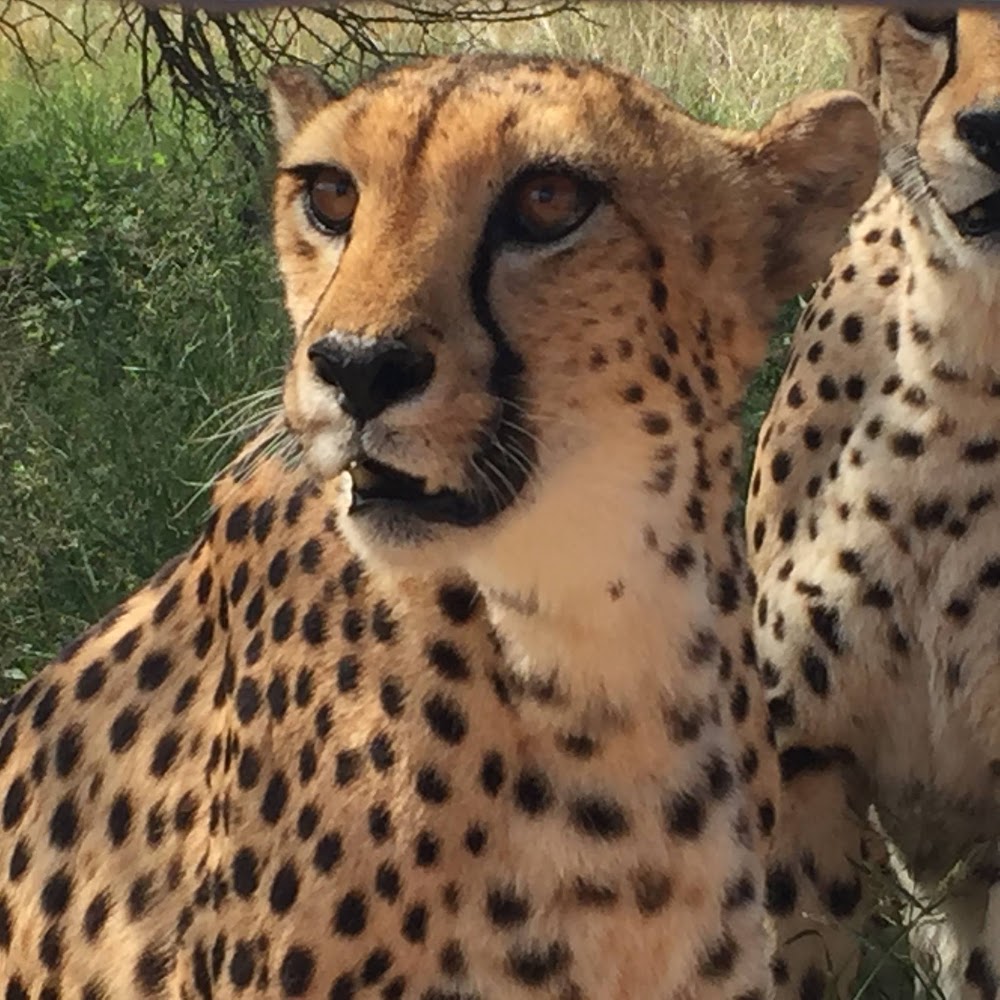
The week started out with a trip for Environmental Connections to N/a’an ku sê Wildlife Sanctuary. It was established in 2006 by Dr. Rudie and Marlice van Vuuren to conserve wildlife, preserve landscape, and support local communities, specifically the indigenous San people. Their mission is to promote “conservation through innovation.” The animals there have been orphaned, injured, or otherwise had their safety threatened by humans. In class, we are learning about human-wildlife conflict, which was evident during our visit. The various animals have been saved from humans who shot them, touched them as cubs, or have had their habitats and lives threatened by humans in another manner. While it was incredible to see one of my favorite animals, the cheetah, up close, it was heart-breaking to see them interact with the guide. The cheetah would come right up to the fence and let the guide pet her. You could hear her and her sister purring loudly the whole time. Unfortunately, these animals are here because their mother was killed by a farmer and they could not survive on their own. They have been raised by humans, which makes it dangerous to return them to the wild for themselves and for the humans, whom they no longer fear. They are sentenced to a life imprisonment, due to the actions of humans. While the sanctuary is doing good work in order to save these animals, they are merely trying to compensate for decisions other people have made. Since these animals can no longer be released into the wild, they will never be able to live out their lives as intended.
A night out at a local restaurant
Later in the week, in our religion and social change class we had a speaker named Reverend Godriam join us to discuss the subject of Ubuntu. Ubuntu is defined in the dictionary as “a quality that includes the essential human virtues; compassion and humanity.” In a paper by Faustin Ntamushobora, we read about the role ubuntu has played in African history. The concept was popularized by Archbishop Desmond Tutu and through him, Nelson Mandela, especially when it came to reconciliation. According to the article, reconciliation can be defined as “respect for a person’s dignity, irrespective of what that person has done.” Without ubuntu, one could refuse to forgive their enemies. Using the compassionate care of ubuntu instead, one would be able to create harmonious relationships. In a discussion I had with our professor, Lamont, we discuss how the concept of ubuntu is something to apply in our lives. If everyone cares for one another, then the world would be a happier, safer, more unified place. However, we had doubts about how this could be applied on a larger, macro scale. It is clear that one could apply the concept on a micro level with their inner circle. Yet, beyond that, it is hard to achieve this unity when people are asked to apply it to the whole world. It is impossible for every person to be open and available to other people all the time. However, if people can begin with their close friends to have harmonious and compassionate relationships, then perhaps this can be extended out to everyone they met, who will then also act with ubuntu. However, until that point is reached, it seems like a worthy ideal to strive for so that the world is still a nicer place, even if true ubuntu is never reached.
 
Based on this week’s experiences, I have deeper concepts to ponder and apply to my own life. It can be easy to get swept up into the excitement of an event, such as seeing wild animals at a sanctuary. However, it is important to take a step back and ask questions about how they got there, how they are being treated, and the purpose of the organization. Without this critical thinking, we may miss a chance to not only learn about but to improve a situation. Along with this, we must consider ideals that are above ourselves. Striving for harmonious, compassionate relationships through ubuntu can create a better world for those involved. If we do not try to promote these actions, then we are failing our world and each other. While it may seem impossible, it is not pointless to fight for these ideals, which can raise us to a higher standard.


Even in captivity, one can see the power the lion possesses

Wednesday, October 25, 2017

Week 6: A Week of Unexpected Growth

By Carly Dillis
This week, all of us are fresh off of our homestay experiences and back into the grind of classes and internships. However, that does not mean that this week was quiet or uneventful.

One of the Cheetahs from N/a'ankuse. There were two cheetahs in the
reserve who will be there for the rest of their lives.
On Monday, our environmental class visited N/a’an ku sê  nature reserve. The reserve takes in injured or orphaned African animals and raises them, often keeping them in captivity for life. We were able to see baboons, lions, caracal, leopards, cheetahs, and wild African dogs. Aside from baboons, these animals are some of the most endangered in the country and very few people get to see them. The readings for class this week had focused around human wildlife conflict. Thus, the reserve gave us the opportunity to see examples of the victims of this conflict. The animals housed in the reserve mostly ended up there because they had made their way into farms or private land and were either hurt, orphaned, or brought into the reserve by the farmers who refuse to have them on their land. The experience greatly helped to ground the readings of the week and it was easy to understand why the country of Namibia has difficulty in navigating human wildlife conflict.
The rest of the week went as scheduled. In history, we discussed anti-racism and how the movement has developed in Namibia. We had a guest speaker who was originally from the United States come in and explain the comparisons between the two societies. After he left, the students engaged in a spontaneous conversation at lunch about the speaker and his lecture. We were critical of his experiences and his opinions on women’s rights, environmental law, and LGBTQIA+ rights. In our politics class, we talked about democratization. Using Zimbabwe as an example, we discussed leadership, corruption, state sponsored violence, voting, etc. It is interesting to look at case studies from countries in the region and have them be so drastically different than they are when I read about neighbouring countries back home in the United States. It is a powerful reminder of where I am, how grateful I am to be here, and the depth of life and history in this place.
Some of the dunes at the inner most part of Sossuvlei  The trees and clay flats
can be seen in the distance.
Despite the incredible experiences of the week, the most powerful activity I participated in was a weekend camping excursion to Sossuvlei. Sossuvlei is a park where many of the most famous dunes in Namibia can be seen. It is about a 6-hour drive South from Windhoek. Five of the students rented a four-wheel drive truck with rooftop tents and booked a campsite to. We drove through the most rural and the most beautiful roads I have ever seen. The topography in Namibia changes about every 100 km, so we would go from driving in mountains to driving through the flat drylands. When we arrived at Sossuvlei, we entered the park and made our way to the dunes. They stretch higher than I ever thought possible. We stopped at one with a beautiful ridge and tried to hike it, before realizing that what we thought to be the top, was only about the halfway point. We also drove into the main part of the park where the biggest dunes are and there is a clay flat petrified forest. In the United States, I grew up in a state park in the forested hills of Massachusetts. We would regularly spend entire days outside, hiking, biking, collecting leaves, etc. I consider myself to be fairly well versed in the ways of nature. However, my experience at Sossuvlei was truly humbling in this way. Certainly, I never believed myself to know everything or be ready for everything this trip will show me. However, I sincerely do not think I could have prepared myself for the experiences I had in Sossuvlei.
I entered this week with the expectation that it would serve me as a week to reflect, which it certainly has. Additionally however, it has also empowered me to keep exploring Namibia on my own, to seek the things not sought. I am so grateful for my experiences this week as they have once again made me understand myself and the world more fully.

Wednesday, March 16, 2016

Week Six: Lions and Cheetahs and Learning - Oh My!

by: Olivia Cook, Lia Wellen, Richie Wehman III, Nathanael Juliot

We are settling into our routine at the Center for Global Education and Experience here in Windhoek, Namibia. Most of our classes involve either speakers or field trips which enhances our learning and understanding of Southern Africa and most specifically Namibia in terms of history, politics, development, religion, and environment. In this post we will tell you about some of these engaging class experiences! We felt weird taking pictures of the speakers, but we have some pictures of the Environment & Sustainability class field trip, which is more exciting anyways! Why is it more exciting? Keep on reading to see!

Clearance the lion roaring for his dinner.
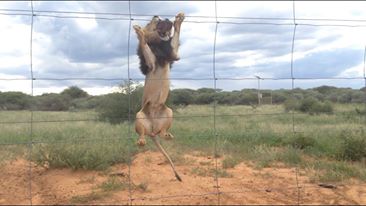
Following an incredibly rewarding week-long urban homestay, the CGEE students were ready to attack the new week. On Monday the Environmental and Sustainability class had the great pleasure of visiting the N/a’an ku se Lodge and Wildlife Sanctuary, located just 42 km east of Windhoek. Upon our arrival the tour guides drove our group out to visit a San Bushmen family that periodically stays at the sanctuary to educate tourists about their traditional lifestyle. The San people took us around the land to showcase their traditional hunter-gatherer techniques, as well as the way they utilize plants for holistic healing purposes. It was a tremendous learning opportunity, but many members of our group felt conflicted about the implications of our experience as the San people were removed from their lands and are now considered the most marginalized community in Namibia, forcing them to commodify their culture to tourists. Shortly following the tour, our group was off to visit and learn about the Wildlife Sanctuary. Through the visitation of different animals such as lions, wild dogs, baboons, cheetahs and leopards, our class was able to get a much better idea as to how N/a’an ku sê has successfully been able to protect wildlife and their habitats. The sanctuary provides a haven and second chance for countless injured, orphaned, and abused animals. It’s the organization's goal to release every animal free so they can live a natural life in the wild, but that sadly isn’t always the case. We learned that the release or rehabilitation is not always possible due to the severity of an animal's injury or habituation to humans, all serving as a threat to their safety if they were to be released. One highlight of the trip was being able to witness Clarence, the male lion, soar into the air to snatch his dinner. It was extraordinary seeing him viciously mark his territory and establish his dominance.
Beautiful snapshot of one of the cheetahs

On Tuesday March 1st Mr. Phil Ya Nangoloh spoke in our History class, entitled “Race & Racism in Southern Africa and the U.S.”. Mr. Ya Nangoloh is a human rights activist and director and co-founder of NamRights. He described NamRights as a monitoring and advocacy human rights organization that can be compared to Human Rights Watch or Amnesty International, except that NamRights operates on a national, rather than international, scale. NamRights also gives paralegal services of which most cases are either people dismissed in the private sector or women seeking complaints against their male counterpart.

His task was to explain his understanding of discrimination and racism in Namibia and Southern Africa currently and historically. Mr. Ya Nangoloh claims that Namibia has historically been a victim of state racism, having undergone both German and South Africa occupation, the latter of which engulfed Namibia into apartheid. He spoke of how the Namibian constitution is extremely liberal and has very good human rights components, but that these laws are not effectively implemented in Namibia, if at all. The main point Mr. Ya Nangoloh made was that since the end of apartheid, and the liberation struggle, the way in which discrimination plays out has changed. During the liberation movement there was one common enemy to fight against, which was South Africa and the apartheid regime. Now, as this one enemy has technically been conquered, discrimination stems from wealth inequality, racism, and the scramble for scarce resources. Discrimination, now, he explained, comes from within societies or communities rather than from outside. He concluded on what I thought was a grounding note. He said that “racism is an innate and human nature, but there are good people doing things about it, like you and me”. We have been struggling with learning about all the awful disgraces of both the United States and Southern Africa, and it was nice to hear a “realistic” view on things, that there is discrimination but that there are people working to combat it. 

On Wednesday March 2, we had a very interesting speaker visit our Development class. Herbert Jauch, a German expat and political activist in Windhoek, has spent the last couple years studying income inequality in Namibia. The beginning of his presentation explained key points of Namibian history and eventually evolved to explain how income inequality is a product of old historical systems still prevalent today. After setting the foundation for today’s inequalities, Jauch continued to explain a study that was conducted in hopes of alleviating poverty in Namibia. This social experiment, set in a small village south of Windhoek, focused on people who earn so little that basic necessities, such as education and health care, are inaccessible. A solution to these problems was an idea called a Basic Income Grant. This monthly grant of N$100 (US$ 6.25) was given out to every person in the area regardless of income or age in order to help cover basic costs of school books, registration fees, small health needs, or other costs that would help families access services and improve their quality of life. One staggering statistic Jauch shared with us was that in this community 60% of kids dropped out of school because they were hungry, but after the BIG was implemented, 95% of kids completed school. He also shared various benefits such as increased visits to clinics, and malnutrition dropping by half within a year of this grant. Unfortunately leaders at the time did not appreciate the success rates as much as Jauch and his organization did, and plans to continue this idea nationwide are at a standstill.

The idea of a monthly income grant fit well with what we have been covering in our Development class, specifically ideas of poverty alleviation and cases of well-intentioned development projects that do more hurt than harm. Jauch’s presentation was an interesting example of a poverty alleviation strategy and I was intrigued by the both the positive outcome and some ramifications such as the conclusion that programs like this are hard to implement regionally because of family members who migrated to the area to benefit as well. Another point Jauch made was that social welfare programs are generally stigmatized and by providing every individual with an equal grant stigmas are avoided and people are empowered to live healthier lives. Many people in the United States dislike the terms socialism and social welfare, but this speaker highlighted how these ideas can be helpful to society and gave me a case study I can use to support new ideas of aid implementation that I can share with others. Overall, I was very impressed by our speaker; his comments added insight into what we have been studying and local poverty alleviation efforts to combat a nationwide problem.

On Friday March 4th, the Religion and Social Change class had a guest speaker visit named Reverend Gotthard Gurirab. Reverend Gurirab is a faculty member at the University of Namibia working with a focus in critical issues facing the church. His talk focused on African Traditional Religion and how it has been affected by colonialism. Specifically, he discussed the diminishing role of Ubuntuism in African culture. Ubuntu is an African word which refers to a universal concept where people value the good of the community above self-interest. Reverend Gurirab has seen that Ubuntuism is almost dead in cities and those people who live on the same street live as if they are in foreign countries. He went on to describe the relationships between people in the cities and it paralleled greatly with relationships between people in the United States. I found it extremely interesting to hear him describe in detail, American society and condemn it as ruining the Namibian people. Africa is constantly subjected to the effects of colonialism even to this day and it can be seen that western society has overwhelmed the traditional values of the Namibian people. Ubuntu has ideologies of sharing, compassion, peace, reconciliation, combating crime and violence, and poverty eradication. These ideologies have been cast away by the younger population for western ideologies of focusing on the individual. Reverend Gurirab called for a massive revitalization of African Traditional Religion in Namibia and throughout Africa. This will be an uphill battle, however, to remove the stains of imperialism that still exist within Africa and many Namibians do not have any desire to move away from the western ideologies that promise a path to prosperity.

Overall, we had a great week of learning through speakers and field trips. We hope you enjoyed following us along our journey!